• Why America is Divided : Division Isn't a Mystery — It's a System
    Jan 31 2026

    America feels divided in a way that goes beyond disagreement. Disagreement is normal. What we're experiencing feels different, urgent, harder to resolve.

    In this solo episode, Daniel Stih expands on his essay Division Isn't a Mystery. It's a System. Rather than arguing issues or taking sides, the episode examines the mechanics and patterns that repeatedly turn different events into polarization.

    • Why division doesn't require conspiracy or bad actors
    • How extreme events dominate our perceptions and choices
    • The role of algorithms
    • Why reacting strongly narrows, instead of expands, solutions.
    • Where individual choice exists

    This an attempt to slow things down enough to see how the system works and where restraint can change outcomes at the edges.

    Read the full artice:
    Division Isn't a Mystery. It's a System.

    Show More Show Less
    24 mins
  • Why Battery Fire Safety on Airplanes Is Backwards
    Jan 28 2026

    Lithium battery fires on airplanes are rare. When they happen, they're dangerous, disruptive, and costly. What's interesting is how we've chosen to deal with that risk.

    The aviation safety strategy for this focuses on what to do after a device is on fire — containment bags, emergency procedures, and diversion. Those measures work. They're also fundamentally reactive.

    In this episode, I offer a clean way to think about the problem — using lithium battery fires as a case study. We'll examine:

    • What actually causes lithium battery fires (thermal runaway)
    • Why phone and laptop batteries fail in predictable ways
    • How aircraft are trained to handle in-cabin battery fires
    • Why containment isn't the same as prevention
    • What an upstream, design-based safety approach could look like

    This is a systems-level look at how aviation safety has historically improved — moving risk controls upstream into design standards, rather than relying on emergency response.

    I walk through common objections, including:

    • Don't batteries already meet safety standards?
    • How could something such as this be enforced in practice?
    • How do you reduce risk without unfairly burdening passengers?

    If you're interested in aviation safety, engineering, or simply how complex systems fail and improve, this episode is for you.

    📩 Subscribe for more episodes that use real-world problems to practice better thinking. 💬 Leave a comment — especially if you work in aviation, engineering, or safety.

    #SystemsThinking #AviationSafety #PreventiveDesign

    Show More Show Less
    8 mins
  • When Style Outpaces Function
    Jan 23 2026

    What the iPhone's latest UI change reveals about a recurring design failure mode

    A recent iPhone UI update sparked a broader question: what happens when style starts to lead function?

    I explore why highly stylized interfaces can feel exciting at first—yet introduce subtle friction, reduce clarity, and age poorly under real-world use. This isn't about taste or Apple. It's about understanding a recurring design failure mode that shows up across software, products, and systems.

    Walk away with this question:
    Does this design choice improve clarity under real-world conditions—or just aesthetic novelty?

    #DesignThinking #UXDesign #ProductDesign

    Show More Show Less
    6 mins
  • Why Responsible Borrowers End Up Worse Off
    Jan 21 2026

    If you've ever looked at credit cards, student loans, or mortgages and thought,
    "If I pay responsibly, why does this feel harder over time—not easier?"
    this episode is for you.

    Modern credit is framed as a tool for stability, education, and homeownership.
    But in practice, it often turns responsible borrowing into long-term extraction.

    This episode isn't a rant about banks or a pitch for free money. It's to understand a basic contradiction in how credit works.

    By the end of this episode, you'll walk away with one clear mental model:
    why modern credit has stopped functioning as trust—and what changes when credit is treated as earned reputation instead of rented, made up money.

    This isn't about eliminating responsibility - it's restoring the original purpose of credit: to align trust, risk, and long-term stability. You don't have to agree with the model. You will understand the system—and your own borrowing— clearly afterward.

    IMPORTANT NOTICE:

    I am not advocating anyone take a current 0% interest loan or credit offers. Interest rates can change, fees can be added, and penalties accumulate in ways that trap people in long-term debt. In this episode I discuss the idea for systemic change to how credit works, and what a truly 0% interest credit system could look like. These ideas only make sense as part of a broader structural change where interest rates cannot be raised, fees cannot be added, and the rules are different from today.

    In this Episode:

    I lay out a practical alternative: Credit as Earned Reputation (CER), not as borrowed money. Think of this as Promise-based credit. For most of human history, credit worked as trust. Modern finance replaced that with interest, leverage, and bailouts, disconnecting credit from accountability, and turning everyday borrowing into a trap. I explore a realistic, non-utopian model, in which there is no interest on loans for:

      • Student loans
      • Credit cards
      • Mortgages
      • Why this approach doesn't break the bank
      • How it outperforms today's model for loans

    It isn't about free money. It's about rebuilding the credit system so borrowing leads to stability, not extraction. This episode explains what Credit as Reputation (Promise-based) is, and how it could work to make it easier, faster, and fairer to re-pay loans.

    #Inflation #DebtCrisis #FinancialSystem

    Show More Show Less
    33 mins
  • Greenland : Why the U.S. Has No Peaceful Way to Compete
    Jan 14 2026

    If you've ever looked at U.S. strategy toward China, the Arctic, or Greenland and thought, "We say we don't want war — so why does every serious option still feel like pressure, coercion, or force?" this episode is for you.

    The United States keeps running into the same contradiction:

    • We say we want to compete without war
    • We say we want to support allies without dominating them
    • We say strategic places like Greenland matter

    And yet, when you look at the actual tools available, almost everything points in one direction.

    In this episode, I use Greenland as a test case—not because Greenland is the story, but because it exposes a deeper structural problem in U.S. strategy.

    This isn't a failure of leadership or intention. It's a failure of options.

    By the end of this episode, you'll walk away with one clear mental model:
    why the U.S. keeps defaulting to military power, sanctions, or extractive private investment—and what's missing in between.

    Specifically:

    • why military power alone can't create long-term alignment
    • why markets can't justify ports, roads, or Arctic resilience
    • why "doing nothing" is still a strategic choice
    • and how the interstate highway system once solved a similar problem at home

    This is not an argument about politics.
    It's a conversation about systems, incentives, and missing institutions.

    Greenland isn't the story.
    Greenland is the diagnostic.

    Show More Show Less
    11 mins
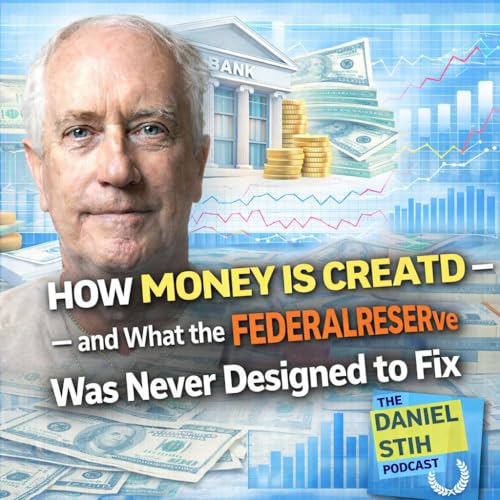
  • How Money Is Created & The Federal Reserve - Steve Keen
    Jan 7 2026

    Most people think banks lend money.
    They don't. They create it.

    I sit down with economist Steve Keen to explain how money, banking, and the Federal Reserve actually work. Our conversation tackles one of the biggest sources of confusion in economics:
    where money comes from, what the Federal Reserve was designed to do, and why financial crises keep repeating—even when the tools change.

    This episode is about mechanics, incentives, and systems.

    We cover:
    • Where money really comes from
    • Why banks don't lend existing money
    • How money is created when a loan is approved
    • How this explains booms, crashes, and sudden financial collapses
    • What the Federal Reserve is—and what it isn't
    • Is the Federal Reserve public or private?
    • Why it wasn't designed as a normal government agency
    • What the Fed was never meant to fix
    • Why stabilizing panic ≠ fixing incentives
    • How boom–bust cycles really work
    • Quantitative Easing explained without jargon

    SHOW NOTES:

    Steve Keen

    Substack - Building a New Economics: https://profstevekeen.substack.com/

    Website: https://www.stevekeen.com/
    Invite-Only: Dr. Steve Keen's Private 7-Week 'Rebel Economist Challenge'

    Patreon: https://www.patreon.com/ProfSteveKeen

    YouTube: https://www.youtube.com/ProfSteveKeen

    Books:

    Money and Macroeconomics from First Principles for Elon Musk and Other Engineers.: https://www.amazon.com/Money-Macroeconomics-First-Principles-Engineers-ebook/dp/B0FLWJ8LXY

    Debunking Economics (Digital Edition - Revised, Expanded and Integrated): The Naked Emperor Dethroned: https://www.amazon.com/Debunking-Economics-Digital-Integrated-Dethroned-ebook/dp/B09LQ9JJYP

    • USA: https://www.amazon.com/dp/B0FLWJ8LXY
    • UK: https://www.amazon.co.uk/dp/B0FLWJ8LXY
    • Germany: https://www.amazon.de/dp/B0FLWJ8LXY
    • FR ; ES ; IT ; NL ;JP ; BR ; CA ; MX ; AU

    Forbes Articles: https://www.forbes.com/sites/stevekeen/?utm_source=chatgpt.com

    Show More Show Less
    1 hr and 16 mins
  • Why Venezuela Doesn't Make Sense (Oil, Gas Prices, and Geopolitics Explained)
    Jan 4 2026

    Most explanations about Venezuela fall into two simple stories:

    "They removed a bad guy."
    "This will lead to cheaper gas."

    Both sound plausible. Neither survive with how oil markets, geopolitics, and incentives work. Examine the mechanics underneath the story:

    • How "bad actor" narratives simplify a complex structural conflict
    • How oil prices are set and why Venezuela's oil won't lower gas prices
    • Why strategic alignment, precedent, and rule-setting matter more than bad actor behavior and pump prices

    This is not a defense of any government or leader, and it does not minimize real abuses or governance failures. This is an exercise in thinking clearly.

    Show More Show Less
    9 mins
  • If the Economy Is Strong, Why Is Everyone Struggling?
    Jan 1 2026

    If the economy is "strong," why does everyday life feel harder than ever? In this episode, I break down the disconnect between official economic indicators like GDP and job numbers, and why prices rise faster than paychecks. Clarity comes first. Solutions come after understanding the problem.

    Show notes + MORE

    Watch on YouTube

    Show More Show Less
    11 mins