What if the mind isn't random—but a system?
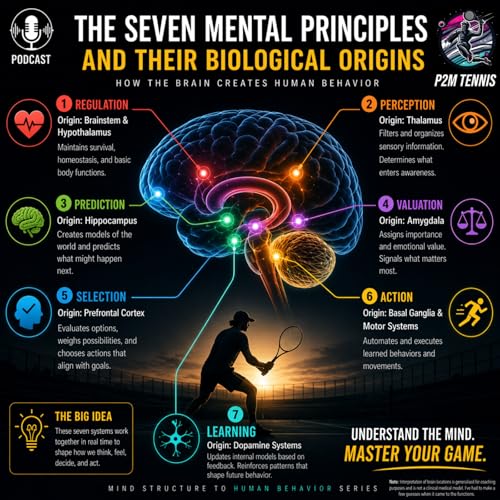
In this first episode of the Mind Structure to Human Behavior series, we explore a powerful framework designed to organize human mental activity into a clear and understandable structure. Instead of viewing thoughts, emotions, decisions, and behaviors as separate or unpredictable events, this episode introduces seven core principles that work together to shape every human experience:
Regulation → Perception → Prediction → Valuation → Selection → Action → Learning
What makes this episode unique is how these ideas are brought to life through real tennis match scenarios. By connecting each principle to situations that occur on the court, you'll see how the mind operates in real time under pressure, competition, uncertainty, success, and failure.
Whether you're an athlete, coach, parent, student, business professional, or simply curious about how the mind works, this episode will help you understand why people think, feel, and behave the way they do.
If you've ever wondered why confidence changes, why emotions influence decisions, why habits become automatic, or why performance can vary from one moment to the next, this episode provides a systematic way of understanding those experiences.
The goal is not simply to learn about the mind, but to begin seeing it differently.
Research Foundation
The concepts discussed in this episode are based on established neuroscience and psychology research and are presented through the interpretation of Coach Arias, founder of P2M TENNIS. By combining scientific literature with years of coaching and consulting experience, Coach Arias translates complex topics into practical and engaging lessons that can be understood and applied in everyday life.
Primary references include:
• Kandel, E. R., et al. — Principles of Neural Science • Eagleman, D. — The Brain: The Story of You • Hohwy, J. — The Predictive Mind • Damasio, A. R. — Descartes' Error • National Institutes of Health (NIH) • National Institute of Mental Health (NIMH) • BrainFacts.org (Society for Neuroscience)


 24 mins