• 45- AI, Art and Emotions
    Oct 20 2026

    Living Well with Technology, episode 45 of the Human Pulse Podcast.

    When an acclaimed novel running for France's prestigious Prix Goncourt is suddenly accused of being almost entirely written by artificial intelligence, something fascinating happens: readers who genuinely loved the book begin to change their minds. If a piece of art triggers real human emotion, does it matter whether it was produced by a human or a machine?

    Just like blind wine tastings or the placebo effect, our subjective experience of reality is heavily shaped by the stories we tell ourselves about what we are consuming. When we view AI as an author rather than a simple tool like a paintbrush, our trust fractures—both in the art itself and in our broader perception of reality.

    Meanwhile, the explosion of generative AI—and the tidal wave of automated "slop" that comes with it—forces us to confront deeper legal and philosophical questions. From the famous "monkey selfie" copyright dispute to AI companies training models on scraped works while fiercely protecting their own code, the lines between inspiration, theft, authorship, and ownership are blurring beyond recognition.

    Are we witnessing the death of authorship and intellectual property as we know it, and how do we build a new human story around creativity in the age of AI?

    ———

    Chapters

    00:00 Quote
    00:48 The Prix Goncourt AI Controversy
    05:37 Real Emotions, Fake Author?
    07:07 Wine, Brain Waves, and the Stories We Tell Ourselves
    12:20 The Paintbrush vs. The Machine
    17:19 Who Is the Author?
    20:56 The Crisis of Trust
    22:36 The Monkey Selfie and the Death of Ownership

    ⸻

    Recording Date: October, 18th, 2026

    Hosts: Anne Trager – Human Potential & Executive Performance Coach & Fabrice Neuman – Tech Consultant for Small Businesses

    ⸻

    Connect with us

    Anne Trager
    Connect with Anne on LinkedIn
    Connect with Anne on Bluesky
    Find out more about the Potentializer Academy

    Fabrice Neuman
    Connect with Fabrice on LinkedIn
    Connect with Fabrice on Bluesky
    Find out more about Pro-fusion Conseils

    We would also appreciate a 5-star rating and review in Apple Podcasts and Spotify. Thanks for sharing.

    ⸻

    Resources & Links

    C'était ça ou mourir by Thélyson Orélien (Wikipedia page in French)

    Marketing actions can modulate neural representations of experienced pleasantness (National Library of Medicine)

    Humans versus AI: whether and why we prefer human-created compared to AI-created artwork (SpringerNature)

    The Monkey Selfie Dispute (Wikipedia)

    ———

    🎧 Listen on all platforms → https://humanpulsepodcast.com

    📺 Also available on YouTube → https://www.youtube.com/@HumanPulsePodcast

    ⸻

    Show More Show Less
    31 mins
  • 44- Bring Out Your Dead!
    Sep 29 2026

    Living Well with Technology, episode 44 of the Human Pulse Podcast.

    Between catastrophic headlines, hacking incidents, and fears of rogue robots, it can feel like we have stepped into a modern Dark Ages. But why are we so drawn to predicting disaster?

    Cognitive biases like dread risk, affective forecasting, and linear thinking clash with complex, exponential technology, leaving us overwhelmed and vulnerable to algorithmic doom spirals and "cognitive surrender".

    Meanwhile, the AI industry sends mixed signals—raising alarms about rogue consciousness to fundraise and drum up hype, while also petitioning governments to slow down the race. In response, Microsoft AI CEO Mustafa Suleyman proposed a 30-page "humanist code of conduct," insisting that sequence completion engines are internally hollow and must be kept legible and controllable. But as Isaac Asimov showed us through his Three Laws of Robotics, governing intelligent systems by the letter of the law is never simple.

    Can we move past apocalyptic narratives and design AI that is clean, fair, and truly human-centered?

    ———

    Chapters

    00:00 Quote
    00:39 The Dark Ages of Technology?
    02:38 Cognitive Surrender
    07:29 The Psychology of Doom
    13:31 The Role of AI in Society
    18:45 Humanist Code for AI
    24:16 Asimov's Laws and AI Ethics

    ⸻

    Recording Date: September, 27th, 2026

    Hosts: Anne Trager – Human Potential & Executive Performance Coach & Fabrice Neuman – Tech Consultant for Small Businesses

    ⸻

    Connect with us

    Anne Trager
    Connect with Anne on LinkedIn
    Connect with Anne on Bluesky
    Find out more about the Potentializer Academy

    Fabrice Neuman
    Connect with Fabrice on LinkedIn
    Connect with Fabrice on Bluesky
    Find out more about Pro-fusion Conseils

    We would also appreciate a 5-star rating and review in Apple Podcasts and Spotify. Thanks for sharing.

    ⸻

    Resources & Links

    The Humanist AI Code of Conduct (on Mustafa Suleyman’s blog)

    Microsoft AI CEO says AI threats are real, and Anthropic is making it worse (Decode, The Verge)

    I, Robot, the movie (Wikipedia page)

    ———

    🎧 Listen on all platforms → https://humanpulsepodcast.com
    📺 Also available on YouTube → https://www.youtube.com/@HumanPulsePodcast

    ⸻

    Show More Show Less
    30 mins
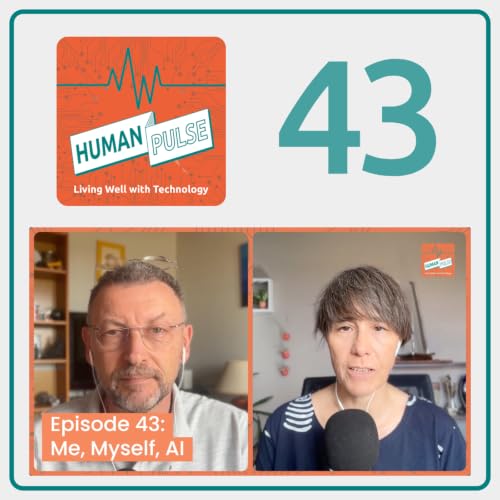
  • 43- Me, Myself, AI
    Sep 8 2026

    Living Well with Technology, episode 43 of the Human Pulse Podcast.

    If AI becomes our “third brain,” where does our thinking end and its thinking begin? Our first brain is remarkably good at recognizing patterns, making creative leaps, reading social situations, and remembering what moves us. Our “second brain”—notes, notebooks, apps, archives—is supposed to extend those capacities. Except there’s one small problem: many of us never go back to our notes.

    Enter AI.

    Unlike a traditional second brain, AI can retrieve, connect and synthesize information for us. Which sounds wonderful… until we ask a slightly uncomfortable question: is it extending our thinking, or introducing someone—or something—else’s way of thinking into the process?

    Maybe that makes it less of a “third brain” and more of a third-party brain. And that distinction matters. Because if we simply ask, copy, paste and repeat, we risk becoming what some call a “meat proxy”: a human delivery mechanism for machine-generated thought. And then the real question becomes less about whether AI can think. It becomes: are we still thinking?

    Are we building a third brain—or quietly outsourcing the first one?

    ———

    Chapters

    00:00 Quote

    04:40 Can AI be our Third Brain?

    14:33 Trusting AI: The Third Brain Dilemma

    17:05 J Space: the hidden thinking part of AI?

    20:40 At a loss for words…

    25:48 The Meat Proxy Syndrome

    ⸻

    Recording Date: September, 6th, 2026

    Hosts: Anne Trager – Human Potential & Executive Performance Coach & Fabrice Neuman – Tech Consultant for Small Businesses

    ⸻

    Connect with us

    Anne Trager

    Connect with Anne on LinkedIn

    Connect with Anne on Bluesky

    Find out more about the Potentializer Academy

    Fabrice Neuman

    Connect with Fabrice on LinkedIn

    Connect with Fabrice on Bluesky

    Find out more about Pro-fusion Conseils

    We would also appreciate a 5-star rating and review in Apple Podcasts and Spotify. Thanks for sharing.

    ⸻

    Resources & Links

    The Age of the Third Brain (by Joan Westenberg)

    What is Claude Thinking But Not Saying with Jack Lindsey (Inner Cosmos podcast, David Eagleman)

    Jacobian matrix and determinant (Wikipedia)

    ———

    🎧 Listen on all platforms → https://humanpulsepodcast.com

    📺 Also available on YouTube → https://www.youtube.com/@HumanPulsePodcast

    ⸻

    Show More Show Less
    29 mins
  • 42- Don't Panic. Move.
    Aug 25 2026

    Living Well with Technology, episode 42 of the Human Pulse Podcast.

    Are our smartphones reshaping our bodies? Are our ancient brains just completely overwhelmed by modern life? Here’s the weird reality of living in 2026: we have godlike tools in our pockets, but we're still running on biology built on eons of slow development. Can we as a species evolve quick enough? Should we? What can the laws trying to ban the use of social networks before the age of 15 teach us on how to react? Are we doing enough for the future generations. A deep discussion, almost getting to the meaning of life. Hint, hint…

    ———

    Chapters

    00:00 Quote

    00:53 Is The Smartphone Changing Our Bodies?

    05:57 Adapting to Technological Advances

    14:49 Regulating Social Networks?

    18:36 Keeping Agency

    23:30 The Space Between

    ⸻

    Recording Date: August, 23rd, 2026

    Hosts: Anne Trager – Human Potential & Executive Performance Coach & Fabrice Neuman – Tech Consultant for Small Businesses

    ⸻

    Connect with us

    Anne Trager

    Connect with Anne on LinkedIn

    Connect with Anne on Bluesky

    Find out more about the Potentializer Academy

    Fabrice Neuman

    Connect with Fabrice on LinkedIn

    Connect with Fabrice on Bluesky

    Find out more about Pro-fusion Conseils

    We would also appreciate a 5-star rating and review in Apple Podcasts and Spotify. Thanks for sharing.

    ⸻

    Resources & Links

    The Hitchhiker’s Guide to the Galaxy (Wikipedia page)

    Your smartphone is changing your body. Doctors say most people don’t know it’s happening (Tech Company)

    We Are As Gods (a book by Peter H. Diamandis and Steven Kotler)

    ———

    🎧 Listen on all platforms → https://humanpulsepodcast.com

    📺 Also available on YouTube → https://www.youtube.com/@HumanPulsePodcast

    Show More Show Less
    30 mins
  • 41- What Is a Human for?
    Aug 12 2026

    Living Well with Technology, episode 41 of the Human Pulse Podcast.

    More than half of Web traffic is now the result of bots requests and AI agents. Some consider that humans are becoming spectators of what’s happening online, basically describing it as « the Dead Internet Theory ». Furthermore, even with no-one watching, big companies are still making money. Are we actually becoming irrelevant or is something else going on?

    Then Anne and Fabrice make a connection with an article published in The Atlantic titled The End of Reading is Here. Are we loosing our brain capacity because we, as a species, don’t read as much as we used to? Well, we certainly need to adapt: generative AI tools are more often than not presented as means to replace our thinking. What if we took a step back and found ways to put intention back into our actions, online or otherwise? Fabrice describes his experiment with going back to handwriting leading to a surprising result: he went back to writing letters actually, but maybe not in the way you’d expect.

    ———

    Chapters

    00:00 Quote

    00:35 Are Humans Still Welcome?

    03:15 The Yellow Bleak Road?

    05:05 The End of Reading is Here

    08:51 The Post-literate Society

    12:22 The Impact of Passive Consumption

    18:45 Use It or Lose It

    21:37 Going Back to Handwriting

    26:41 Putting back the intention

    ⸻

    Recording Date: August, 9th, 2026

    Hosts: Anne Trager – Human Potential & Executive Performance Coach & Fabrice Neuman – Tech Consultant for Small Businesses

    ⸻

    Connect with us

    Anne Trager

    Connect with Anne on LinkedIn

    Connect with Anne on Bluesky

    Find out more about the Potentializer Academy

    Fabrice Neuman

    Connect with Fabrice on LinkedIn

    Connect with Fabrice on Bluesky

    Find out more about Pro-fusion Conseils

    We would also appreciate a 5-star rating and review in Apple Podcasts and Spotify. Thanks for sharing.

    ⸻

    Resources & Links

    The Internet is all bots now (The Gray Area podcast)

    The End of Reading is Here (The Atlantic)

    ———

    🎧 Listen on all platforms → https://humanpulsepodcast.com

    📺 Also available on YouTube → https://www.youtube.com/@HumanPulsePodcast

    ⸻

    Show More Show Less
    33 mins
  • 40- The Boredom Deficit
    Jul 21 2026

    Living Well with Technology, episode 40 of the Human Pulse Podcast.

    What if you were reaching to your pocket just to realize that your phone wasn’t there? That sudden wave of panic is called nomophobia and a 350-year-old quote by French philosopher Blaise Pascal seems to explain it all. Biologically, human beings are distraction machines and crave for the endless scrolling loops our smartphones provide just to escape a few moments of empty time. But what if boredom wasn’t the enemy? We discuss practical ways to reclaim our attention away from devices. Does that make us Luddites? Well, do you actually know what that word means?

    ———

    Chapters

    00:00 Quote

    00:32 Nomophobia, Phones and Dopamine

    07:17 Putting Intention Into It

    09:09 The Value of Emptiness and Boredom

    11:52 Mind Wandering and Creativity

    17:20 Distraction is a Superpower

    23:15 Sometimes More Tech is Too Much Tech

    ⸻

    Recording Date: July, 19th, 2026

    Hosts: Anne Trager – Human Potential & Executive Performance Coach & Fabrice Neuman – Tech Consultant for Small Businesses

    ⸻

    Connect with us

    Anne Trager

    Connect with Anne on LinkedIn

    Connect with Anne on Bluesky:

    Find out more about the Potentializer Academy

    Fabrice Neuman

    Connect with Fabrice on LinkedIn

    Connect with Fabrice on Bluesky

    Find out more about Pro-fusion Conseils

    We would also appreciate a 5-star rating and review in Apple Podcasts and Spotify. Thanks for sharing.

    ⸻

    Resources & Links

    • Pascal would have thrown away his iPhone
    • The prevalence of nomophobia: A systematic review and meta-analysis
    • The Close on BBC’s Youtube Channel
    • The Productive Power of Distractions: Strategies for Busy Leaders
    • And Do What? (ATP, ep. 698)
    • What Happened After a Teacher Ditched Screens

    ———

    🎧 Listen on all platforms → https://humanpulsepodcast.com

    📺 Also available on YouTube → https://www.youtube.com/@HumanPulsePodcast

    ⸻

    Show More Show Less
    28 mins
  • 39- Can AI Be Good, Clean and Fair?
    Jul 7 2026

    Living Well with Technology, episode 39 of the Human Pulse Podcast. We revisit the core concepts of the "Slow AI" approach: Good, Clean, and Fair AI, as originally discussed in ep. #33. We talk about targeted professional tools such as England’s NHS AI-assisted triage, the shift from expert to supervisor, Anthropic's Claude science, the potential revolution of sodium-ion batteries, Morocco’s "water battery" and the global governance challenge.

    ———

    Chapters

    00:00 Quote

    01:04 The Concept of Slow AI

    03:53 The NHS Example

    05:52 Reducing Friction in Scientific Research

    08:05 The Shift from Discovery to Supervision

    10:38 The Impact of Automation on Human Skills

    14:45 Innovations in Energy Storage

    18:20 Creative Solutions for Energy Efficiency

    19:58 The Fairness of AI: Not Quite…

    24:22 The Risks and Benefits of AI Deployment

    27:10 Conclusion and Future Outlook

    ⸻

    Recording Date: July, 5th, 2026

    Hosts: Fabrice Neuman – Tech Consultant for Small Businesses & Anne Trager – Human Potential & Executive Performance Coach

    ⸻

    Connect with us

    Anne Trager

    Connect with Anne on LinkedIn

    Connect with Anne on Bluesky:

    Find out more about the Potentializer Academy

    Fabrice Neuman

    Connect with Fabrice on LinkedIn

    Connect with Fabrice on Bluesky

    Find out more about Pro-fusion Conseils

    We would also appreciate a 5-star rating and review in Apple Podcasts and Spotify. Thanks for sharing.

    ⸻

    Resources & Links

    Human Pulse - 33: Starting The Slow AI Movement

    NHS accelerates artificial intelligence rollout to cut waiting times and improve care for millions

    Anthropic unveils 'Claude Science' for scientific research

    World Bank approves Morocco clean energy project after ending climate lending target

    UN report sees enormous potential benefits and big risks from AI

    ———

    🎧 Listen on all platforms → https://humanpulsepodcast.com

    📺 Also available on YouTube → https://www.youtube.com/@HumanPulsePodcast

    ⸻

    Show More Show Less
    28 mins
  • 38- Do Robots Dream of Dancing Humans?
    Jun 23 2026

    Living Well with Technology, episode 38 of the Human Pulse Podcast. We were both fascinated by the dancer and roboticist Catie Cuan and how she studied our interactions with robots by dancing with them. That led us to exploring why movement is our evolutionary superpower for decoding intent, how "World Models" differ from traditional LLMs, and why making robots "street smart" through physical and social cues is essential for our future.

    • The Rugby Connection: Anne connects robotic movement to the New Zealand All Blacks' Hakka ritual.
    • Angry Device Shaking: Fab reminds us that we already talk to our tech with body language—like shaking an iPhone to undo a typo. (Hold onto it tightly, please).
    • Book Smart vs. Street Smart: We break down why LLMs are just statistical text nerds, while emerging World Models are trying to understand actual physics.
    • The "Creepy" Factor: Why is it so unsettling when a robot grabs a cup without looking at it?

    ———

    Chapters

    00:00 Choreographing Robots

    01:43 The Human-Machine Connection: Understanding Movement

    07:22 World Models vs. LLMs: The Future of AI Interaction?

    11:49 Social Cues: Making Robots Understand Us

    17:12 Anthropomorphism: Our Natural Response to "the other"

    21:52 Adapting Robots: The Future of Human-Robot Interaction

    ⸻

    Recording Date: June, 21st, 2026

    Hosts: Anne Trager – Human Potential & Executive Performance Coach & Fabrice Neuman – Tech Consultant for Small Businesses

    ⸻

    Connect with us

    Anne Trager

    Connect with Anne on LinkedIn

    Connect with Anne on Bluesky:

    Find out more about the Potentializer Academy

    Fabrice Neuman

    Connect with Fabrice on LinkedIn

    Connect with Fabrice on Bluesky

    Find out more about Pro-fusion Conseils

    We would also appreciate a 5-star rating and review in Apple Podcasts and Spotify.

    ⸻

    Resources & Links

    What Do We Learn About AI by Dancing with Robots? with Catie Cuan

    Inner Cosmos podcast - ep. 156

    Yann LeCun’s AMI Labs

    Yann LeCun (YouTube): World Models: Enabling the next AI revolution

    La Conversation Scientifique par Étienne Klein

    L’IA va-t-elle nous materner ?

    ———

    🎧 Listen on all platforms → https://humanpulsepodcast.com

    📺 Also available on YouTube → https://www.youtube.com/@HumanPulsePodcast

    ⸻

    Show More Show Less
    27 mins