• TP477: The Trust Debt: The Hidden Cost of Automating the Wrong Things
    Mar 4 2026
    Automation was sold as a way to scale good experiences. It scales bad ones just as efficiently. Healthcare has spent the last decade deploying chatbots, portals, AI-generated content, and personalization engines in the name of patient experience. The ROI case was built on efficiency: lower cost per interaction, faster throughput, reduced call center volume. What was never put on the balance sheet is what happens to patient trust when those systems fail — and they fail regularly, quietly, and without anyone in the organization knowing it happened. That's trust debt. Every time an automated system fails a patient and the patient absorbs the cost silently — closes the portal, hangs up, stops engaging — a withdrawal is made from an account most health systems never knew they had. It doesn't show up in satisfaction scores. It shows up in churn, in rising call volumes that automation was supposed to reduce, in patients who schedule once and don't come back. Chris Boyer and Reed Smith work through where the debt is accumulating right now — and where automation is actually doing the opposite: Why AI-generated health content optimized for fluency, not accuracy, is seeding doubt in the patients most likely to engage with it How portal adoption metrics are measuring the wrong signal — and why enrollment without satisfaction is just a larger audience for your frustration Where DXP personalization crosses from service into surveillance — and how thin consent frameworks are accelerating that perception What trust-building automation actually looks like, and what it has in common with the best human interactions in healthcare The three questions every team should ask before the next automated touchpoint goes live The research is catching up to what practitioners already sense. AI safety disclaimers in patient-facing responses dropped from 26% in 2022 to under 1% in 2025. Sixty-one percent of patients say they'd consider switching providers over a better digital experience. And the 2025 Edelman Trust and Health report found that no institution — not business, not government, not NGOs — is trusted to address patient needs. Healthcare is operating in a trust deficit it didn't create alone, but automation is making it worse in ways that are largely invisible to the organizations doing it. The question isn't whether to automate. It's whether you've been honest about what you're actually scaling. Mentions from the Show: TP456: When AI Speaks for the Patient — touchpoint.health TP460: When Digital Speaks for the Patient — touchpoint.health TP470: When AI Becomes the First Stop for Care — touchpoint.health AI errors in healthcare — Healthcare Brew, August 2025: https://www.healthcare-brew.com/stories/2025/08/20/healthcare-execs-ai-errors Declining medical safety messaging in AI — npj Digital Medicine, October 2025: https://www.nature.com/articles/s41746-025-01943-1 ECRI Top 10 Patient Safety Concerns 2025: https://www.medtechdive.com/news/ecri-patient-safety-report-2025-ai/742114/ ONC Patient Portal Access Data Brief 2024: https://healthit.gov/data/data-briefs/individuals-access-and-use-patient-portals-and-smartphone-health-apps-2024/ Experian Health patient portal switching stat: https://www.experian.com/healthcare/solutions/patient-engagement-solutions 2025 Edelman Trust Barometer: Trust and Health: https://www.edelman.com/trust/2025/trust-barometer/special-report-health 2026 Edelman Trust Barometer: https://www.edelman.com/trust/2026/trust-barometer Reed Smith on LinkedIn: https://www.linkedin.com/in/reedtsmith/ Chris Boyer on LinkedIn: https://www.linkedin.com/in/chrisboyer/ Chris Boyer website: http://www.christopherboyer.com/ Chris Boyer on BlueSky: https://bsky.app/profile/chrisboyer.bsky.social Reed Smith on BlueSky: https://bsky.app/profile/reedsmith.bsky.social Learn more about your ad choices. Visit megaphone.fm/adchoices
    Show More Show Less
    38 mins
  • TP476: Good Enough for People Is Not Good Enough for Machines
    Feb 25 2026
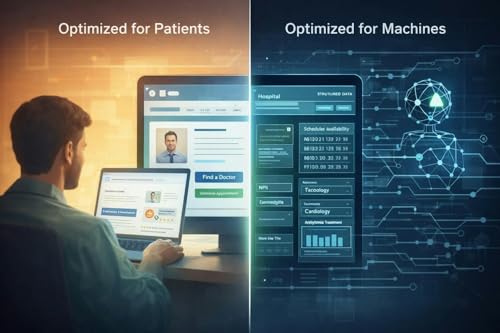
    Health systems have spent 20 years optimizing for the patient who searches, clicks, and reads. They are not optimizing for the agent that queries, evaluates, and routes. Those are two different audiences — and most organizations are only ready for one of them. The digital front door was built on a human assumption: that discovery begins with a search, passes through a website, and ends in conversion. Agentic AI doesn't use doors. It uses structured pathways, machine-readable attributes, and decision logic that operates entirely outside your owned channel. The routing is already happening. The question is whether health systems are in the decision set - or invisible to it. The infrastructure making this possible isn't speculative. Model Context Protocol (MCP), now an open standard backed by Anthropic, OpenAI, and Google DeepMind, defines how AI agents connect to external tools and data sources. NLWeb, launched by Microsoft in May 2025, turns websites into machine-queryable endpoints. Together, they create an execution layer on top of your digital ecosystem. And most hospital websites aren't built to be legible to it. Chris Boyer and Reed Smith work through what this shift actually requires: Why the patient journey now runs conversation → AI interpretation → machine routing → conversion — and health systems control only the last step What breaks when machines encounter unstructured provider bios, inconsistent service line naming, and scheduling availability gaps Why brand strength built on emotional resonance doesn't translate to machine-readable signals — and what does The gap between "78% of health systems engaged in AI projects" and the 52% that feel operationally ready to implement them What a practical machine readiness audit looks like, and who inside the organization should own it The organizational problem is as hard as the technical one. Marketing owns content but rarely owns schema. IT owns infrastructure but rarely thinks in terms of machine-readable patient experience. Someone has to own machine readiness as a cross-functional problem. Right now, almost no one does. If your digital strategy was designed for the patient who searches, clicks, and reads - it was not designed for the agent that queries, evaluates, and routes. Mentions From the Show: Dean Browell on LinkedIn Danny Fell on LinkedIn Reed Smith on LinkedIn Chris Boyer on LinkedIn Chris Boyer website Chris Boyer on BlueSky Reed Smith on BlueSky Learn more about your ad choices. Visit megaphone.fm/adchoices
    Show More Show Less
    37 mins
  • TP475: Is AI Making Us Better… or Just Cheaper?
    Feb 18 2026
    Artificial intelligence is being framed as innovation. But sometimes it sounds a lot like cost cutting. In this episode of Touch Point, hosts Chris Boyer and Reed Smith tackle a provocative question sparked by recent headlines describing workforce reductions as “AI productivity savings.” If thousands of jobs are eliminated under the banner of efficiency, is that transformation — or just margin management with better branding? Healthcare is under pressure to do more with less. AI is now embedded in marketing, access, scheduling, operations, and content workflows. But how are we actually measuring success? Is it: Revenue growth? Cost efficiency? Improved patient experience? Or simply labor reduction? Chris and Reed introduce a balanced AI value framework built around four dimensions: growth impact, cost efficiency, experience enhancement, and trust durability. Because in healthcare, productivity alone is not strategy — and cost savings without context can distort behavior. Then, they welcome guest experts Danny Fell and Dean Browell for a deeper executive-level discussion on how to position AI initiatives to the C-suite. How do you communicate long-term brand and trust value in a boardroom that applauds immediate cost reductions? And how do you avoid what they call “productivity theater” in the AI era? This episode challenges healthcare leaders to rethink ROI before AI reshapes the definition of value itself. Mentions From the Show: Dean Browell on LinkedIn Danny Fell on LinkedIn Reed Smith on LinkedIn Chris Boyer on LinkedIn Chris Boyer website Chris Boyer on BlueSky Reed Smith on BlueSky Learn more about your ad choices. Visit megaphone.fm/adchoices
    Show More Show Less
    1 hr and 2 mins
  • TP474 - Inside Healthcare's Dark Funnel
    Feb 11 2026
    Healthcare marketers are seeing something strange: campaigns look like they’re working, but analytics can’t explain why. In this episode, Chris Boyer and Reed Smith unpack what’s really happening inside healthcare’s “dark funnel” — the growing share of patient decision-making that happens outside trackable channels. Patients are increasingly influenced by AI summaries, private communities, reputation signals, and access realities long before they ever visit a website. By the time someone schedules care, the decision has already been shaped — just not in places marketing dashboards can see. This conversation explores: What the dark funnel actually is and why it’s accelerating in healthcare How AI tools are reshaping discovery before patients ever search Why reputation now acts as a signal of future loyalty, not just a score Where attribution breaks down — and why that doesn’t mean marketing is failing How health systems can influence decisions they’ll never directly measure If patient intent is forming off the radar, the real question isn’t how to track it — it’s how to stay relevant when your brand is being inferred instead of discovered. Mentions From the Show: Reed Smith on LinkedIn Chris Boyer on LinkedIn Chris Boyer website Chris Boyer on BlueSky Reed Smith on BlueSky Learn more about your ad choices. Visit megaphone.fm/adchoices
    Show More Show Less
    39 mins
  • TP473: When Demand Outruns Supply (And Marketing Gets Stuck in the Middle)
    Feb 4 2026
    Healthcare talks a lot about growth, access, and consumerism. But there’s a growing problem hiding in plain sight: demand is getting easier to create, while supply remains stubbornly hard to deliver. In this episode, Chris Boyer and Reed Smith unpack a tension many health systems are feeling but rarely name out loud. As digital marketing, online scheduling, and consumer-first strategies mature, organizations are getting better at generating demand. Too often, that demand runs headfirst into real constraints on the supply side: provider schedules, clinic capacity, access center workflows, EMR logic, bylaws, and reimbursement realities. The result? Campaigns that work. Experiences that break. And patients who did everything right, only to be told there are no appointments available. The conversation starts with a quick reset on classic supply-and-demand economics and why those models fall apart in healthcare. From there, Chris and Reed explore: Why marketing is being asked to drive demand without influence over supply How digital tools are exposing access gaps that have always existed The disconnect between growth strategy, clinical operations, and access management Why “no appointments available” may be the most expensive UX pattern in healthcare What a route-first approach to access could look like in practice This is not about blaming clinicians or oversimplifying a complex system. It’s about naming the mismatch, understanding the incentives, and starting a more honest conversation about how demand and supply actually meet inside modern health systems. If healthcare is serious about consumerism, it has to get serious about access. Mentions From the Show: Reed Smith on LinkedIn Chris Boyer on LinkedIn Chris Boyer website Chris Boyer on BlueSky Reed Smith on BlueSky Learn more about your ad choices. Visit megaphone.fm/adchoices
    Show More Show Less
    38 mins
  • TP472: Reputation as a Signal, Not a Score
    Jan 28 2026
    Trust in institutions is declining, and healthcare is not immune. At the same time, patients are relying more heavily than ever on what other people say online to decide where, when, and whether to seek care. In this episode of Touch Point, hosts Chris Boyer and Reed Smith revisit reputation management with a fresh lens. Not as a checklist of review sites to monitor, but as a leading indicator of patient trust, experience, and long-term loyalty. The conversation explores how reputation is shifting beyond Google and Facebook into places health systems rarely control or even monitor. From Reddit threads and local forums to unsolicited patient stories that carry more weight than polished testimonials, reputation today is fragmented, emotional, and deeply contextual. Chris and Reed also unpack a growing tension in healthcare marketing and patient experience. As more organizations are encouraged to solicit reviews through formal programs, are we improving transparency or simply priming the pump. And how should teams interpret star ratings versus narrative feedback when trying to understand real service breakdowns and recovery opportunities. Key topics include: Why declining trust makes reputation a strategic asset, not a marketing afterthought The difference between solicited and unsolicited reviews and why it matters How online reputation signals future loyalty and patient experience scores Where reputation actually forms today and why traditional monitoring tools fall short How health systems can move from reactive review management to meaningful insight and action This episode is a practical, opinionated update for anyone responsible for brand, experience, access, or digital strategy in healthcare. Reputation is no longer just about what people say. It is about what organizations choose to hear and how they respond. Mentions From the Show: Edelman Trust Barometer Reed Smith on LinkedIn Chris Boyer on LinkedIn Chris Boyer website Chris Boyer on BlueSky Reed Smith on BlueSky Learn more about your ad choices. Visit megaphone.fm/adchoices
    Show More Show Less
    47 mins
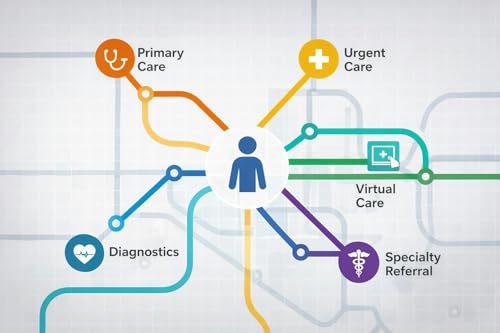
  • TP471 - Developing a “Route-First” Access Strategy
    Jan 21 2026
    Access is still one of healthcare’s most talked-about problems. But a year after our last access-focused episode, the conversation has shifted in quieter and more consequential ways. In this episode, Chris Boyer and Reed Smith revisit access not as a single front door problem, but as a routing challenge shaped by workforce constraints, digital behavior, reimbursement realities, and patient expectations that continue to evolve. Rather than rehashing familiar headlines about staffing shortages or online scheduling, they introduce a route-first access strategy. One that prioritizes guiding patients to the right care, at the right time, through the right channel. Sometimes that means digital. Sometimes it does not. The conversation covers what has actually changed over the past year, where health systems are making progress, and where access friction has simply moved instead of disappearing. Chris and Reed also explore how consumer expectations are colliding with clinical capacity, why access success increasingly depends on orchestration rather than availability, and what leaders should stop measuring if they want real improvement. This is a practical, forward-looking discussion for healthcare leaders who want to move beyond access theater and design experiences that work in the real world. Mentions From the Show: Fierce Healthcare 2026 outlook on hybrid care Gartner Strategic Predictions for 2026 Zocdoc 2024 What Patients Want report Reed Smith on LinkedIn Chris Boyer on LinkedIn Chris Boyer website Chris Boyer on BlueSky Reed Smith on BlueSky Learn more about your ad choices. Visit megaphone.fm/adchoices
    Show More Show Less
    39 mins
  • TP470 – When AI Becomes the First Stop for Care
    Jan 14 2026
    For years, healthcare has talked about patients as informed consumers. Now, many of them are showing up informed before they ever touch a health system. In this episode of Touch Point, hosts Chris Boyer and Reed Smith unpack what’s behind OpenAI’s launch of ChatGPT Health and why it signals a meaningful shift in how people seek, process, and act on health information. The conversation starts with a look at new research from OpenAI that shows how millions of people are already using ChatGPT for healthcare related questions. Not hypotheticals. Real behavior. Real scale. From understanding lab results to navigating insurance, AI has quietly become a first stop in the health journey. From there, Chris and Reed break down what ChatGPT Health actually does, what it does not do, and why that distinction matters for health systems, marketers, and experience leaders. They explore how AI is filling gaps created by short appointments, fragmented records, and limited access, and what that means for trust, preparation, and patient expectations moving forward. They then feature an interview with Brandon Scott, Chief Innovation and Growth Officer of TenAdams, that grounds the discussion in reality, examining where AI genuinely helps patients, where it creates new tensions, and why slow moving, walled garden thinking is increasingly out of step with how people now manage their health. This is not an episode about replacing clinicians. It is about understanding a new layer of the patient experience that already exists and deciding how healthcare organizations respond to it. If your digital strategy still assumes the website is the first interaction, or that education starts after the visit, this episode will challenge that assumption. Mentions From the Show: OpenAI — AI as a Healthcare Ally (Jan 2026) OpenAI — Introducing ChatGPT Health ChatGPT Health launches to serve “hundreds of millions” seeking health and wellness guidance each week Anthropic joins OpenAI's push into health care with new Claude tools Brandon Scott on LinkedIn TenAdams.com Reed Smith on LinkedIn Chris Boyer on LinkedIn Chris Boyer website Chris Boyer on BlueSky Reed Smith on BlueSky Learn more about your ad choices. Visit megaphone.fm/adchoices
    Show More Show Less
    57 mins