• You're Not the Problem: Adaptations, Nervous System Safety & the Conditions for Change with Lori Montry
    May 14 2026

    Send us Fan Mail

    Today's guest is Lori Montry — somatic healing practitioner, author of You're Not the Problem, and creator of The Freedom Formula, a nervous system-based roadmap for sustainable behavior change. Lori helps people who feel stuck in stress, overwhelm, or self-sabotage understand the survival patterns driving their choices so they can build the safety, capacity, and clarity needed to take aligned action in every area of their lives.

    There is so much resonance in this conversation — between Lori's work and Ayurveda, between the Freedom Formula and what we talk about every week on this podcast. I think you're going to feel it too.

    What we cover:

    • Why Lori uses the word adaptation instead of problem, habit, or failure — and why that single reframe changes everything about how we relate to ourselves and our patterns
    • The most common adaptation she sees in women: I'm not enough — and the Mississippi River of coping mechanisms, people-pleasing, overachieving, and self-sabotage that flows from it
    • What is actually happening at the nervous system level when you know what to do and still don't do it — and why it has nothing to do with willpower
    • The three things the nervous system needs before behavior change is even possible: safety, capacity, and energy — and why trying to change without these in place is like expecting a seed to bloom in a dark closet with no water
    • Why nervous system tools sometimes make things worse — and what to do instead
    • The difference between managing stress and befriending it — and why safety lives in the body, not in the mind
    • The resonance between Lori's framework and Ayurveda — being situated in the self, the sattvic state, and why regulated nervous systems see reality more clearly
    • Lori's vision of reaching 50 million people with the message that they are not the problem — and why a more somatic-literate world is one of the most urgent things we need right now

    Connect with Laurie:

    • Website: www.LoriMontry.com
    • Youtube: Lori Montry -Somatic Healing Practitioner - YouTube
    • Facebook: www.facebook.com/LoriMontry
    • Instagram: Instagram
    • Email List : https://www.lorimontry.com/book-intro

    Resources:

    Free Masterclass: The Alchemy of the Perimenopause Portal

    Ayurvedic Dosha Quick Reference Guide

    Abhyanga Self Massage Guide

    Weekend Nervous System Reset

    Nourished For Resilience Workbook


    Find me at www.nourishednervoussystem.com

    and @nourishednervoussytem on Instagram


    Show More Show Less
    45 mins
  • Oxytocin, Neural Plasticity & the Practices That Change Your Brain
    May 7 2026

    Send us Fan Mail

    Today we're going somewhere I've been wanting to go for a while — into the neuroscience of oxytocin. Not oxytocin as the cuddle hormone, though it is that too.

    Oxytocin as a brain-changing, nervous system-healing, plasticity-promoting substance that you can actually learn to stimulate intentionally through your daily practices.

    What we cover:

    • What oxytocin actually is — beyond the "love hormone" label, it is a neuroplasticity agent that promotes new neuron growth, reshapes synaptic connections, and helps the brain become more open to change and healing
    • The oxytocin-safety loop — how oxytocin and the parasympathetic nervous system reinforce each other, and why this is the biological basis for healing happening in relationship and community rather than in isolation
    • The research on meditation — particularly loving-kindness, gratitude, and compassion-based practices — and why the heart-opening, relational quality of the practice matters more than meditation style alone
    • Nadi Shodhana (alternate nostril breathing) — the honest framing of what the research does and doesn't yet show, and why the vagus nerve pathway makes it one of the most direct routes to oxytocin release we have
    • Seven everyday oxytocin releasers — gentle touch and self-massage, warmth, face-to-face community, humming and chanting, gratitude — and how each maps onto Ayurvedic practices you may already be doing

    Free downloads: Grab the one-page guide — 7 Ways to Release Oxytocin Today — with the science and Ayurvedic wisdom behind each practice. Click Here

    And my Self Abhyanga Guide Here


    Research References

    Oxytocin & Neural Plasticity

    Pekarek, B.T., Hunt, P.J., & Arenkiel, B.R. (2020). Oxytocin and Sensory Network Plasticity. Frontiers in Neuroscience, 14, 30. https://doi.org/10.3389/fnins.2020.00030

    Froemke, R.C., & Young, L.J. (2021). Oxytocin, Neural Plasticity, and Social Behavior. Annual Review of Neuroscience, 44, 359–381. https://doi.org/10.1146/annurev-neuro-102320-102847

    Meditation & Oxytocin

    Bellosta-Batalla, M., et al. (2020). Increased salivary oxytocin and reduced anxiety in a mindfulness and compassion-based intervention. Mindfulness. (Referenced in Frontiers in Endocrinology, 2024)

    Machida, S., Sunagawa, M., & Takahashi, T. (2018). Oxytocin release during the meditation of altruism and appreciation (Arigato-Zen). International Journal of Neurology Research, 4, 364–370.


    Resources:

    Free Masterclass: The Alchemy of the Perimenopause Portal

    Ayurvedic Dosha Quick Reference Guide

    Abhyanga Self Massage Guide

    Weekend Nervous System Reset

    Nourished For Resilience Workbook


    Find me at www.nourishednervoussystem.com

    and @nourishednervoussytem on Instagram


    Show More Show Less
    33 mins
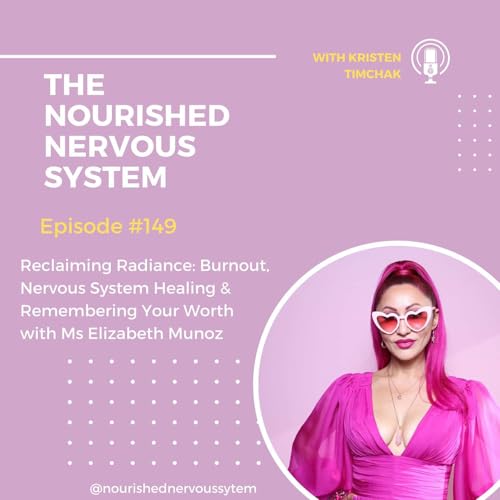
  • Reclaiming Radiance: Burnout, Nervous System Healing & Remembering Your Worth with Ms Elizabeth Munoz
    Apr 30 2026

    Send us Fan Mail

    Today's guest is Ms Elizabeth Munoz, founder of Soul Haven and creator of the Reclaiming Radiance framework. Elizabeth spent 17 years in corporate — the last 11 in high-stakes technology sales — before her body completely shut down. Two emergency C-sections, a fibromyalgia diagnosis, and the moment her legs gave out walking to an airport when her daughter was three months old were the turning points that changed everything.

    What followed was a deep healing journey — through the nervous system, through identity, through grief — that led Elizabeth to build a life and business rooted in joy, regulation, and what she calls reclaiming radiance. She is also certified through the HeartMath Institute, holds a degree in psychology, and brings a deeply personal and deeply practical perspective to everything she teaches.

    What we cover:

    • Why burnout is not a personal failure but intelligent nervous system signaling — and why pushing through only drives it deeper
    • The too much / not enough paradox that so many women carry, and how it shapes the way we show up in our bodies and our work
    • The difference between resilience and regulation — and why regulation has to come first
    • A simple, accessible mirror practice for women who have been overriding their bodies and want to begin rebuilding trust with themselves
    • What emotional congruence actually feels like in the body — and how micro aligned actions taken consistently are what build it over time
    • Why our healing is never just for ourselves — and the personal loss that deepened Elizabeth's commitment to this work
    • Why midlife is not a decline but a reclamation — and why it is never, ever too late

    Elizabeth's invitation: You do not have to prove your worth. You were born worthy. The fact that you are here, breathing, in this timeline is proof enough.

    Connect with Elizabeth:

    • Soul Haven
    • Reclaiming Radiance course
    • Podcast
    • Instagram
    • Linkedin


    Resources:

    Free Masterclass: The Alchemy of the Perimenopause Portal

    Ayurvedic Dosha Quick Reference Guide

    Abhyanga Self Massage Guide

    Weekend Nervous System Reset

    Nourished For Resilience Workbook


    Find me at www.nourishednervoussystem.com

    and @nourishednervoussytem on Instagram

    Show More Show Less
    39 mins
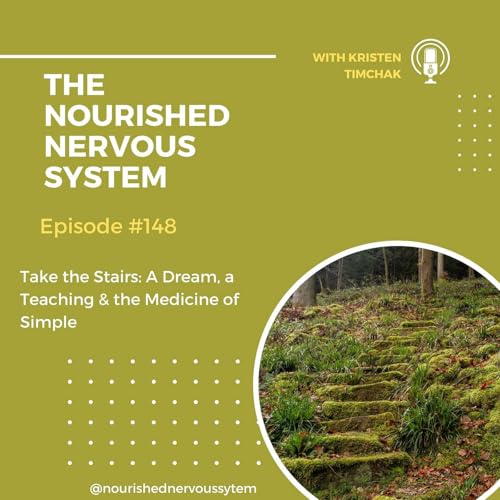
  • Take the Stairs: A Dream, a Teaching & the Medicine of Simple
    Apr 23 2026

    Send us Fan Mail

    Here in Maine we're still tiptoeing into spring — warm days that feel like a promise, then snow flurries and the wood stove again. It's been a season of letting go and being with what is, which turns out to be exactly what this episode is about.

    A few weeks ago I had a dream. In it, I was on top of a crumbling Lego platform, trying to hold everything together, piece by piece — while a perfectly good staircase sat right there, unused. When I woke up, I couldn't stop thinking about what it meant. This episode is me unpacking that.

    Two teachings from one dream:

    The first is about taking the stairs — the simple, unsexy, already-available thing — instead of endlessly complicating our way toward health. We live in a world that constantly tells us to do more, take this supplement, follow this protocol, optimize this. And in all that noise, we miss the stairs. The morning sunlight. The consistent bedtime. The seasonal meal. The thing that actually works, hiding in plain sight.

    The second teaching is about foundation. It doesn't matter how hard you work at the top of the platform if the foundation is shaky. Whether we're talking about hormonal health, autoimmune disease, perimenopause, or just a general sense of depletion — the small, slow, foundational steps are what make everything else possible. HRT might help. Supplements might help. But if we're not also looking at sleep, stress, diet, and the root causes underneath, we're still just patching the top of a crumbling platform.

    And perhaps most importantly: how we talk to ourselves in this process matters enormously. When we notice we've been making choices that aren't serving us, do we take our own hand like a loving friend and say look, there are stairs, we can do this — or do we berate ourselves for not seeing them sooner?

    Free resource mentioned: The Nourished for Resilience Workbook — a simple pie chart to help you see where you feel nourished and where you don't, and find your starting place. Also includes questions for contemplation and a habit tracker.

    Free Workbook Here!

    Resources:

    Free Masterclass: The Alchemy of the Perimenopause Portal

    Ayurvedic Dosha Quick Reference Guide

    Abhyanga Self Massage Guide

    Weekend Nervous System Reset

    Nourished For Resilience Workbook


    Find me at www.nourishednervoussystem.com

    and @nourishednervoussytem on Instagram


    Show More Show Less
    20 mins
  • Your Life Is Not the Enemy: Energy Codes and Embodiment with Michelle Walker
    Apr 16 2026

    Send us Fan Mail

    Today's guest, Michelle Walker is a life coach, self-healing mentor, and retreat guide devoted to embodied awakening and holistic healing.

    In this conversation, we explore the Energy Codes — a seven-step system developed by Dr. Sue Morter — and the profound philosophical reframe at its heart: that our challenges, our symptoms, our struggles are not separate from us or happening to us. They are our lives, and they are feedback.

    What we cover:

    Michelle shares her own journey — from running a successful retail business while battling chronic pain she couldn't resolve, to discovering the work of Dr. Joe Dispenza and eventually Dr. Sue Morter, and realizing that her condition wasn't something separate from her life to be eliminated. It was an expression of how she was living — and that realization was the gateway to everything changing.

    We explore the Energy Codes system itself: how it maps onto the seven chakras, what "circuit building" means and why it matters, and how working at the level of energy rather than trying to force change at the physical level is both more efficient and more sustainable.

    We talk about the difference between the protective personality — the ego self that adapted to keep us safe, often in childhood — and the soulful self: the eternal, expansive being that sees life as an adventure it signed up for rather than a threat to survive. And we talk about the quantum flip — the idea that the moment we recognize we've slipped into protection or defense, we can shift back. It doesn't have to take weeks. It can happen in an instant.

    There is so much resonance in this conversation with Ayurveda, yogic philosophy, and somatic work — the prana body, the idea of being "situated in the self," the understanding that energy precedes matter. If you've been listening to this podcast for a while, you'll feel it.

    Michelle leads us through two practices:

    The Central Channel Breath — a foundational embodiment practice from the Energy Codes that connects cosmic energy above with earth energy below, anchored through the body using Mula Bandha. Grounding, orienting, and genuinely beautiful.

    Take It to the Body — a circuit-building practice for working with triggers and difficult sensations. Rather than moving away from discomfort into story, this practice invites you to locate the sensation in the body, embrace it with your breath and attention, and build the capacity to let it move through.

    Resources mentioned:

    • The Energy Codes by Dr. Sue Morter — foundational reading for this work
    • Dr. Joe Dispenza — Michelle's earlier influence in understanding the mind-body connection
    • Limina Renewal Center, Searsport, Maine — where Kristen and Michelle both offer retreats and classes

    Connect with Michelle: [Add Michelle's website, Instagram, and coaching links here]

    Resources:

    Free Masterclass: The Alchemy of the Perimenopause Portal

    Ayurvedic Dosha Quick Reference Guide

    Abhyanga Self Massage Guide

    Weekend Nervous System Reset

    Nourished For Resilience Workbook


    Find me at www.nourishednervoussystem.com

    and @nourishednervoussytem on Instagram


    Show More Show Less
    50 mins
  • Moving Through the Mud: Yamas & Niyamas as Medicine for Kapha Season
    Apr 9 2026

    Send us Fan Mail

    This episode is one I've been sitting with for a while — a synthesis of two things that have shaped my whole path: Ayurveda and yoga philosophy.

    In this episode, I bring those two threads together and look at the yamas and niyamas — yoga's ethical and personal observances — through the lens of kapha season.

    What we cover:

    Kapha dosha is made up of earth and water. It's heavy, slow, stable, cool, and moist — and late winter into spring is kapha season. When kapha goes out of balance, we might notice lethargy, mental fog, resistance to change, a tendency to oversleep or overeat, or that feeling of comfortable-but-stuck stagnation. The medicine for kapha is warmth, stimulation, movement, and letting go — and the yamas and niyamas offer a beautiful map for exactly that.

    I give a brief grounding in the eight limbs of yoga and what the yamas and niyamas actually are — not as a rulebook, but as living, breathing invitations to notice and redirect with curiosity rather than criticism.

    Then we explore six practices through the lens of kapha season:

    The Yamas — how we relate to the world:

    • Aparigraha (non-grasping) — where are you clinging, and what wants to be released as spring arrives?
    • Satya (truthfulness) — using honest, clear seeing to notice where we've gotten comfortable in stagnation — without judgment
    • Brahmacharya (right use of energy) — not about deprivation, but about noticing where energy is leaking and asking: is this giving me life or pulling me deeper into heaviness?

    The Niyamas — how we relate to ourselves:

    • Tapas (inner fire) — the gentle, consistent showing up; kindling the fire rather than forcing it
    • Saucha (purity/cleanliness) — clearing physical clutter, mental tabs, and anything that's accumulating and pulling on your energy
    • Svadhyaya (self-study) — observing your own kapha patterns without judgment and seeking what genuinely inspires you

    I also talk about my own evolving relationship with tapas — how it looked very different in my pitta-dominant twenties than it does now in midlife, and why the middle path is the one I keep returning to.

    My invitation for you this week: pick one of these six practices, sit with the questions it offers, and let it be a gentle lens for seeing your life more clearly — without judgment, without pressure, just with curiosity.

    Free download: Grab the one-page guide to all six practices — with reflection questions for each — in the link below. A simple, beautiful reference to keep nearby as you move through the season.

    https://canva.link/yamas-niyamas-kapha

    Mentioned in this episode:

    • Abigail Rose Clark — author and somatic facilitator, cleaning/decluttering as a somatic practice https://www.abigailroseclarke.com/store/p/k473j0h0mmmar

    Resources:

    Free Masterclass: The Alchemy of the Perimenopause Portal

    Ayurvedic Dosha Quick Reference Guide

    Abhyanga Self Massage Guide

    Weekend Nervous System Reset

    Nourished For Resilience Workbook


    Find me at www.nourishednervoussystem.com

    and @nourishednervoussytem on Instagram


    Show More Show Less
    28 mins
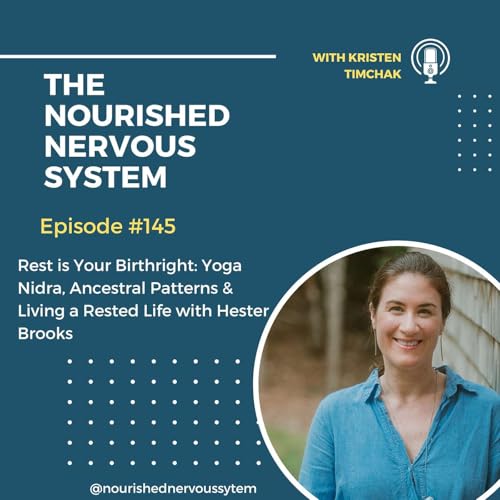
  • Rest is Your Birthright: Yoga Nidra, Ancestral Patterns & Living a Rested Life with Hester Brooks
    Apr 2 2026

    Send us Fan Mail

    In this episode I'm joined by Hester Brooks, a certified Daring to Rest coach and Yoga Nidra facilitator based in Lincolnville, Maine.

    Hester specializes in helping women break the cycle of exhaustion and create a life that truly honors their capacity — and this conversation could not have come at a better time.

    We talk about what it really means to rest (hint: it's not the same as sleep), why so many women struggle to give themselves permission to do it, and how our family lineages shape our relationship to both rest and productivity.

    Hester shares her own journey of discovering Yoga Nidra during a period of major life changes, and how it transformed her sleep, digestion, anxiety, and overall sense of self.

    In this episode we explore:

    • What it means to be a highly sensitive person and why rest is a nervous system necessity
    • The difference between rest and sleep — and why both matter
    • How ancestral patterns and family modeling shape our "rest ethic"
    • What Yoga Nidra is and what to expect from the practice
    • The concept of the "rested voice" and how the way we speak about our lives affects our energy
    • Rested decision-making as a daily practice
    • The difference between resting and living a rested life
    • Why this work is especially important during perimenopause and times of transition

    Resources mentioned:

    • Hester's free 18-minute "I Had a Long Day" Yoga Nidra recording
    • Hester's website
    • Hester's Rest Offerings

    Resources:

    Free Masterclass: The Alchemy of the Perimenopause Portal

    Ayurvedic Dosha Quick Reference Guide

    Abhyanga Self Massage Guide

    Weekend Nervous System Reset

    Nourished For Resilience Workbook


    Find me at www.nourishednervoussystem.com

    and @nourishednervoussytem on Instagram


    Show More Show Less
    34 mins
  • Breaking the Breakfast Rules: An Ayurvedic Approach to the Morning Meal
    Mar 26 2026

    Send us Fan Mail

    I get this question all the time from clients and listeners: what do I eat for breakfast? So in this episode, I'm finally diving in.

    I'll start with my own story — because I was not always a breakfast person. It took a bowl of miso soup at Kripalu in my twenties to crack open my idea of what breakfast could even be. And once I realized I could eat anything for breakfast — soup, roasted vegetables, leftover dinner — everything changed.

    From there we get into the science, because the research around breakfast and cortisol is genuinely fascinating and validates so much of what Ayurveda has been saying for thousands of years. Then we look at breakfast through the Ayurvedic lens — what agni needs in the morning, how to eat for your dosha, and how to shift your breakfast with the seasons.

    This episode is a permission slip to ditch the breakfast rules and start listening to what your body actually needs.

    In this episode:

    • My personal journey from breakfast-skipper to born-again breakfast eater
    • The miso soup moment at Kripalu that changed everything
    • What the research says about cortisol, blood sugar, and skipping breakfast
    • The UC Davis study on breakfast skippers and elevated cortisol
    • A nuanced take on intermittent fasting and how to do it in a way that's easier on your nervous system
    • Agni and the Ayurvedic philosophy of the morning meal
    • Breakfast for Vata, Pitta, and Kapha doshas
    • Seasonal breakfast wisdom — what to eat in fall, winter, spring, and summer
    • Why savory oatmeal is underrated (and delicious)
    • Practical tips for making nourishing breakfasts sustainable and doable
    • This week's small step: one simple question to ask before you reach for your coffee

    Resources mentioned:

    • Dosha episodes: Vata, Pitta, and Kapha deep dives
    • Free Dosha Reference Chart
    • Witbracht et al. (2015). Female breakfast skippers display a disrupted cortisol rhythm and elevated blood pressure. Physiology & Behavior, 140, 215–221. https://pubmed.ncbi.nlm.nih.gov/25545767/

    Resources:

    Free Masterclass: The Alchemy of the Perimenopause Portal

    Ayurvedic Dosha Quick Reference Guide

    Abhyanga Self Massage Guide

    Weekend Nervous System Reset

    Nourished For Resilience Workbook


    Find me at www.nourishednervoussystem.com

    and @nourishednervoussytem on Instagram


    Show More Show Less
    27 mins