The Guilty Files cover art

The Guilty Files

The Guilty Files

By: Paranormal World Productions
Listen for free

About this listen

Welcome to The Guilty Files Podcast, where a former police officer takes you beyond the headlines and deep inside real criminal case files.T his isn’t sensationalized true crime.
It’s the story after the official report. Each case unfolds in two investigative parts, designed to show not just what happened—but what was missed.

True Crime: UncoveredThe factual foundation.Brian reconstructs each case exactly as it happened—step by step, timeline by timeline. Drawing on real law-enforcement experience, he breaks down crime scenes, witness statements, investigative decisions, and procedural missteps with clarity and precision. No speculation. No internet myths.
Just the facts—presented the way investigators see them.

The Redacted ReportThe story they didn’t tell.

Once the facts are laid out, Brian digs into what was overlooked, ignored, or quietly buried. Missing details. Abandoned leads. Evidence that didn’t fit the narrative. The moments where cases veered off course behind closed doors.No conspiracy hype. No sensational claims.

Just careful analysis of the gaps that still raise questions.

The Guilty Files Podcast
Because the truth is rarely simple—and the most important details are often redacted.Copyright Paranormal World Productions LLC
Social Sciences True Crime
Episodes
  • TGF 083 Ottis Toole: The Redacted Report
    Jan 30 2026
    If you listened to Tuesday's episode covering the cold hard facts of the Ottis Toole case, you know the basics. His horrific childhood in Jacksonville's Springfield neighborhood. His partnership with Henry Lee Lucas. His six confirmed murder convictions. His confessions to the Adam Walsh killing. But the basics only scratch the surface of one of the most mishandled investigations in American criminal history.

    This episode of The Redacted Report digs into the dark corners that mainstream coverage leaves out. We expose the Jacksonville detective who was removed from the case after allegedly feeding Toole information about the Walsh murder in exchange for a promised book deal. We examine the controversial Luminol photograph that a retired detective claims shows Adam Walsh's face etched in blood on Toole's car floorboard, and why critics say the image was manipulated to show something that was never really there.

    We reveal the disturbing 1988 letter Toole sent to John and Revé Walsh demanding five thousand dollars in exchange for telling them where their son's body was buried. We play excerpts from the recorded prison phone calls between Toole and Lucas where the two killers casually discussed cannibalism and compared notes on their crimes. We revisit the seventeen-year-old Sears security guard whose decision to kick a group of children out of the store may have placed six-year-old Adam Walsh directly in the path of a predator.

    We also investigate the Jeffrey Dahmer connection that the Hollywood Police Department never adequately addressed. Two credible eyewitnesses independently identified Dahmer as a man they saw at the Hollywood Mall the same day Adam disappeared. Dahmer was living in South Florida at the time and had access to a blue van matching witness descriptions. When FBI Agent Neil Purtell interviewed Dahmer about the case, Dahmer's response haunted him for years.

    This episode examines why the case was closed using an exceptional clearance rather than an actual prosecution, what that administrative maneuver really means, and why Police Chief Chad Wagner admitted at the press conference that the magic wand piece of evidence simply does not exist.

    We discuss the other suspect nobody remembers, a man named Edward James who reportedly confessed to a cellmate and had new seat covers installed in his car weeks after the murder.

    The Ottis Toole case is a study in tunnel vision, lost evidence, competing agendas, and a justice system more interested in closing files than finding truth.
    Show More Show Less
    31 mins
  • TGF 082 Ottis Toole
    Jan 27 2026
    Ottis Elwood Toole claimed to have murdered over one hundred people. While that number remains disputed, what we know for certain is horrifying enough. Six confirmed kills. A partnership with fellow serial killer Henry Lee Lucas that terrorized the American South. And quite possibly the most infamous child murder in American history. Born in Jacksonville, Florida in 1947, Toole emerged from a childhood so brutal it defies comprehension. Sexual abuse by his father starting at age five.

    A mother who dressed him in girl's clothing and paraded him around as the daughter she wished she'd had. A grandmother who took him on midnight trips to rob graves. Every adult in his life either exploited him or looked the other way.None of that excuses what he became.

    Toole drifted through the 1970s leaving a trail of suspicion across multiple states. He was a suspect in murders in Nebraska and Colorado before fleeing back to Florida each time. In 1976, he met Henry Lee Lucas at a Jacksonville soup kitchen, and the two formed a killing partnership that would span years and cross state lines.

    But it was the 1981 murder of six-year-old Adam Walsh that would make Toole's name infamous. Toole confessed to abducting the boy from a Hollywood, Florida Sears store, then recanted, then confessed again. This pattern continued for years while the Hollywood Police Department systematically lost every piece of physical evidence that could have secured a conviction. The bloodstained carpet from his car. The machete. The car itself. All gone.

    Toole died in prison in 1996 without ever being charged in the Walsh case. It took until 2008 for police to officially name him as Adam's killer. This episode examines how a man with a lengthy criminal history and an IQ of 75 managed to evade justice for so long. We explore the systemic failures that allowed him to keep killing, the victims whose names deserve to be remembered, and the legacy of one father's grief that changed how America searches for missing children.

    The Jacksonville Cannibal is a story about monsters. But more importantly, it's a story about the cracks in our system that allow monsters to thrive.
    Show More Show Less
    1 hr and 20 mins
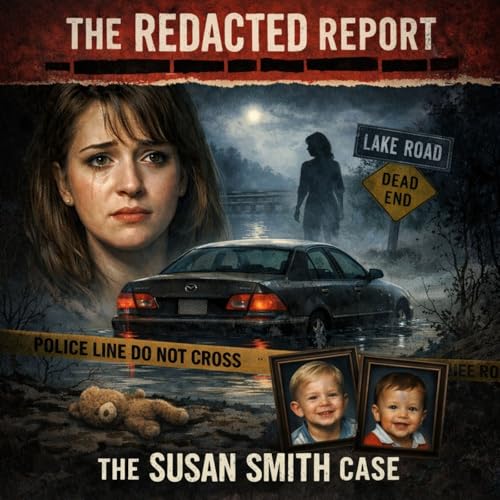
  • TGF 081 Susan Smith: The Redacted Report
    Jan 23 2026
    Earlier this week, you heard the facts about Susan Smith. You heard about the burgundy Mazda rolling into John D. Long Lake. You heard about Michael and Alex. But this episode goes deeper into the details that didn't make the nightly news.We start with Susan's father Harry, who shot himself in the driveway when Susan was six years old, just hours after telling her he loved her. We examine the arrival of stepfather Beverly Russell, a pillar of the community, a Christian Coalition leader, and a predator who began sexually abusing Susan when she was fifteen and continued until just weeks before the murders.

    We reveal that Susan's mother Linda knew about the abuse and chose to stay with Beverly anyway.We uncover Susan's suicide attempt at eighteen, when she reported the abuse to hospital staff and was sent back into the same home with almost no follow-up care. We trace her troubled marriage to David Smith, the affairs on both sides, and the pressure cooker of her relationship with Tom Findlay, the wealthy man's son who told her explicitly that her children were the obstacle to their future together.

    We break down the night of October twenty fifth, including the desperate phone calls Susan made searching for Tom, and the fact that she had visited that same boat ramp the night before. We examine the six minutes the car floated while Susan stood on the shore. We expose the lie about the traffic light at Monarch Mills, a sensor-activated light that couldn't have been red without another car present to trigger it.

    We explore the nine days of deception, Susan's bizarre behavior at parties, her continued calls to Tom Findlay, and the question she asked a reporter that revealed everything: "Did I come across as believable?"

    We cover Beverly Russell's extraordinary courtroom testimony admitting to years of abuse, and the jury's controversial decision to spare Susan's life.This is the full story. The uncomfortable truths. The redacted details that help explain, though never excuse, how a mother could do the unthinkable.
    Show More Show Less
    1 hr and 5 mins
No reviews yet