The Critical Edge Podcast cover art

The Critical Edge Podcast

The Critical Edge Podcast

By: The Critical Edge
Listen for free

Welcome to The Critical Edge, the podcast where cutting-edge trauma surgery and critical care research meets clear, actionable insight—curated by a Harvard-trained, AAST-certified trauma surgeon dual-boarded in Surgical Critical Care and General Surgery.

In each episode, we distill the latest high-impact studies, meta-analyses, and guideline updates—from journals like the Journal of Trauma and Acute Care Surgery, Journal of the American College of Surgeons, World Journal of Surgery, and EAST Practice Management Guidelines—into digestible discussions. Whether it's evolving damage control resuscitation strategies, refined whole blood protocols, updated ERATIC (Enhanced Recovery After Trauma and Intensive Care) recommendations, geriatric trauma management, or debates around REBOA and non-operative approaches to solid organ injuries, we break it down with clinical relevance front and center.

No fluff, no filler—just the evidence that matters right now in the OR, ICU, or trauma bay. Perfect for busy surgeons, fellows, residents, APPs, and intensivists who need to stay sharp without wading through stacks of PDFs.

Join us to sharpen your practice with the critical edge that saves lives. New episodes drop regularly—subscribe today and stay ahead of the curve in this fast-moving field.

Please contact us at: thecriticaledgepodcast@gmail.com


The Critical Edge is for educational and informational purposes only and is not intended to diagnose, treat, cure, or prevent any disease, nor does it substitute for professional medical advice, diagnosis, or treatment from a qualified healthcare provider—always seek in-person evaluation and care from your physician or trauma team for any health concerns.

Copyright 2026 All rights reserved.
Hygiene & Healthy Living Physical Illness & Disease
Episodes
  • Combat Torso Trauma
    Apr 28 2026
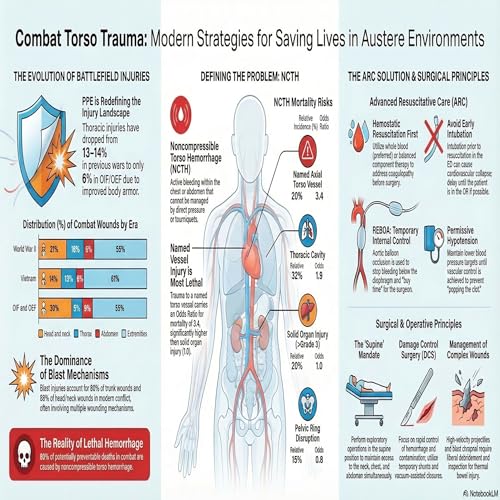
    This episode explores the evolving landscape of combat torso trauma care, highlighting how advancements in body armor and rapid transport have increased the number of survivors reaching medical facilities with severe injuries. The authors emphasize the critical nature of noncompressible torso hemorrhage, which remains a primary cause of preventable death on the battlefield. Effective management requires a disciplined approach, prioritizing whole blood resuscitation and damage control surgery over early intubation or extensive imaging. Modern techniques like REBOA and advanced resuscitative care are increasingly utilized by specialized teams to stabilize patients in austere environments. Furthermore, the source details the unique challenges posed by high-velocity weaponry and improvised explosive devices, which cause complex tissue destruction and multisystem wounds. Ultimately, these military medical insights continue to refine global trauma protocols and drive the development of innovative therapies for life-threatening bleeding. DISCLAIMER The Critical Edge is for educational and informational purposes only and is not intended to diagnose, treat, cure, or prevent any disease, nor does it substitute for professional medical advice, diagnosis, or treatment from a qualified healthcare provider—always seek in-person evaluation and care from your physician or trauma team for any health concerns. Combat Torso Trauma: Clinical Management and Surgical Strategies TOP TEN TAKEAWAYS Lethality of Noncompressible Torso Hemorrhage (NCTH): Active bleeding from abdominal or thoracic structures accounts for 80% of potentially preventable deaths in combat settings.Epidemiological Shifts: While thoracic injuries have declined to approximately 6% due to improved personal protective equipment (PPE), the complexity of injuries remains high, with blasts now accounting for roughly 80% of truncal wounds.The Risk of Early Intubation: Intubation prior to adequate resuscitation in unstable patients frequently leads to cardiovascular collapse and traumatic arrest due to the loss of vascular tone from sedative and vasodilatory medications.Whole Blood Priority: Fresh whole blood (FWB) or low-titer type O whole blood (LTOWB) is the preferred resuscitative product, offering superior hemostatic properties compared to balanced component therapy.Advanced Resuscitative Care (ARC): The ARC protocol focuses on early whole blood administration and the use of Zone 1 Resuscitative Endovascular Balloon Occlusion of the Aorta (REBOA) to control sub-diaphragmatic bleeding.Surgical Positioning and Access: Exploratory operations on the trunk should be performed in the supine position to maintain flexibility for accessing the neck, chest, mediastinum, abdomen, and groin simultaneously.Operative Management of Solid Organ Injuries (SOI): Unlike civilian trauma, combat-related SOIs are typically managed operatively because of limited monitoring capabilities in austere settings and the severity of high-velocity wounding.Blast-Specific Intestinal Damage: Fragments from improvised explosive devices (IEDs) often create thermal injury zones surrounding small bowel defects; these burned areas must be completely excised during repair.Vascular Control for Massive Wounds: For devastating perineal or high-groin injuries, proximal aortoiliac control via laparotomy is often safer and more effective than attempting direct exposure in a distorted, actively bleeding field.The Walking Blood Bank (WBB): In austere environments where component storage is limited, the WBB remains a cornerstone of massive transfusion protocols, utilizing prescreened donors for fresh whole blood. -------------------------------------------------------------------------------- STUDY GUIDE I. Epidemiology and Mechanisms of Injury Combat trauma in the modern era is defined by high-velocity projectiles and explosive devices, most notably the improvised explosive device (IED). The distribution of wounds has shifted significantly since World War II. While head and neck injuries have increased to 30%, thoracic injuries have decreased to 6% in recent conflicts like Operation Iraqi Freedom (OIF). This decline in truncal trauma is largely attributed to the widespread use of hardened vehicles and advanced torso body armor. Despite the lower incidence of thoracic wounds, truncal injuries remain highly lethal. Blast mechanisms now account for approximately 80% of truncal and extremity wounds. These mechanisms produce a combination of primary blast injury, penetrating fragments, blunt trauma (e.g., vehicular rollover), and thermal injury. High-velocity military projectiles also cause significantly more tissue destruction than the low-velocity weapons typically encountered in civilian urban trauma centers. II. Noncompressible Torso Hemorrhage (NCTH) NCTH is defined by anatomic and physiologic criteria, including systolic blood pressure (SBP) < 90 mmHg or the need for ...
    Show More Show Less
    49 mins
  • Ballistics
    Apr 27 2026
    The International Committee of the Red Cross developed these materials to educate diverse professionals on wound ballistics, the scientific study of how projectiles interact with human tissue. Through a combination of a film and a brochure, the organization demonstrates the physical effects of bullets and explosive fragments using reproducible simulants like soap and gelatine. This research is vital for medical practitioners treating trauma, forensic experts determining cause of death, and legal specialists aiming to uphold international humanitarian law. By analyzing variables such as velocity, mass, and bullet stability, the resources illustrate how different weapons cause specific patterns of injury. Ultimately, the work aims to reduce unnecessary suffering by providing military and law enforcement personnel with a clear understanding of the lethal consequences of their equipment. DISCLAIMER The Critical Edge is for educational and informational purposes only and is not intended to diagnose, treat, cure, or prevent any disease, nor does it substitute for professional medical advice, diagnosis, or treatment from a qualified healthcare provider—always seek in-person evaluation and care from your physician or trauma team for any health concerns. Wound Ballistics and Clinical Management: A Comprehensive Study Guide Wound ballistics is the scientific study of the interaction between wounding agents—such as bullets and fragments from explosive weapons—and human tissue. This field of study is critical for a diverse range of professionals, including trauma surgeons, forensic experts, lawyers, and law enforcement officials. Understanding the physical processes of wounding and the subsequent pathophysiological reactions (ballistic trauma) is essential for effective clinical management, legal accountability, and the promotion of international humanitarian law. 1. Fundamentals of Ballistics Theory The severity and characteristics of a wound are primarily determined by the physical properties of the projectile and the velocity at which it strikes the target. The Physics of Kinetic Energy The potential for a projectile to cause damage is rooted in its kinetic energy. This energy is calculated using the formula: E (joules) = mv^2/2 m = mass (kg)v = velocity (m/s) Because velocity is squared in this equation, incremental increases in speed generate significantly more kinetic energy than equivalent increases in the mass of the projectile. Determinants of Wound Production Muzzle Velocity: The speed of the bullet as it exits the barrel. This is influenced by the bullet's caliber (diameter), the capacity of the casing (amount of powder), and the length of the weapon's barrel.Velocity Degradation: While velocity increases rapidly within the barrel, it gradually slows upon exiting due to air resistance.Bullet Characteristics: Mass, shape (profile), and deformability are critical. Heavier elements like lead are standard due to their mass, but their softness makes them prone to deformation.Rifling and Twist: Internal spiraling grooves in a barrel (rifling) impart a spin to the bullet, providing stability in flight. The twist length refers to the distance required for one full turn of the spiral. Projectile Stability in Flight A bullet in flight rotates around its long axis between 1,500 and 6,000 times per second. Its stability is influenced by: Precession: The rotation of the bullet's tip around the center of mass.Nutation: The small, circular movement of the bullet's tip.Yaw: The tendency of a bullet to tumble or turn sideways.Range Impact: Bullets are generally stable for the first meter after exiting the barrel, then enter a phase of low stability before becoming increasingly stable again. Stable, non-expanding bullets typically create long, narrow tracks initially, whereas bullets with low stability turn rapidly upon impact, depositing energy earlier in the wound track. 2. Mechanisms of Tissue Injury When a projectile enters the body, it performs "work" on the tissue, resulting in two distinct types of cavities. Permanent Cavity The permanent cavity is the path of direct tissue destruction created by the projectile. The tissue in this path is lacerated and crushed. The depth and degree of this crush are determined by the amount of kinetic energy transferred to the tissue. Temporary Cavity The temporary cavity is formed by the lateral displacement of adjacent tissues as the projectile forces its way through the body. This force can affect an area many times larger than the diameter of the bullet.The clinical importance of the temporary cavity depends on tissue elasticity. For example, the rapid displacement of chest tissue can cause significant pulmonary contusion. Energy Deposition The rate at which energy is transferred depends on the area of contact between the projectile and the tissue. A bullet traveling tip-first may deposit little energy initially; however, if it ...
    Show More Show Less
    56 mins
  • Battlefield Medical Systems
    Apr 26 2026
    This episode chronicles the long-standing evolution of battlefield medicine, tracing its growth from ancient surgical techniques to the sophisticated Joint Trauma System used today. It highlights how major conflicts, from the American Civil War to the wars in Iraq and Afghanistan, spurred innovations in triage, rapid evacuation, and data-driven performance improvement. The authors describe a transition from focusing solely on individual wounds to establishing a comprehensive continuum of care that integrates prehospital aid with long-term rehabilitation. A significant portion of the source advocates for a national trauma system that blends military and civilian expertise to eliminate preventable deaths at home and abroad. Furthermore, it explains how the Department of Defense engages in global health initiatives to help partner nations develop their own emergency medical infrastructures. Ultimately, the source emphasizes that a unified, learning health system is essential for maintaining readiness against future medical crises and large-scale disasters. DISCLAIMER The Critical Edge is for educational and informational purposes only and is not intended to diagnose, treat, cure, or prevent any disease, nor does it substitute for professional medical advice, diagnosis, or treatment from a qualified healthcare provider—always seek in-person evaluation and care from your physician or trauma team for any health concerns. Comprehensive Study Guide: Evolution and Architecture of Military Trauma Systems This study guide provides a detailed synthesis of the historical development, organizational structure, and clinical advancements of military trauma systems, with a particular focus on the transition toward an integrated national trauma care framework. I. Historical Evolution of Battlefield Medicine The preparation for and care of battlefield casualties has evolved from isolated surgical techniques to integrated, data-driven systems. Early History and Individual Care Ancient Foundations: The earliest written reports of battlefield care are found in the Egyptian Edwin Smith Papyrus. Early Greek and Roman contributions included Hippocrates' teachings on wound suppuration and Galen’s novel techniques for suturing intestines and trepanning the skull.Middle Ages to the 18th Century: French surgeons Henri de Monteville and Guy De Chauliac advanced surgical techniques, followed by Ambroise Paré’s "healing salve" and Jean Louis Petit’s screw tourniquet.Early United States: In 1775, the Second Continental Congress established the Hospital Department of the Army, appointing John Morgan as Director. While Morgan attempted to centralize care in general hospitals, the system suffered from poor resource availability. The 19th Century: Triage and Transport Dominique Jean Larrey: During the Napoleonic Wars, Larrey invented the "flying ambulance," which allowed for treatment during battle. He also developed the first triage system, prioritizing treatment based on the extent of injury rather than military rank.Jonathan Letterman: Known as the "Father of Modern Battlefield Medicine," Letterman developed a formal Army Ambulance Corp during the U.S. Civil War and instituted a triage system to ensure expeditious transport of casualties. The 20th Century: System Integration and Technology World War I: Russian surgeon Vladimir Oppel developed the first integrated system of echelons of care. He advocated for the "right operation for the right patient at the right location at the right time," moving surgical care closer to the point of injury.World War II: The conflict saw the creation of Auxiliary Surgical Groups (mobile units) and the advent of large-scale transcontinental aeromedical evacuation.The Korean War: Groundbreaking advancements included the use of helicopter evacuations to navigate rocky terrain and the establishment of Mobile Army Surgical Hospitals (MASH).The Vietnam War: Helicopter evacuation reached maturity, and Major Norman Rich developed the Vietnam Vascular Registry, the first trauma research registry of its kind, providing longitudinal follow-up for patients. II. The Joint Trauma System (JTS) Framework Modern military trauma care is managed through the Joint Trauma System, which transitioned from a single-service initiative to a Department of Defense (DoD)-level organization. Organizational Development Establishment: Post-9/11 initiatives led to the 2003 Theater Trauma Registry and the 2004 Joint Theater Trauma System (JTTS). The JTS was formally established as an enduring entity in 2011 and designated a Defense Center of Excellence in 2013.DHA Integration: The 2017 National Defense Authorization Act (NDAA) directed the JTS to be established within the Defense Health Agency (DHA).Core Responsibilities: The JTS serves as the reference body for Military Health System (MHS) trauma care, establishes standards for military medical treatment facilities (MTFs), and translates research ...
    Show More Show Less
    52 mins
adbl_web_anon_alc_button_suppression_t1
No reviews yet