Combat Torso Trauma cover art

Combat Torso Trauma

Combat Torso Trauma

Listen for free

View show details
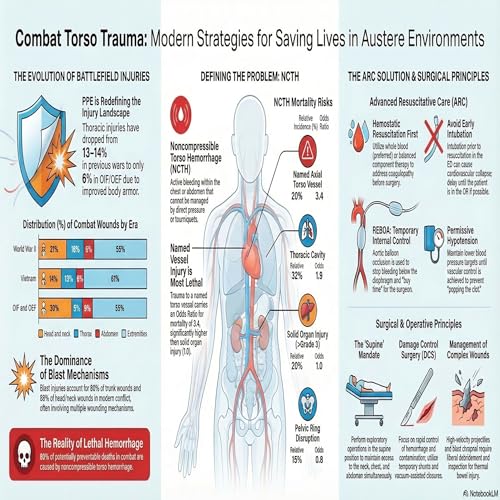
This episode explores the evolving landscape of combat torso trauma care, highlighting how advancements in body armor and rapid transport have increased the number of survivors reaching medical facilities with severe injuries. The authors emphasize the critical nature of noncompressible torso hemorrhage, which remains a primary cause of preventable death on the battlefield. Effective management requires a disciplined approach, prioritizing whole blood resuscitation and damage control surgery over early intubation or extensive imaging. Modern techniques like REBOA and advanced resuscitative care are increasingly utilized by specialized teams to stabilize patients in austere environments. Furthermore, the source details the unique challenges posed by high-velocity weaponry and improvised explosive devices, which cause complex tissue destruction and multisystem wounds. Ultimately, these military medical insights continue to refine global trauma protocols and drive the development of innovative therapies for life-threatening bleeding. DISCLAIMER The Critical Edge is for educational and informational purposes only and is not intended to diagnose, treat, cure, or prevent any disease, nor does it substitute for professional medical advice, diagnosis, or treatment from a qualified healthcare provider—always seek in-person evaluation and care from your physician or trauma team for any health concerns. Combat Torso Trauma: Clinical Management and Surgical Strategies TOP TEN TAKEAWAYS Lethality of Noncompressible Torso Hemorrhage (NCTH): Active bleeding from abdominal or thoracic structures accounts for 80% of potentially preventable deaths in combat settings.Epidemiological Shifts: While thoracic injuries have declined to approximately 6% due to improved personal protective equipment (PPE), the complexity of injuries remains high, with blasts now accounting for roughly 80% of truncal wounds.The Risk of Early Intubation: Intubation prior to adequate resuscitation in unstable patients frequently leads to cardiovascular collapse and traumatic arrest due to the loss of vascular tone from sedative and vasodilatory medications.Whole Blood Priority: Fresh whole blood (FWB) or low-titer type O whole blood (LTOWB) is the preferred resuscitative product, offering superior hemostatic properties compared to balanced component therapy.Advanced Resuscitative Care (ARC): The ARC protocol focuses on early whole blood administration and the use of Zone 1 Resuscitative Endovascular Balloon Occlusion of the Aorta (REBOA) to control sub-diaphragmatic bleeding.Surgical Positioning and Access: Exploratory operations on the trunk should be performed in the supine position to maintain flexibility for accessing the neck, chest, mediastinum, abdomen, and groin simultaneously.Operative Management of Solid Organ Injuries (SOI): Unlike civilian trauma, combat-related SOIs are typically managed operatively because of limited monitoring capabilities in austere settings and the severity of high-velocity wounding.Blast-Specific Intestinal Damage: Fragments from improvised explosive devices (IEDs) often create thermal injury zones surrounding small bowel defects; these burned areas must be completely excised during repair.Vascular Control for Massive Wounds: For devastating perineal or high-groin injuries, proximal aortoiliac control via laparotomy is often safer and more effective than attempting direct exposure in a distorted, actively bleeding field.The Walking Blood Bank (WBB): In austere environments where component storage is limited, the WBB remains a cornerstone of massive transfusion protocols, utilizing prescreened donors for fresh whole blood. -------------------------------------------------------------------------------- STUDY GUIDE I. Epidemiology and Mechanisms of Injury Combat trauma in the modern era is defined by high-velocity projectiles and explosive devices, most notably the improvised explosive device (IED). The distribution of wounds has shifted significantly since World War II. While head and neck injuries have increased to 30%, thoracic injuries have decreased to 6% in recent conflicts like Operation Iraqi Freedom (OIF). This decline in truncal trauma is largely attributed to the widespread use of hardened vehicles and advanced torso body armor. Despite the lower incidence of thoracic wounds, truncal injuries remain highly lethal. Blast mechanisms now account for approximately 80% of truncal and extremity wounds. These mechanisms produce a combination of primary blast injury, penetrating fragments, blunt trauma (e.g., vehicular rollover), and thermal injury. High-velocity military projectiles also cause significantly more tissue destruction than the low-velocity weapons typically encountered in civilian urban trauma centers. II. Noncompressible Torso Hemorrhage (NCTH) NCTH is defined by anatomic and physiologic criteria, including systolic blood pressure (SBP) < 90 mmHg or the need for ...
adbl_web_anon_alc_button_suppression_t1
No reviews yet