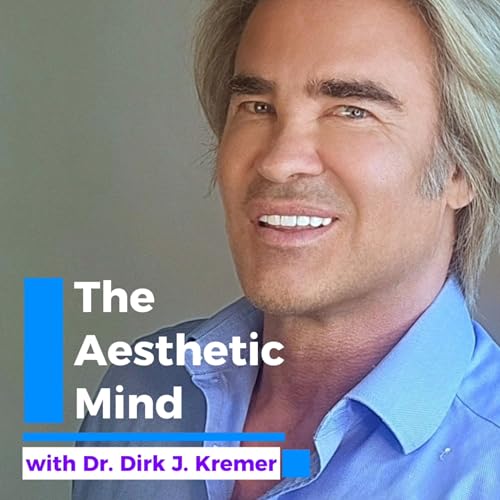
• Episode 10: The Face Is Not A Biography
    May 27 2026

    In this episode of The Aesthetic Mind, Dr. Dirk J. Kremer challenges one of the most persistent ideas surrounding ageing: the belief that the face tells a life story — and that changing it somehow means erasing something meaningful.

    We often hear that wrinkles reflect wisdom, suffering, joy, or experience. That the ageing face becomes a kind of emotional biography. But is that actually true?

    Drawing from both medical reality and years of observing patients, Dr. Kremer explores the difference between poetic narratives and biological ageing. Genetics, skin quality, tissue strength, fat distribution, and decades of repetitive facial movement shape the ageing face far more than the emotional events of a person’s life.

    This episode also examines something deeper: why so many people feel emotionally disconnected from their ageing reflection. Not because they are denying age, but because they no longer recognise the face they have identified with for most of their adult life.

    Far from being an attempt to “erase a story,” aesthetic surgery is explored here as something more subtle — an effort to preserve continuity, familiarity, and the alignment between inner identity and outer appearance.

    A reflective and thought-provoking conversation about ageing, authenticity, perception, and the psychology of recognition.

    Show More Show Less
    7 mins
  • Episode 9: When Grieving Delays Healing
    May 2 2026

    In this episode of The Aesthetic Mind, Dr. Dirk J. Kremer explores a rarely discussed aspect of recovery after facial surgery: the influence of emotional stress on healing.

    Using the story of a patient whose recovery was affected by unexpected grief, he reflects on why even a technically successful procedure may not immediately reveal its full result.

    What appears to be a surgical issue is often something else entirely.

    This episode explains how physiological changes — including elevated cortisol levels, altered circulation, and increased inflammation — can subtly affect the healing process after procedures such as facelift or eyelid surgery. These changes may temporarily influence swelling, skin quality, and facial expression, creating a result that feels “not quite right” in the early stages.

    More importantly, it explores how emotional state and physical recovery are closely connected — and why healing is not always linear.

    A thoughtful reflection on patience, perception, and the relationship between the body, the mind, and the face.

    Show More Show Less
    8 mins
  • Episode 8: When The Mirror Lies: A Surgeon’s Experience With Dysmorphia
    Mar 26 2026

    In this deeply personal episode of The Aesthetic Mind, Dr. Dirk J. Kremer explores one of the most challenging and misunderstood aspects of aesthetic surgery: body dysmorphia.

    Through the lens of real clinical experience, he reflects on what happens when a technically successful result is perceived as failure — not because of the surgery, but because of the patient’s internal reality.

    This episode moves beyond technique and into psychology, revealing the quiet tension between what is objectively visible and what is emotionally felt.

    It is an honest and nuanced look at the limits of surgery, the complexity of perception, and the moments where the mirror no longer reflects truth — but fear.

    Show More Show Less
    12 mins
  • Episode 7: The Loneliness Of Looking Good
    Feb 26 2026

    We often assume beauty protects people — from rejection, insecurity, even from suffering.
    But what if the opposite is sometimes true?

    In this episode, Dr. Dirk J. Kremer explores a rarely discussed emotional paradox: how looking good can quietly create distance instead of connection. Why attractive people are often judged before they are known, why ageing can feel like losing a place in the world rather than losing youth, and why admiration does not always translate into belonging.

    Through reflections from the consultation room — and a personal perspective — this episode examines the psychological weight of being reduced to appearance, the pressure to remain recognisable to others, and the unexpected loneliness that can exist behind an admired face.

    Because beauty may give visibility…
    but it does not always give understanding.

    Show More Show Less
    12 mins
  • Episode 6: Ageing With Grace
    Jan 28 2026

    “Aging with grace” is a phrase we hear everywhere — often spoken with admiration, sometimes with quiet judgment. But what does it actually mean?

    In this episode of The Aesthetic Mind, Dr. Dirk J. Kremer explores the complexity behind this seemingly gentle idea. He reflects on how “aging with grace” is frequently misunderstood — framed as moral superiority, restraint, or doing nothing at all. And he asks a more uncomfortable question: how many of us could truly watch our appearance change year after year without being emotionally touched by it?

    To age without intervention requires a philosopher’s mindset — an extraordinary capacity to detach from the mirror, from loss, from visibility. Most people are not philosophers. Most people simply want to feel at ease in their own skin.

    This episode reframes aging with grace not as passivity, but as agency. Grace, Dr. Kremer suggests, lies in the freedom to choose: choosing to do nothing, choosing to intervene, choosing what feels right for you — without shame, fear, or borrowed ideals.

    A reflective, honest conversation about aging, judgment, autonomy, and the quiet courage it takes to age on your own terms.

    Show More Show Less
    12 mins
  • Episode 5: What people really mean when they say they want to look 'fresher'
    Jan 1 2026

    In this thoughtful episode, Dr. Dirk J. Kremer explores one of the most common phrases in aesthetic medicine — and reveals the deeper emotional truth behind it.

    “Freshness” is rarely about looking younger. It’s about recognising yourself again. It’s about the subtle moment when your reflection feels slightly out of sync with your inner identity — a heaviness, tiredness, or sadness the face shows even when you don’t feel that way inside.

    Drawing on two decades of surgical experience, Dr. Kremer explains why patients struggle to name this feeling, why “fresh” has become the universal shortcut for emotional alignment, and how modern facial rejuvenation can restore clarity, vitality, and authenticity rather than change someone’s appearance.

    A reflective, intimate look at ageing, identity, and the quiet wish to feel like yourself again — told through the lens of one deceptively simple word.

    Show More Show Less
    10 mins
  • Episode 4: Why I Started This
    Dec 11 2025

    In this episode of The Aesthetic Mind, Dr. Dirk J. Kremer steps into the personal origin of his work — and into the quiet reasons behind this podcast.

    Long before training, there was an early awareness of ageing, change, and the emotional weight carried by the human face. Alongside this grew a constant instinct for making things by hand — for patience, structure, and precision. Over time, these two strands slowly converged into a single, deliberate path: facial surgery. Medical school was never a detour. It was a direction chosen early — and followed with intention.

    With experience came another clarity: that aesthetic surgery remains one of the most misunderstood fields of medicine. It is easy to dismiss it as superficial. Much harder to see the emotional truth beneath it — the tension between the inner sense of self and the face that meets the world each morning.

    This episode is about why The Aesthetic Mind had to be created.
    To speak about what usually stays unspoken.
    To give language to the psychological space behind aesthetic change.
    And to offer a quieter, more honest way of understanding why people choose it.

    Not as spectacle.
    Not as judgement.
    But as human reality.

    Show More Show Less
    9 mins
  • Episode 3: The Morning After The Bandages
    Nov 15 2025

    There is a moment in every aesthetic journey that almost no one talks about. It is quiet, private, unseen. Not the surgery itself, not the dramatic reveal, not the before-and-after photos that people obsess over — but the small, intimate morning when the bandages come off.

    In this reflective episode, Dr. Dirk J. Kremer explores what really happens in that moment when a patient sits in front of the mirror and sees a new version of themselves. It is not about shock or perfection; it is about recognition. About reconnecting the inner self with the outer reflection after months — sometimes years — of hesitation, doubt, or quiet longing.

    Dr. Kremer looks at the psychological landscape of this moment: the hope, the vulnerability, the relief, the fear of being disappointed, the wish to feel “aligned” again. He explores how surgery is rarely about looking different — it is about returning to oneself, clearing the fog, and removing the noise that has built up over time as ageing slowly shifted the face away from the person someone still feels they are inside.

    The morning after the bandages reveals something surprising: that healing is not just physical. There is a reorganisation of identity, a quiet recalibration between how someone feels and what they see. Many patients whisper the same sentence, again and again: “This feels like me.”

    This episode reflects on the emotional intimacy of this moment. The gentleness required. The trust patients place in their surgeon. And the profound shift that happens when the face and the inner self finally speak the same language again.

    Dr. Kremer also discusses the early emotional reactions — the swell of relief, the sudden softness, even the temporary uncertainty as the face begins its healing journey. He examines why these early days matter: because they set the foundation for the psychological integration that follows.

    “The Morning After the Bandages” is not about spectacle. It is about humanity. It is about the quiet dignity of someone reclaiming their reflection. It is about the subtle, fragile beauty of seeing yourself clearly again, without the distraction of time.

    A slow, intimate meditation on the moment when transformation becomes real — not through perfection, but through recognition.

    Show More Show Less
    9 mins