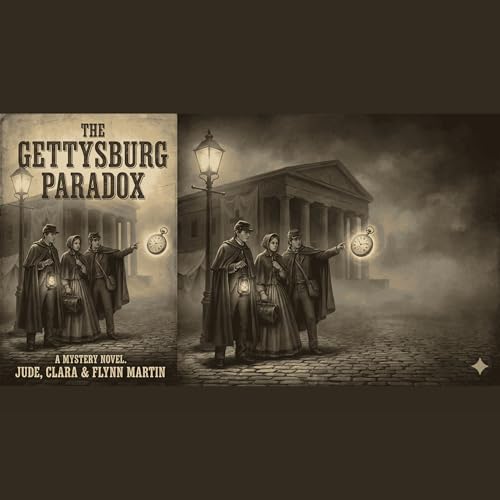
Martin Mysteries cover art

Martin Mysteries

Martin Mysteries

By: Dean Martin
Listen for free

About this listen

Follow the Martin Siblings on a Wild AdventureDean Martin Drama & Plays Literature & Fiction
Episodes
  • Chapter One: The Thunder That Wasn’t Thunder
    Jan 15 2026
    Flynn Martin woke to the smell of smoke and the taste of dirt. His cheek pressed against something cold and wet—leaves, he realized, as his eyes fluttered open. Dead leaves, brown and rotting, carpeting a forest floor he didn’t recognize. His head throbbed like someone had stuffed a bass drum inside his skull and was pounding out a rhythm only pain could hear. Where am I? He pushed himself up on shaking arms, and that’s when he heard it—a sound like thunder, but wrong somehow. Too sharp. Too close together. And underneath it, something worse: screaming. Flynn scrambled backward, his sneakers slipping on the damp ground. Through the trees, maybe two hundred yards away, he could see smoke rising in thick gray columns. Figures moved through the haze—running, falling, some of them not getting back up. That’s not thunder, his brain finally supplied, catching up to what his ears already knew. Those are gunshots. Another boom, louder than the rest, shook the ground beneath him. Flynn threw himself behind a massive oak tree, pressing his back against the rough bark, breathing so hard he thought his lungs might burst. Think, he commanded himself. Think, think, think. The last thing he remembered was Papa’s workshop. The converted barn behind his grandfather’s farmhouse in rural Pennsylvania, cluttered with tools and wire and pieces of equipment Flynn couldn’t name. Clara had been there, holding a wrench, her dark braids swinging as she leaned over something mechanical. And Jude—where was Jude? Flynn squeezed his eyes shut, trying to grab hold of the memory, but it slipped away like water through his fingers. He risked a glance around the tree trunk. The battle—because that’s what it was, he understood now, an actual battle—seemed to be moving away from him, the sounds of combat drifting eastward. But the smoke still hung thick in the air, and somewhere in the distance, a horse screamed. I need to move. Flynn forced his legs to work, staying low as he crept through the underbrush in the opposite direction of the fighting. Branches scratched at his face and caught at his jacket—his favorite blue hoodie, now torn at the sleeve and covered in mud. He didn’t care. He just needed to get away, find somewhere safe, figure out what was happening. That’s when he saw the wreckage. It lay in a small clearing, scattered across the forest floor like the remains of some mechanical beast. Twisted copper pipes. Shattered glass that caught the weak sunlight filtering through the leaves. A control panel, cracked down the middle, still sparking weakly. Flynn’s heart stopped. He knew that control panel. He’d watched Papa build it over the past three months, carefully soldering each connection while explaining the theory behind temporal displacement in terms a twelve-year-old could almost understand. “The key is the caesium oscillator,” Papa had said, his wild white hair sticking up at odd angles as it always did when he was excited. “It creates a frequency that, when properly amplified, can theoretically punch a hole in the fabric of spacetime itself.” Flynn had nodded like he understood. He mostly didn’t. But he understood enough to know that what lay scattered before him now was the remains of Papa’s time machine. And that meant— “Clara,” Flynn whispered. Then louder: “CLARA! JUDE!” No answer. Just the distant pop-pop-pop of gunfire and the rustle of wind through branches. Flynn dropped to his knees beside the wreckage, searching frantically through the debris. Papa’s leather journal—ruined, the pages soaked with something that might have been rain or might have been worse. A pocket watch, its face shattered, hands frozen at 3:47. The brass housing of the caesium oscillator itself, dented but somehow still intact. But no Clara. No Jude. No Papa. They could be anywhere, Flynn realized, and the thought hit him like a physical blow. Anywhen*.* A twig snapped behind him. Flynn spun, grabbing the first thing his hand found—a length of copper pipe, bent but solid—and raised it like a weapon. The man who emerged from the trees was tall and thin, dressed in a blue uniform coat that hung loose on his bony frame. His face was gaunt, shadowed by a beard that looked like it hadn’t seen a razor in weeks, and his eyes were the pale gray of old ice. A rifle was slung over his shoulder, and a red-stained bandage wrapped around his left hand. “Easy there, son,” the man said, holding up his good hand, palm out. “I ain’t looking to harm you.” Flynn didn’t lower the pipe. “Who are you?” “Corporal Thomas Whitfield, 20th Maine Volunteer Infantry.” The man’s eyes swept over Flynn, taking in his strange clothes, his muddy sneakers, the copper pipe clutched in his white-knuckled grip. “Question is, who are you? And what in the name of the Almighty are you doing out here dressed like that?” Flynn’s mind raced. 20th Maine. Civil War. But which battle? Which day?...
    Show More Show Less
    14 mins
  • Chapter Two: The Girl in the Barn
    Jan 15 2026
    Clara Martin had always been the practical one. When Jude got lost in his books and Flynn got lost in his video games, Clara was the one who remembered to feed the dog, who set reminders for homework assignments, who made sure everyone had their lunch boxes before the bus came. Being the middle child didn’t mean being the least responsible—at least not in the Martin family. But nothing in twelve years of practical experience had prepared her for waking up in the middle of the nineteenth century. She’d been alone when she came to, lying in a field of tall grass with the sun beating down on her face and the sound of distant explosions rattling her teeth. It had taken her twenty minutes to find the road, another hour to find the farm, and every second of that time she’d spent fighting down the panic that threatened to swallow her whole. Flynn and Jude are out there somewhere, she’d told herself over and over. You’ll find them. You just have to stay calm. Easier said than done when cannons were firing in the distance and soldiers in blue were streaming past in organized chaos, some of them staring at her jeans and sneakers like she’d dropped down from the moon. Now she sat on an overturned crate in the Weikert barn, wrapping bandages around the arm of a young Union private who couldn’t have been more than seventeen. His name was James, and he kept apologizing for the blood he was getting on her hands. “It’s fine,” Clara said for the fourth time. “Really. It doesn’t bother me.” This was a lie. It bothered her a lot. But what was she supposed to do—refuse to help? “Where’d you say you were from again?” James asked, wincing as she tied off the bandage. “Pennsylvania.” At least that part was true. “Near… Harrisburg.” “City girl, huh?” James tried to smile, but it came out more like a grimace. “Never been there myself. Always wanted to, though. Hear they’ve got theaters and everything.” Clara was trying to formulate a response when the barn door swung open and a figure rushed in, silhouetted against the bright afternoon sun. “Clara!” She knew that voice. She’d know it anywhere. “Flynn!” She was off the crate and running before she could think, throwing her arms around her brother so hard she nearly knocked him over. “Oh my Goodness, Flynn, I thought—I didn’t know if—” “I’m okay.” Flynn hugged her back just as fiercely. “I’m okay. Are you hurt? What happened? Where’s Jude?” Clara pulled back, shaking her head. “I don’t know. I woke up alone in a field. I haven’t seen him. I haven’t seen anyone except—” She stopped. “Wait. Have you seen Jude?” “No.” Flynn’s face was pale under the dirt and scratches. “I woke up near the battle. Found what’s left of the time machine. It’s destroyed, Clara. Completely destroyed.” The practical part of Clara’s brain filed that information away for later panic. Right now, they had more immediate problems. “Mrs. Weikert told me something weird,” Flynn continued, lowering his voice even though James and the other wounded soldiers were too far away to hear. “About a letter. She said you had a letter?” Clara had almost forgotten about the letter. She reached into the pocket of her jacket—her favorite denim jacket, now covered in grass stains and splashes of blood that weren’t hers—and pulled out the folded document. The paper was old, brownish at the edges, and part of one corner had been burned away. But the writing was still legible: elegant, looping script that Clara couldn’t read no matter how hard she squinted. “I found it in my pocket when I woke up,” she said. “I don’t know where it came from. I don’t remember picking it up.” Flynn took the letter, unfolding it carefully. His eyes scanned the text, and Clara watched his face go from confused to shocked to something close to afraid. “This is dated July 4th, 1863,” he said slowly. “Three days from now.” “How is that possible? We just got here.” “I don’t know. But Clara—” Flynn looked up at her. “This letter is warning President Lincoln about an assassination attempt. Here, at Gettysburg. On Independence Day.” Clara’s stomach dropped. “But Lincoln wasn’t assassinated at Gettysburg. Everyone knows that. He was killed at Ford’s Theatre in 1865.” “Exactly.” Flynn folded the letter and handed it back to her. “So either this letter is a fake, or…” “Or something changed,” Clara finished. “Something changed the timeline.” They stared at each other, the weight of that possibility hanging between them. “We need to find Jude,” Flynn said finally. “And we need to figure out where this letter came from. But first, we need to—” “Children.” They both jumped. Mrs. Weikert stood in the barn doorway, her face grim. Beside her was a man Clara hadn’t seen before: tall, broad-shouldered, wearing a Union officer’s uniform with a general...
    Show More Show Less
    14 mins
  • Chapter Three: The Confederate Camp
    Jan 17 2026
    Jude Martin woke in darkness, and for a moment he thought he was dead. Then the pain hit—a throbbing ache in his skull, a burning sensation across his ribs, the sharp protest of muscles that had been pushed far beyond their limits—and he decided that death probably wouldn’t hurt this much. He was lying on something scratchy. Straw, his brain supplied after a moment. He was lying on straw, in near-total darkness, and somewhere close by, someone was groaning. Jude tried to sit up. The world spun. He lay back down. Okay, he thought. One thing at a time. Where am I? He could hear voices outside—low, murmured conversations in accents he didn’t quite recognize. Southern, maybe? And underneath the voices, other sounds: the creak of wagon wheels, the stamp of horses, the distant pop of what he was pretty sure was gunfire. Memories came back in fragments. Papa’s workshop. The time machine humming to life. Clara’s face, lit up with excitement. Flynn’s voice saying something Jude couldn’t quite remember. And then— Nothing. Just blackness, and the smell of smoke, and a sensation like falling through infinite space. “You awake over there, son?” Jude’s whole body tensed. The voice came from somewhere to his left, rough and tired but not unkind. “Who’s there?” A chuckle. “Could ask you the same question. But I’ll go first. Name’s Private William Tucker, 15th Alabama Infantry. Currently a prisoner of the United States Army, same as you—except I know how I got here, and I got a suspicion you don’t.” Jude’s eyes were adjusting to the darkness now. He could make out shapes: the walls of a barn, the slats of light coming through gaps in the wooden boards, the form of a man sitting against the opposite wall with his legs stretched out in front of him. “I’m not a prisoner,” Jude said automatically. “That so?” Tucker sounded amused. “Then why are you locked in a barn surrounded by Union guards?” Fair point. Jude pushed himself up again, slower this time, fighting through the dizziness. “Where are we?” “Few miles east of Gettysburg, best I can tell. Yanks picked us up after yesterday’s fighting—me and about thirty others.” Tucker paused. “And you. Though damned if anyone knows where you came from.” “I don’t understand. I’m not a soldier. I’m fourteen.” “Didn’t say you were a soldier, son. Said you were a prisoner. Two different things.” Tucker shifted, and Jude heard him wince. “Yanks found you unconscious near the creek, dressed in clothes nobody’s ever seen before. They figured you were a Reb spy—young ones make the best scouts, they say. Brought you here with the rest of us.” Jude’s head was pounding, but pieces were starting to fall into place. The time machine had malfunctioned. He’d been thrown into the past—Civil War, obviously, probably Gettysburg based on what Tucker had said. But he’d landed behind Confederate lines, and now the Union thought he was a spy. Which meant Clara and Flynn were somewhere else. Maybe somewhere close, maybe not. And he had no way to find them. “I’m not a spy,” Jude said. “Figured as much. No offense, but you don’t exactly look the type.” “What do I look like?” Tucker was quiet for a moment. “Lost,” he said finally. “Scared. Looking for someone.” Jude felt tears prick at his eyes and blinked them back furiously. “My brother and sister. We got separated.” “Ah.” Tucker’s voice softened. “That’s hard. This war’s separated a lot of families. I’ve got two boys back home—seven and nine. Haven’t seen them in eight months.” “I’m sorry.” “Me too.” A long pause. “What’s your name, son?” “Jude. Jude Martin.” “Well, Jude Martin, here’s the situation as I see it. We’re locked in this barn until the Yanks figure out what to do with us. Tomorrow, maybe the day after, they’ll probably march us to some prison camp up north. Your brother and sister—if they’re out there, and if they’re looking for you—they’d have to find you before then.” “That’s not a lot of time.” “No. It’s not.” Jude pulled his knees up to his chest, wrapping his arms around them. His jacket pocket crinkled, and he remembered—Papa’s backup notes. A small notebook, thin enough to fit in a pocket, containing simplified versions of the equations and schematics needed to operate the time machine. Papa had insisted they each carry one, “just in case.” Just in case of exactly this, apparently. Jude pulled out the notebook. Even in the dim light, he could make out Papa’s handwriting, cramped but legible. Most of it didn’t make sense to him—he was smart, but he wasn’t a genius… temporal mechanics wasn’t exactly covered in ninth-grade science—but there was one section he remembered Papa explaining: EMERGENCY BEACON: The caesium oscillator contains a low-power transmitter that can be activated manually. If separated from the...
    Show More Show Less
    11 mins
No reviews yet