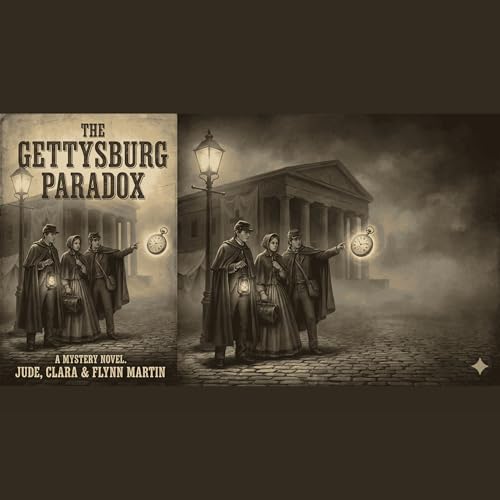
Chapter One: The Thunder That Wasn’t Thunder cover art

Chapter One: The Thunder That Wasn’t Thunder

Chapter One: The Thunder That Wasn’t Thunder

Listen for free

View show details

About this listen

Flynn Martin woke to the smell of smoke and the taste of dirt. His cheek pressed against something cold and wet—leaves, he realized, as his eyes fluttered open. Dead leaves, brown and rotting, carpeting a forest floor he didn’t recognize. His head throbbed like someone had stuffed a bass drum inside his skull and was pounding out a rhythm only pain could hear. Where am I? He pushed himself up on shaking arms, and that’s when he heard it—a sound like thunder, but wrong somehow. Too sharp. Too close together. And underneath it, something worse: screaming. Flynn scrambled backward, his sneakers slipping on the damp ground. Through the trees, maybe two hundred yards away, he could see smoke rising in thick gray columns. Figures moved through the haze—running, falling, some of them not getting back up. That’s not thunder, his brain finally supplied, catching up to what his ears already knew. Those are gunshots. Another boom, louder than the rest, shook the ground beneath him. Flynn threw himself behind a massive oak tree, pressing his back against the rough bark, breathing so hard he thought his lungs might burst. Think, he commanded himself. Think, think, think. The last thing he remembered was Papa’s workshop. The converted barn behind his grandfather’s farmhouse in rural Pennsylvania, cluttered with tools and wire and pieces of equipment Flynn couldn’t name. Clara had been there, holding a wrench, her dark braids swinging as she leaned over something mechanical. And Jude—where was Jude? Flynn squeezed his eyes shut, trying to grab hold of the memory, but it slipped away like water through his fingers. He risked a glance around the tree trunk. The battle—because that’s what it was, he understood now, an actual battle—seemed to be moving away from him, the sounds of combat drifting eastward. But the smoke still hung thick in the air, and somewhere in the distance, a horse screamed. I need to move. Flynn forced his legs to work, staying low as he crept through the underbrush in the opposite direction of the fighting. Branches scratched at his face and caught at his jacket—his favorite blue hoodie, now torn at the sleeve and covered in mud. He didn’t care. He just needed to get away, find somewhere safe, figure out what was happening. That’s when he saw the wreckage. It lay in a small clearing, scattered across the forest floor like the remains of some mechanical beast. Twisted copper pipes. Shattered glass that caught the weak sunlight filtering through the leaves. A control panel, cracked down the middle, still sparking weakly. Flynn’s heart stopped. He knew that control panel. He’d watched Papa build it over the past three months, carefully soldering each connection while explaining the theory behind temporal displacement in terms a twelve-year-old could almost understand. “The key is the caesium oscillator,” Papa had said, his wild white hair sticking up at odd angles as it always did when he was excited. “It creates a frequency that, when properly amplified, can theoretically punch a hole in the fabric of spacetime itself.” Flynn had nodded like he understood. He mostly didn’t. But he understood enough to know that what lay scattered before him now was the remains of Papa’s time machine. And that meant— “Clara,” Flynn whispered. Then louder: “CLARA! JUDE!” No answer. Just the distant pop-pop-pop of gunfire and the rustle of wind through branches. Flynn dropped to his knees beside the wreckage, searching frantically through the debris. Papa’s leather journal—ruined, the pages soaked with something that might have been rain or might have been worse. A pocket watch, its face shattered, hands frozen at 3:47. The brass housing of the caesium oscillator itself, dented but somehow still intact. But no Clara. No Jude. No Papa. They could be anywhere, Flynn realized, and the thought hit him like a physical blow. Anywhen*.* A twig snapped behind him. Flynn spun, grabbing the first thing his hand found—a length of copper pipe, bent but solid—and raised it like a weapon. The man who emerged from the trees was tall and thin, dressed in a blue uniform coat that hung loose on his bony frame. His face was gaunt, shadowed by a beard that looked like it hadn’t seen a razor in weeks, and his eyes were the pale gray of old ice. A rifle was slung over his shoulder, and a red-stained bandage wrapped around his left hand. “Easy there, son,” the man said, holding up his good hand, palm out. “I ain’t looking to harm you.” Flynn didn’t lower the pipe. “Who are you?” “Corporal Thomas Whitfield, 20th Maine Volunteer Infantry.” The man’s eyes swept over Flynn, taking in his strange clothes, his muddy sneakers, the copper pipe clutched in his white-knuckled grip. “Question is, who are you? And what in the name of the Almighty are you doing out here dressed like that?” Flynn’s mind raced. 20th Maine. Civil War. But which battle? Which day?...
No reviews yet