Lead Change cover art

Lead Change

Lead Change

By: Mary Mulcahey
Listen for free

About this listen

On this podcast, we will share stories from physicians in various medical specialties and those in roles that support the advancement of medicine to understand the skills necessary to be an effective leader. We’ll celebrate their success and hear about strategies to overcome hurdles. We will also highlight some of the unique challenges faced by women in medicine who are interested in pursuing leadership positions and the importance of mentorship, sponsorship, and allyship in achieving and being successful in those roles.

2025 Mary Mulcahey
Career Success Economics
Episodes
  • Episode 14: Maddie Davis Tully. Seek First To Understand: The Coaching Mindset That Transforms Teams
    Feb 17 2026

    In this episode of the Lead Change, Dr. Mary Mulcahey sits down with leadership coach and former national champion rower and collegiate head coach Maddie Davis Tully to explore what high-performance sport teaches us about sustainable leadership.

    Maddie shares her journey from Princeton lightweight rowing to coaching at Stanford, Ohio State, and Boston University, and ultimately to executive leadership coaching. The conversation centers on a critical shift for high achievers: moving from time management to energy management. She explains how protecting finite energy—not just scheduling time—allows leaders to perform at a high level without burnout.

    Drawing on her experience as a young head coach, Maddie discusses the evolution from performative toughness to authentic leadership, emphasizing the importance of empathy, trust-building, and seeking to understand before being understood. The discussion highlights how discipline, role clarity, and celebrating small wins drive long-term success in both athletics and medicine.

    The episode also explores lessons from leading through COVID as president of the Collegiate Rowing Coaches Association, including leveraging crisis for innovation, building national collaboration, and proactive advocacy.

    Ultimately, this conversation offers a framework for physicians and leaders to sustain performance, build high-trust teams, and align daily actions with what matters most.

    Key Take-Home PointsEnergy and Performance

    · Energy management > time management for sustainable high performance

    · Identify energy drains, energy sources, and what truly moves the needle

    · Protect energy for high-impact work and life outside of work

    Discipline and Process

    · Discipline creates freedom and enables long-term success

    · Focus on the process and small wins, not just distant outcomes

    · Motivation starts action; discipline sustains it

    Team and Role Clarity

    · High performers succeed when they understand their role on the team

    · Role players are essential to collective success

    · Trust and buy-in increase when leaders value each individual’s contribution

    Leadership Growth

    · Seek to understand before being understood

    · Empathy strengthens—not weakens—leadership authority

    · Authenticity builds trust and psychological safety

    · Toughness is situational; credibility comes from consistency and care

    Transition from Athlete to Leader

    · Athletic experiences build:

    • Patience and incremental improvement mindset
    • Structure and prioritization skills
    • Comfort with feedback and accountability

    · Team-first thinking

    Leading Through Crisis

    · Use disruption as an opportunity for innovation and connection

    · Collaboration across silos strengthens organizations

    · Proactive advocacy is essential in changing environments

    Personal Purpose

    · Fulfillment comes from being challenged and being useful

    · Leadership is about expanding others’ belief in their own potential

    Show More Show Less
    53 mins
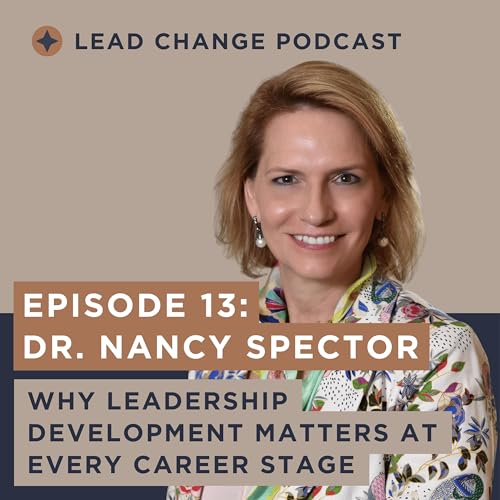
  • Episode 13: Dr. Nancy Spector Why Leadership Development Matters at Every Career Stage
    Feb 3 2026

    In this episode of Lead Change, host Mary K. Mulcahey, MD sits down with Dr. Nancy Spector, Professor of Pediatrics and Senior Vice Dean for Faculty at Drexel University College of Medicine, and Executive Director of the Executive Leadership in Academic Medicine (ELAM) and Executive Leadership in Health Care (ELH) programs.

    Dr. Spector shares her leadership journey—from her roots as a pediatrician and chief resident to becoming a nationally recognized leader in faculty development, equity, mentoring, and systems-level change. She reflects on formative moments in her career, including the importance of mentorship, peer support, and leadership training early and throughout one’s professional life.

    The conversation explores the origins and evolution of ELAM, its mission to transform leadership at the highest levels of academic medicine, and its shift from “fixing women” to fixing systems. Dr. Spector discusses inclusive leadership, allyship, infrastructure-building, and the necessity of preparing leaders to manage and lead effectively amid ongoing uncertainty.

    Throughout the episode, Dr. Spector emphasizes purpose-driven leadership, strategic patience, and the power of creating environments where diverse talent can thrive—ultimately improving medicine, science, and patient care.

    Key Takeaways

    • Leadership training is essential at every stage of a medical career, not just at senior levels—and should ideally begin in medical school.
    • Peer mentorship is often as powerful as senior mentorship, providing support, perspective, and shared growth throughout one’s career.
    • Effective faculty development goes beyond teaching skills to include career alignment, professional growth, and leadership identity.
    • The future of leadership in academic medicine depends on fixing systems and infrastructure, not asking individuals to adapt to broken models.
    • Inclusive leadership requires partnership and allyship, including engagement across gender, disciplines, and professional roles.
    • Successful leaders focus on alignment with purpose (“the why”), helping individuals and organizations maximize impact.
    • Leading in today’s environment means accepting uncertainty and learning to lead through it, rather than waiting for clarity.
    • A critical leadership skill is the ability to identify gaps, build infrastructure, and then empower others to lead.
    • Maintaining a sense of humor and humility is key to longevity and resilience in high-level leadership roles.
    Show More Show Less
    51 mins
  • Episode 12: Dr. Alex Ghanayem Integrity Is the Currency: Stewardship, Trust & Building for Tomorrow
    Jan 17 2026

    In this episode of Lead Change, Dr. Mary Mulcahey sits down with Dr. Alex Ghanayem—orthopedic spine surgeon, longtime Loyola faculty member, department chair, and past president of the American Orthopaedic Association—for a candid and deeply reflective conversation about leadership in medicine.

    Dr. Ghanayem shares how his leadership journey unfolded organically, never driven by titles or ambition, but by consistently doing the work, earning trust, and saying yes when others saw potential in him. He reflects on nearly 30 years at one institution and how stewardship, culture, and people—not individual recognition—define true leadership legacy.

    The discussion explores leading through disruption (particularly the post-COVID era), the importance of financial and organizational sustainability, and why leaders must think years—not months—ahead. Dr. Ghanayem emphasizes integrity and trust as the true currency of leadership, the discipline required to stay focused amid constant noise, and the humility needed to empower others and step out of the weeds.

    Throughout the episode, listeners gain practical wisdom on leadership development, the value of professional societies like the AOA, and why aspiring leaders should stop chasing titles and instead invest in relationships, allies, and the long-term health of their organizations.

    Key Take-Home Points

    • Leadership is earned, not planned.
      Many impactful leaders never set out to lead—they focused on doing meaningful work well and accepted responsibility when trusted by others.
    • Integrity and trust are leadership currency.
      People may disagree with you, but if they trust your intentions and integrity, productive leadership is possible—even in conflict.
    • Think long-term, not just short-term.
      Today’s challenges were shaped by decisions made years ago; effective leaders must look 5–10 years ahead and plan accordingly.
    • Culture matters more than structure.
      A strong, people-centered culture creates resilience, collaboration, and a willingness to go the extra mile—even in challenging environments.
    • Great leaders “become smaller.”
      Self-awareness, humility, and understanding how your presence affects others are essential to empowering teams.
    • Transition from doer → manager → leader.
      Leaders must resist staying in the weeds and instead trust, support, and elevate those closest to the work.
    • Focus on what you can control.
      Noise and distractions are inevitable—discipline and strategic focus allow leaders to move forward effectively.
    • Don’t chase titles—build allies.
      Leadership success is never achieved alone; relationships and trust built along the way make advancement possible.
    • Professional societies matter.
      Organizations like the AOA play a critical role in leadership development, education, and safeguarding the future of musculoskeletal care.
    Show More Show Less
    49 mins
No reviews yet