Law Practice Today cover art

Law Practice Today

Law Practice Today

By: The Law Practice Division
Listen for free

This podcast is brought to you by the Law Practice Division of the American Bar Association.

© 2026 Law Practice Today
Economics Management Management & Leadership
Episodes
  • AI Hallucinations in Court The Sullivan & Cromwell Lesson
    Jun 30 2026

    Recorded as a fireside chat at the ABA Law Practice Division Spring Meeting in San Diego, this special episode examines reports that Sullivan & Cromwell filed a brief containing nonexistent or inaccurate case citations and later apologized to opposing counsel and the court.

    Steve Embry, Jennifer Ellis, and Michael Eisenberg discuss why AI hallucinations continue to appear in legal filings despite widespread awareness of the risks. They point to ignored firm policies, time pressure, overreliance on confident-sounding AI outputs, and a lack of understanding of generative AI's limitations as key contributing factors.

    The discussion also explores how these failures relate to lawyers' ethical duties of competence, candor, and supervision. The speakers emphasize that legal citations should always be independently verified using traditional legal research tools—not AI—such as Shepardizing in Lexis or Westlaw. They also stress that proper training and experience are essential for recognizing unreliable AI-generated results.

    00:00 – AI Hallucinations Hit BigLaw
    00:37 – Show Intro and Disclaimer
    01:16 – Sullivan & Cromwell Brief Fallout
    02:19 – Why Lawyers Keep Getting Burned
    04:19 – Competence Rules and Citation Checks
    06:53 – Workflow Reality Check
    08:55 – Training to Spot Hallucinations
    10:45 – Verifying Citations Without AI Tools
    12:55 – Closing Thoughts and Wrap-Up
    13:02 – Podcast Outro and Resources

    Show More Show Less
    14 mins
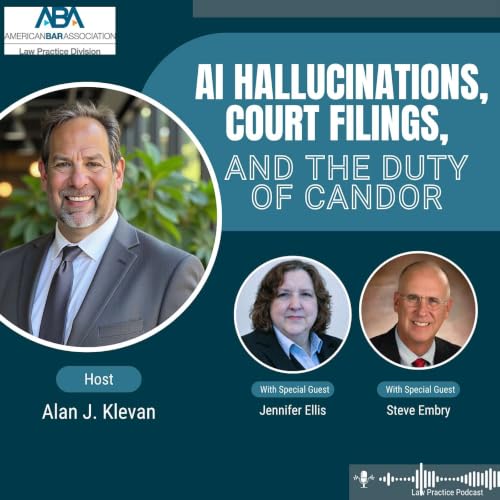
  • Avoiding AI Hallucinations in Legal Practice
    Jun 15 2026

    This Law Practice Podcast fireside chat with Alan Klevan, Jennifer Ellis, and Steve Embry discusses recent court responses to lawyers filing AI-hallucinated or fabricated citations, focusing on the Oregon appeals decision in Williams. The panel explains that the court emphasized Rule 3.3’s duty of candor to both the court and opposing counsel, criticizing the lawyer not only for including fabricated authorities but also for attempting a “quiet correction” without acknowledging the problem. They discuss growing judicial frustration, the likelihood of sanctions and disciplinary referrals, and examples of suspensions. The speakers stress that generative AI hallucinations are inherent, so lawyers must verify every citation by checking links and reading cases, use appropriate research tools, learn effective prompting techniques, and promptly disclose and remedy any errors rather than conceal them.

    00:00 AI Hallucinations Intro
    01:08 Fireside Chat Setup
    02:42 Williams Case Breakdown
    03:24 Candor Rule And Quiet Fix
    05:21 Sanctions And Discipline
    07:45 Protecting Public Trust
    08:34 How To Prevent Hallucinations
    10:14 Verification And Tooling Tips
    11:57 Why AI Hallucinates
    12:59 Wrap Up And Resources

    Show More Show Less
    14 mins
  • How AI Is Changing Legal Billing and Client Value
    Jun 8 2026

    In this Law Practice Podcast fireside chat on “Billing in the Age of AI,” host Jim Calloway is joined by Julie Bays, Director of the Management Assistance Program at the Oklahoma Bar Association, and Wendy Meadows, a family law attorney in Maryland and coaching consultant for small and solo law firms.

    Together, they discuss how AI is changing the way lawyers think about billing, value, and client communication.

    The conversation centers on the “efficiency paradox”: when AI helps lawyers complete certain tasks faster, how should that speed be reflected in the client’s bill? Wendy shares how her practice has shifted toward a hybrid billing model, using flat fees for document-based work like complaints and marital settlement agreements, while continuing to bill hourly for meetings, phone calls, and other client-facing work.

    Julie emphasizes that invoices should do more than request payment — they should help clients understand the value of the work performed. Even when AI makes legal work more efficient, lawyers still bring years of judgment, experience, and legal strategy to the final product.

    The panel also discusses the importance of clearly outlining billing structures in engagement agreements, continuing to track time even for flat-fee work, and setting limits when a matter exceeds the original scope. They also highlight the need for client disclosures around AI use, including warnings about placing attorney work product or confidential documents into public AI platforms.

    Finally, the conversation explores how AI-driven efficiency may help lawyers expand their ability to take on pro bono and low-bono work. Rather than viewing AI only as a billing challenge, the speakers frame it as an opportunity to improve access to justice, increase capacity, and encourage lawyers to adopt AI thoughtfully — one small step at a time.

    00:00 Welcome and Overview
    00:33 Show Disclaimer
    01:12 Billing in the Age of AI
    01:15 Meet the Panelists
    01:35 Invoices as Value Proof
    02:11 Hybrid Billing in Practice
    03:35 Engagement Terms and Time Caps
    04:24 AI Disclosures and Confidentiality
    05:23 Efficiency and Access to Justice
    06:22 Closing Takeaways
    07:05 Outro and Resources

    Show More Show Less
    8 mins
adbl_web_anon_alc_button_suppression_t1
No reviews yet