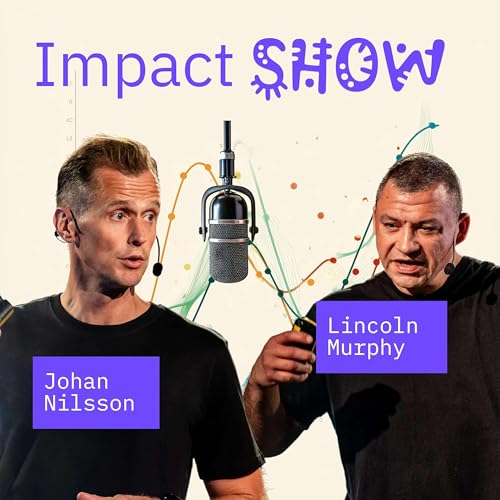
Impact Show cover art

Impact Show

Impact Show

By: Johan Nilsson & Lincoln Murphy
Listen for free

About this listen

Johan Nilsson, CEO & Founder of Startdeliver and Founder of Jecta AI, and
Lincoln Murphy, Thought Leader & Growth Architect at Sixteen Ventures and VP of Customer Success at Listkit, are on a mission to redefine what Customer Success looks like at its best.


Every week, live and on video, they bring the conversations that matter most — cutting through the noise to explore the ideas, strategies, and mindset shifts that separate good Customer Success from truly transformational ones.


This is Impact Show.

© 2026 Impact Show
Career Success Economics
Episodes
  • The Impact Show: Live Pod - The NRR Battle of 2026
    Feb 19 2026
    The Impact Show: AI, SaaS & Customer Success in 2026

    Hosts: Johan Nilsson (Stockholm) & Lincoln Murphy (Brazil)


    SaaS Under Pressure

    A trillion dollars in SaaS market cap was recently wiped out — not because of poor earnings, but because Anthropic released a document showing AI could replace certain software tools outright. This spooked investors and raised a fundamental question: if you can replicate a SaaS product with a weekend of "vibe coding," what's it actually worth?

    For private companies the ripple effect is real too — venture money is flooding toward AI-first startups while traditional SaaS is finding funding increasingly hard.


    "I Could Just Build This"

    Customers are using AI as leverage in renewal negotiations, threatening to replace software with something quickly coded in tools like Lovable or Claude. The hosts' take: partly real, partly bluster — but CSMs need to be prepared either way.

    The answer is to articulate what the software actually delivers: domain expertise, best practices, strategic guidance, accumulated knowledge. The software is just the delivery mechanism. You can't vibe-code that.


    Tools They're Actually Using

    • Jecta AI — Agentic CS tool for customer success workflows
    • Claude — writing, messaging, SOPs, long-context work
    • ChatGPT — spreadsheet and data analysis
    • Grok — real-time research via X
    • Gamma — rapid presentation building
    • VS Code + Claude Code — agentic backend workflows
    • AI note-takers — for all customer calls

    A standout workflow: record a voice memo, transcribe it, paste into Claude, export as markdown to Gamma — full presentation ready before the Zoom starts. The voice memo approach is intentional: people self-edit when typing, but speaking unlocks the real insights.

    One caveat: always have a human review anything customer-facing. Swedish profanity in a client summary is an occupational hazard.


    Do the Work
    For Your Customer

    Lincoln challenges a core CS assumption — "we can't do the work for our customers" — and flips it: what if you could?

    One company in his training cohort was giving customers a 15% discount just to complete a critical onboarding step. By using AI workflows to do that step for the customer, they got faster onboarding and eliminated the discount entirely. The broader point: AI lets CS teams do far more — cleaning data, building tools, filling product gaps — and companies that lean in will deepen their moat, not lose it.


    Scaling Across the Team

    A listener asks: if one CSM builds something useful, how do 30 others benefit?

    Lincoln's approach: have an ops-focused person deploy workflows to shared cloud infrastructure. They run a #OpsDojo Slack channel where anyone drops ideas, the team upvotes them, and the best ones get built and deployed. The prerequisite is that everyone understands what's possible — run workshops, let people experiment, and the ideas will flow naturally.


    The Bottom Line

    Companies approaching AI with a scarcity mindset — cutting costs, reducing headcount — will likely lose. Those asking "what could we do now that we simply couldn't before?" will pull ahead. As Lincoln puts it: if AI appears to destroy a competitor, the real answer is you did, by doing it better.


    Do you want more of this? Check out Impact Academy for interactive Customer Success training programs. https://www.impactdemy.com/

    Do you have a question you want us to answer? Submit it
    here.

    Show More Show Less
    1 hr
  • Variable Comp for CSMs: Motivation or Misstep?
    Jun 27 2024

    ON TODAY'S EPISODE:
    Setting up a variable compensation plan for Customer Success Managers (CSMs) is fraught with challenges. In this week's episode of Impact Weekly, Johan and Lincoln dive deep into the intricacies of variable comp plans. They discuss the potential pitfalls, share effective strategies, and emphasize the irreplaceable role of leadership in motivating CSMs.

    THIS WEEK'S QUESTION: "What's the best approach for a variable comp plan for a Customer Success Manager?"

    TOPICS BEING ADDRESSED:

    • The challenges and pitfalls of variable compensation plans in Customer Success.
    • Effective ways to structure incentives for Customer Success Managers.
    • The importance of leadership and management in motivating and guiding Customer Success teams.

    QUOTES:

    1. Johan Nilsson (00:01:22): "Anyone out there who's been trying to set this up knows it is and can be a challenge. And there's many ins and outs to this one."
    2. Lincoln Murphy (00:05:35): "In Customer Success Management, variable comp often means, 'I'm going to pay you 70 percent of your salary, and you better do your job or you're not going to get the other 30 percent.'"
    3. Lincoln Murphy (00:07:1`): "In Customer Success, variable comp is generally positioned as a threat. It only has downside potential."
    4. Johan Nilsson (00:10:42): "I've seen variable comp plans that incentivize CSMs to only work and maybe even push upgrades on customers that aren't ready, while ignoring those who need more attention."
    5. Lincoln Murphy (00:15:12): "You pay them their market rate salary and you can bonus them on other stuff. That's called being a manager. That's called being a leader."

    Do you want more of this? Check out Impact Academy for interactive Customer Success training programs. https://www.impactdemy.com/

    Do you have a question you want us to answer? Submit it
    here.

    Show More Show Less
    26 mins
  • Predicting Customer Churn: Essential Metrics and Strategies
    Jun 12 2024

    Retention training starts June 17, 2024. Learn more and sign-up here:
    https://www.impactdemy.com/courses/copy-of-the-retention-program-us-oct-24

    ON TODAY'S EPISODE:
    Customer churn is a critical issue that can impact a company's growth and stability. In this week’s episode of Impact Weekly, Johan and Lincoln dive into the essential metrics for predicting churn and discuss effective strategies to mitigate it. They share insights on understanding customer behavior, proactive engagement, and how to communicate potential churn risks to management.

    THIS WEEK'S QUESTION:

    "Can you summarize the key indicators for predicting churn in advance?"

    TOPICS BEING ADDRESSED:

    • The importance of understanding key indicators for predicting churn
    • Strategies for addressing and mitigating lagging churn
    • Effective communication with management about potential churn issues

    QUOTES:
    Lincoln Murphy (02:50): "Meaningful usage is the main thing to look at when predicting churn."

    Johan Nilsson (04:32): "Stakeholder changes are a massive indicator that churn could be on the horizon."

    Lincoln Murphy (06:45): "Proactive engagement with customers can significantly reduce the risk of churn."

    Johan Nilsson (09:20): "The iceberg metaphor helps illustrate the hidden risks beneath the surface of current churn rates."

    Lincoln Murphy (13:52): "Our daily work in Customer Success is crucial to ensuring long-term customer retention."

    Do you want more of this? Check out Impact Academy for interactive Customer Success training programs. https://www.impactdemy.com/

    Do you have a question you want us to answer? Submit it
    here.

    Show More Show Less
    36 mins
No reviews yet