

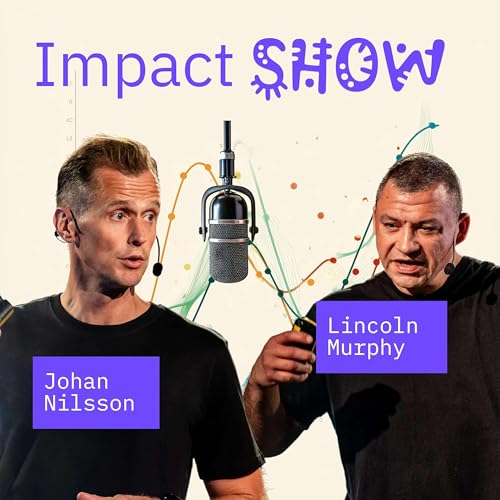
The Impact Show: Live Pod - The NRR Battle of 2026
Failed to add items
Add to basket failed.
Add to wishlist failed.
Remove from wishlist failed.
Adding to library failed
Follow podcast failed
Unfollow podcast failed

The Impact Show: Live Pod - The NRR Battle of 2026
-
Narrated by:
-
By:
About this listen
Hosts: Johan Nilsson (Stockholm) & Lincoln Murphy (Brazil)
SaaS Under Pressure
A trillion dollars in SaaS market cap was recently wiped out — not because of poor earnings, but because Anthropic released a document showing AI could replace certain software tools outright. This spooked investors and raised a fundamental question: if you can replicate a SaaS product with a weekend of "vibe coding," what's it actually worth?
For private companies the ripple effect is real too — venture money is flooding toward AI-first startups while traditional SaaS is finding funding increasingly hard.
"I Could Just Build This"
Customers are using AI as leverage in renewal negotiations, threatening to replace software with something quickly coded in tools like Lovable or Claude. The hosts' take: partly real, partly bluster — but CSMs need to be prepared either way.
The answer is to articulate what the software actually delivers: domain expertise, best practices, strategic guidance, accumulated knowledge. The software is just the delivery mechanism. You can't vibe-code that.
Tools They're Actually Using
- Jecta AI — Agentic CS tool for customer success workflows
- Claude — writing, messaging, SOPs, long-context work
- ChatGPT — spreadsheet and data analysis
- Grok — real-time research via X
- Gamma — rapid presentation building
- VS Code + Claude Code — agentic backend workflows
- AI note-takers — for all customer calls
A standout workflow: record a voice memo, transcribe it, paste into Claude, export as markdown to Gamma — full presentation ready before the Zoom starts. The voice memo approach is intentional: people self-edit when typing, but speaking unlocks the real insights.
One caveat: always have a human review anything customer-facing. Swedish profanity in a client summary is an occupational hazard.
Do the Work For Your Customer
Lincoln challenges a core CS assumption — "we can't do the work for our customers" — and flips it: what if you could?
One company in his training cohort was giving customers a 15% discount just to complete a critical onboarding step. By using AI workflows to do that step for the customer, they got faster onboarding and eliminated the discount entirely. The broader point: AI lets CS teams do far more — cleaning data, building tools, filling product gaps — and companies that lean in will deepen their moat, not lose it.
Scaling Across the Team
A listener asks: if one CSM builds something useful, how do 30 others benefit?
Lincoln's approach: have an ops-focused person deploy workflows to shared cloud infrastructure. They run a #OpsDojo Slack channel where anyone drops ideas, the team upvotes them, and the best ones get built and deployed. The prerequisite is that everyone understands what's possible — run workshops, let people experiment, and the ideas will flow naturally.
The Bottom Line
Companies approaching AI with a scarcity mindset — cutting costs, reducing headcount — will likely lose. Those asking "what could we do now that we simply couldn't before?" will pull ahead. As Lincoln puts it: if AI appears to destroy a competitor, the real answer is you did, by doing it better.
Do you want more of this? Check out Impact Academy for interactive Customer Success training programs. https://www.impactdemy.com/
Do you have a question you want us to answer? Submit it here.