• Why Every Step Feels So Hard (And How to Run More Smoothly)
    Jun 22 2026

    Do your feet sound loud when you run?

    If every step feels heavy, jarring, or harder than it should, the issue may not be your fitness. It may be the way your foot is landing.

    In this episode, Coach Chris and Coach Maya explain overstriding in simple, beginner-friendly language: why landing too far in front of your body creates a braking effect, why that can make running feel harder, and how small changes can help you run more smoothly.

    You’ll learn:

    • Why loud footsteps can be useful feedback
    • How overstriding creates invisible braking forces
    • Why your knees and shins may absorb more impact than necessary
    • Why the “180 cadence rule” is misleading for beginners
    • How shorter, quicker steps can help reduce braking without running faster

    Start Here:
    Download our free 14-week Half Marathon Training Plan and learn how to train smarter while reducing your risk of common running injuries:
    https://halfmarathontrainingplan.com/start

    Related Resources

    • How to Avoid Shin Splints
    • Beginner Running Gear Checklist

    This has been a production of the Half Marathon Training Plan Podcast. Visit HalfMarathonTrainingPlan.com for science-based training guidance, injury prevention articles, and beginner-friendly half marathon coaching.

    Show More Show Less
    19 mins
  • Achilles Pain in Runners: What Actually Works (Science-Based)
    Jun 8 2026

    Why does Achilles pain keep coming back, even after taking time off?

    For many runners, the cycle is frustratingly familiar: your Achilles starts hurting, you rest until it feels better, then the pain returns as soon as you start running again.

    In this episode, Coach Chris and Coach Maya explain what the latest sports medicine research says about Achilles tendinopathy, tendon loading, calf strength, recovery, and how to safely return to running without restarting the injury cycle.

    You'll learn:

    • Why rest alone often isn't enough
    • How tendons adapt differently than muscles
    • The role of progressive loading in recovery
    • When walking helps—and when it doesn't
    • The 24-hour rule for monitoring your progress
    • Common myths that keep runners stuck in the injury cycle

    Read the complete science-based article:
    Achilles Pain in Runners: What Actually Works

    Start Here:
    Download our free 14-week Half Marathon Training Plan and learn how to train smarter while reducing your risk of injury:
    https://halfmarathontrainingplan.com/start

    Related Resources

    • How to Avoid Shin Splints
    • Heavy Legs While Running: Causes & Fixes
    • Electrolytes for Runners

    This has been a production of the Half Marathon Training Plan Podcast. Visit HalfMarathonTrainingPlan.com for more evidence-based training guides, injury prevention articles, and beginner-friendly half marathon coaching.

    Show More Show Less
    22 mins
  • Why Running Suddenly Feels Hard (Even When You’re Training Consistently)
    May 25 2026

    Why do some runs suddenly feel terrible… even when your training hasn’t changed?

    Your legs feel heavy. Your pace falls apart. Your heart rate is unusually high. And suddenly you start wondering if you lost all your fitness overnight.

    In reality, most bad runs are not caused by lost fitness at all. They are caused by accumulated stress your body has not fully recovered from yet.

    In this episode, Coach Chris and Coach Maya break down the hidden factors that quietly make running feel harder than it should:

    • Poor sleep and nervous system fatigue
    • Life stress and recovery debt
    • Heat and dehydration
    • Chronic under-fueling
    • Why your brain sometimes forces your body into “low power mode”

    This episode is designed to help runners stop panicking during rough training weeks and better understand how recovery, stress, and adaptation actually work.

    Start Here: The Injury-Proof Running System
    Download our free 14-week training plan and learn how to build endurance without burnout or injury:
    halfmarathontrainingplan.com/start

    Related Articles:

    • Heavy Legs While Running: Causes & Fixes
    • Electrolytes for Runners

    This has been a production of the Half Marathon Training Plan Podcast. Visit HalfMarathonTrainingPlan.com for more science-based training guidance.

    Show More Show Less
    20 mins
  • Why Easy Running Feels Wrong at First
    May 11 2026

    Why does running slower feel so uncomfortable at first?

    If easy running makes you feel awkward, out of shape, or like you are somehow “doing it wrong,” you are not alone.

    Most beginner runners accidentally spend every run stuck in the middle: too hard to properly recover, but not easy enough to build a true aerobic base.

    In this episode, Coach Chris and Coach Maya break down why slower running feels mentally difficult, why pace anxiety holds runners back, and how easy running quietly builds the endurance engine that actually makes you faster over time.

    We cover:

    • Why easy running feels awkward and ineffective at first
    • The “moderate intensity trap” that keeps runners exhausted
    • How conversational pace training actually improves endurance
    • Why constantly chasing pace can sabotage progress
    • How to build confidence while running slower


    🔗 Start Here: The Injury-Proof Running SystemDownload our Free 14-Week Training Plan and learn how to build endurance without burnout or injury:
    halfmarathontrainingplan.com/start


    ⌚ Simple Gear Mentioned:
    Garmin Forerunner


    This has been a production of the Half Marathon Training Plan Podcast. Visit HalfMarathonTrainingPlan.com for more science-based training guidance.

    Show More Show Less
    16 mins
  • Shin Splints That Won’t Go Away? Here’s What You’re Missing
    Apr 27 2026

    Do your shin splints keep coming back every time you start running again?

    You rest. The pain goes away. You feel good. Then you run… and it comes right back.

    If that cycle sounds familiar, you are not alone—and you are not doing anything wrong.

    In this episode, Coach Chris and Coach Maya break down why shin splints (medial tibial stress syndrome) keep returning, and why the common advice to “just rest until it feels better” doesn’t actually fix the problem.

    We cover:

    • 🔁 The “injury loop” that keeps runners stuck in recurring pain
    • 🦴 Why pain going away does NOT mean your tissue is healed
    • ⚠️ The biggest mistake runners make when returning to training
    • 🏃‍♂️ A simple, practical system to safely get back to running
    • ⚙️ How a small cadence adjustment can reduce stress on your shins

    🔗 Start Here: The Injury-Proof Running System
    Download our Free 14-Week Training Plan and get the step-by-step system we use with beginner runners:
    halfmarathontrainingplan.com/start

    📚 Related Reading:
    How to Avoid Shin Splints

    This has been a production of the Half Marathon Training Plan Podcast. Visit HalfMarathonTrainingPlan.com for more science-based training guidance.

    Show More Show Less
    16 mins
  • Heavy Legs While Running: Why It Happens (And How To Fix It)
    Apr 15 2026

    Why do your legs suddenly feel heavy during a run—even when your fitness is improving?

    This is one of the most frustrating and misunderstood experiences in running. One minute you feel smooth and in control… and the next, your legs feel like bricks.

    This episode is grounded in exercise physiology and real-world training principles.

    In this episode, Coach Chris and Coach Maya break down exactly why this happens—and how to fix it.

    We cover:

    • ⚡ How glycogen depletion impacts muscle force and perceived effort
    • 💧 Why electrolyte imbalance (especially sodium) disrupts muscle contraction
    • 🧠 The role of neuromuscular fatigue and the brain’s “central governor”
    • 🔧 A simple system to prevent heavy legs before, during, and after your runs

    🔗 Start Here: The Injury-Proof Half Marathon System
    Download our free 14-week training plan and learn how to structure your training, fueling, and recovery: halfmarathontrainingplan.com/start

    📚 Learn More:

    • How to Avoid Shin Splints
    • Fueling Long Runs
    • Electrolytes for Runners

    This has been a production of the Half Marathon Training Plan Podcast. Visit HalfMarathonTrainingPlan.com for more science-based training guidance.

    Show More Show Less
    17 mins
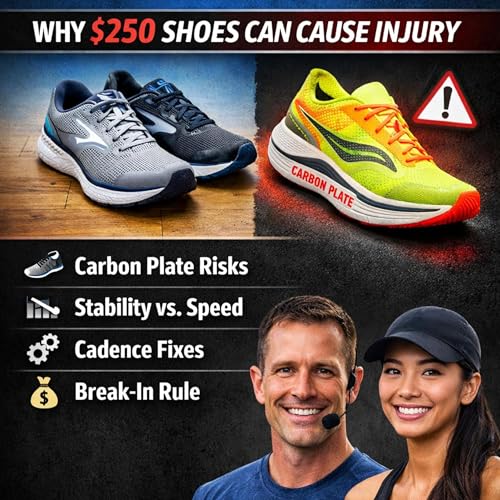
  • The Only Running Shoes Beginners Actually Need (And Why $250 Shoes Can Cause Injury)
    Mar 30 2026

    Do you really need $250 carbon-plated super shoes to run a half marathon?

    If you walk into a running store and feel completely overwhelmed by the "wall of neon," you are not alone. The running shoe industry wants you to think you are broken so they can sell you an expensive fix. But the truth is, the wrong "advanced" shoe can actually contribute to shin splints and knee pain.

    This episode is grounded in sports biomechanics research and real-world training data.

    In this episode, Coach Chris and Coach Maya cut through the marketing hype to tell you exactly what kind of shoes a beginner needs — and what you should completely ignore.

    We cover:

    • 👟 Why carbon-plated race shoes can increase injury risk for beginners.
    • 📉 The "Stability vs. Speed" debate (and why boring shoes win).
    • ⚙️ How increasing your cadence does more for your knees than any shoe.
    • 💰 The "2-Week / 20-Mile" break-in rule to protect your race day.

    🔗 Start Here: The Injury-Proof Half Marathon System
    Download our Free 14-Week Training Plan and get the exact gear checklist we recommend: halfmarathontrainingplan.com/start

    📍 The "Boring but Safe" Daily Trainers We Recommend:

    • Brooks Ghost
    • Saucony Ride

    Read our full guide to the best running shoes for half marathon beginners

    This has been a production of the Half Marathon Training Plan Podcast. Visit HalfMarathonTrainingPlan.com for more science-based training guidance.

    Show More Show Less
    20 mins
  • Why Treadmill Running Feels Easier (And How to Transition Outside Without Injury)
    Mar 16 2026

    Why does running outside feel so much harder than running on a treadmill?

    If you’ve ever felt strong indoors but struggled the moment you hit the pavement, you’re not imagining it. The difference isn’t mental — it’s physiological and biomechanical.

    In this episode, Coach Chris and Coach Maya explain exactly why treadmill running feels easier, what changes when you move outdoors, and how to transition safely without injury.

    We cover:

    • 🏃 Why treadmill running often feels easier (and the science behind it)
    • ⚙️ The biggest difference: posterior chain demand outdoors
    • 📉 How cadence and stride change when you leave the treadmill
    • ⏱️ The pacing mistake almost every runner makes outside
    • ⚠️ Why the first 2–3 weeks outdoors carry the highest injury risk
    • ✅ A simple, step-by-step plan to transition safely

    This episode is especially helpful if you're coming off a winter of treadmill training or preparing for an outdoor race.

    🔗 New to the podcast?
    Start here → The Injury-Proof Half Marathon System

    📚 Helpful Resources:

    • How to Avoid Shin Splints
    • Why Consistency Beats Motivation in Half Marathon Training

    📘 Want the full system step-by-step?
    It’s built directly into the Half Marathon Training Plan book (Kindle & Paperback).

    This has been a production of the Half Marathon Training Plan Podcast. Visit HalfMarathonTrainingPlan.com for more science-based training guidance.

    Show More Show Less
    11 mins