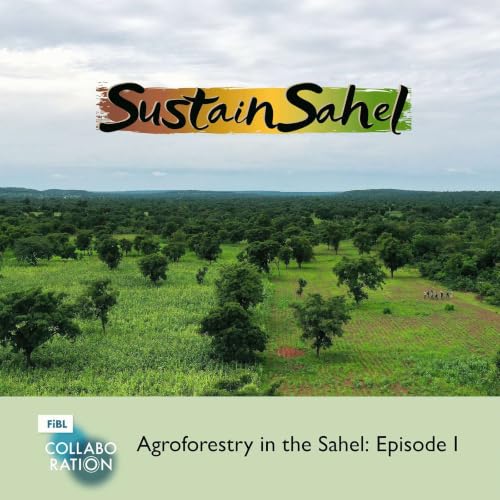
FiBL Collaboration cover art

FiBL Collaboration

FiBL Collaboration

By: Podcastteam FiBL Focus
Listen for free

"FiBL Collaboration" is a multilingual podcast channel produced by the Research Institute of Organic Agriculture FiBL. In the podcast, we talk with experts from around the globe about the latest scientific findings from national and international research projects. We are happy to receive feedback or topic proposals via podcast@fibl.org. Homepage: https://www.fibl.org/en/infothek/podcast-en; Imprint: https://www.fibl.org/en/contact-site-information, © 2021 FiBL

© 2026 FiBL Collaboration
Science
Episodes
  • From pilot to practice: Making agroforestry work at scale
    Jun 23 2026

    Agroforestry in the Sahel: Five years of science, partnership and impact of the SustainSahel project

    Research findings are one thing; farmers actually adopting new practices is another. Across development and agriculture, there is a well-known gap between promising pilot projects and real-world uptake — but what does the evidence actually tell us about what works, for whom, and under what conditions?

    In this episode, we dive deep into five years of rigorous impact data from the SustainSahel project, including randomised controlled trials designed to measure whether shrub-integrated farming genuinely improves yields, livelihoods, and food security. We explore adoption patterns across men and women farmers, unpack the economics that determine whether practices stick, and examine the policy levers and scaling pathways that could extend these benefits far beyond the original research sites.

    This is the moment where research meets reality — where scientists, policymakers, and farmers confront the hard question: does this work at scale? Through lessons learned, surprising findings, and candid reflections from five years in the field, we discover what it actually takes to transform agricultural practice, and why the Sahel's future may depend on getting this right. Listen in for the evidence, the challenges, and the possibilities ahead.

    Written and narrated by: Lauren Dietemann, FiBL

    Guests featured on the episode: Dr. Harun Cicek and Dr. Christian Grovermann, FiBL

    Many thanks to: All SustainSahel project partners

    Photo: FiBL, Harun Cicek

    Links:

    https://www.sustainsahel.net/

    https://www.sustainsahel.net/results-and-learning-materials.html

    https://www.organic-africa.net/organic-agriculture/african-organic-agriculture-training-manual/agroforestry-in-the-sahel.html

    Show More Show Less
    39 mins
  • Re-greening the Sahel: How shrubs and science can transform food security
    Jun 23 2026

    Agroforestry in the Sahel: Five years of science, partnership and impact of the SustainSahel project

    The Sahel is facing a perfect storm: erratic rainfall, degraded soils, rising temperatures, and growing populations with limited access to productive land. For generations, farmers have adapted to these conditions through innovation and resilience — but can traditional knowledge combined with rigorous science offer a genuine pathway to food security and thriving livelihoods?

    For five years, the SustainSahel project set out to answer this question by investigating whether deliberately integrating shrubs and trees into crop and livestock systems could transform farming across West Africa. In this episode, we travel to Senegal, Mali and Burkina Faso to understand what farming in the Sahel actually looks like, explore how agroforestry works in one of the world's most challenging climates, and meet the researchers and farmers who shaped a transdisciplinary research project in the face of COVID-19 and regional instability.

    This is not just about planting trees — it's about reimagining how we produce food in a warming world, with evidence grounded in the realities of smallholder farming and co-designed with the communities who live there. Listen in as we lay the foundation for understanding how science and practice can converge to build more resilient, productive, and equitable food systems.

    Written and narrated by: Lauren Dietemann, FiBL

    Guests featured on the episode: Dr. Harun Cicek and Dr. Christian Grovermann, FiBL

    Many thanks to: All SustainSahel project partners

    Photo: FiBL, Harun Cicek

    Links:

    https://www.sustainsahel.net/

    https://www.sustainsahel.net/results-and-learning-materials.html

    https://www.organic-africa.net/organic-agriculture/african-organic-agriculture-training-manual/agroforestry-in-the-sahel.html

    Show More Show Less
    27 mins
  • Leguminosennetzwerk: Welche Umweltleistungen erbringen Körnerleguminosen?
    Jun 9 2026

    Willkommen beim LeguNet-Podcast, dem Podcast über Soja, Erbse, Ackerbohne, Lupine & Co. Das Leguminosennetzwerk kümmert sich darum, dass wieder mehr Hülsenfrüchte (Körnerleguminosen) in Deutschland angebaut und auf dem Teller und im Trog landen. Denn die eiweißreichen Hülsenfrüchte sind für Tiere, Menschen und sogar für den Boden überaus gesund.

    Körnerleguminosen wie Erbsen, Ackerbohnen, Lupinen oder Soja sind weit mehr als reine Eiweißlieferanten. Sie lockern Fruchtfolgen auf, verbessern die Bodenfruchtbarkeit und fördern die Biodiversität. Gleichzeitig reduzieren sie den Bedarf an mineralischem Stickstoffdünger. Dadurch sinken sowohl der Verbrauch fossiler Energie bei der Düngemittelherstellung als auch Treibhausgasemissionen. Zudem kann ihr Vorfruchtwert Erträge und Qualitäten in Folgefrüchten verbessern. Viele dieser Vorteile zeigen sich jedoch erst im Gesamtsystem der Fruchtfolge und weniger in der Einzelkultur. Warum Körnerleguminosen trotz ihrer positiven Effekte bisher wenig angebaut werden und welche Rolle Wirtschaftlichkeit, Vermarktung und Förderungen spielen, diskutieren wir in dieser Folge mit Martin Kind vom Leibniz-Zentrum für Agrarlandschaftsforschung (ZALF).

    Folge 10/deutsch/14 Min. und 07 Sek.

    Gast: Martin Kind, Leibniz-Zentrum für Agrarlandschaftsforschung (ZALF)

    Moderation Gespräch: Kerstin Spory, FiBL Deutschland e.V.

    Anmoderation: Hella Hansen

    Weiterführende Informationen:

    Umweltleistungen / Fruchtfolgebeispiel:https://www.legunet.de/forschung/umweltleistungen-von-koernerleguminosen

    BMLEH Statistik Hülsenfrüchtehttps://www.bmel-statistik.de/landwirtschaft/bodennutzung-und-pflanzliche-erzeugung/huelsenfruechte

    Mehr heimische Hülsenfrüchte auf den Tellern:Marktrecherche bestätigt Potenzial:https://www.ble.de/SharedDocs/Pressemitteilungen/DE/2024/240424_Marktrecherche-Huelsenfruechte.html

    Eiweißpflanzenstrategie des BMLEH:https://www.bmleh.de/DE/themen/landwirtschaft/pflanzenbau/ackerbau/eiweisspflanzenstrategie.html

    LeguNet: www.legunet.de

    (Bild): Hella Hansen

    Show More Show Less
    14 mins
adbl_web_anon_alc_button_suppression_t1
No reviews yet