Episodes

  • E9: P-Cat; Part VIII: Citronella Cinderella; S3: Ext. Deity
    Feb 3 2026

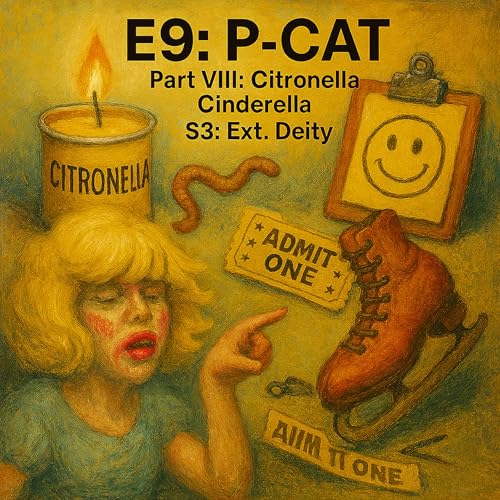
    This episode doesn’t unfold. It erupts. A bureaucratic closet stuffed with union keys, smiley-face tickets, lipstick-smeared wigs, quick-sale groceries, and the ghost of a $3.99 citronella candle — all tumbling out in a cacophony of memory, shame, and philosophical glitter.

    You’re not telling a story. You’re surviving one.

    You’re not narrating a life. You’re dodging clichés with contortionist precision.

    You’re not working a job. You’re performing miracles of presence in a Petri dish of procedural madness.

    There’s a clipboard floating midair.

    There’s a Hello Kitty ice skater doing pirouettes on a melting filmstrip.

    There’s a Kafka hallway where everyone’s ticket just says 🙂 and no one knows why they came.

    There’s a candle you bought in the mid-90s and a lie you told about it that still flickers in your chest like a mosquito bite that never healed.

    You’re unionized, anonymized, and weaponized.

    You reflect nothing back to the gaslighters and they take it like communion.

    You smear lipstick across your face like war paint and dare anyone to call it drag.

    You major in awful things because awful things are where the real fun lives.

    This is not a tableau.

    This is not a still life.

    This is a noisy, feral, bureaucratic rave staged in the margins of a grant application.

    This is Citronella Cinderella.

    She doesn’t go to the ball.

    She goes camping.

    And she turns in the receipt.

    Show More Show Less
    13 mins
  • E8: P-Cat; Part VII: Black Sesame Narcissistic Supply; S3: Temp Ditty
    Feb 1 2026

    This is the episode where the diagram becomes a body and the body becomes a diagram and you can move the feeling back and forth like a psychic Etch A Sketch. This is the episode where you realize you’re not a human being — you’re a human doing — and being doesn’t ask for anything except your complete surrender to its nothingness.

    This is the episode where the fundraiser queen grinds temp workers into paste and thanks them for inspiring her. Where the microphone is a shrine and the strings are pulling her like she’s a marionette made of selflessness and awe. Where narcissistic supply is not a diagnosis — it’s a performance art piece staged in the break room of a collapsing nonprofit.

    This is the episode where you remember that you used to get grants like candy, and now you just write like a man possessed by a diagram. Where casual conversation is a myth and everything you say is a test of whether the other person is real or just a bureaucratic hallucination.

    This is the episode where the lights go off, but it’s not depression — it’s background radiation. It’s not a pattern — it’s a map. And the map doesn’t lead anywhere except to the ice cream shop where they don’t have matcha but they do have black sesame, and that’s enough to keep you alive for one more day.

    This is the episode where you ask:

    What are we supposed to do now that we are?

    And the answer is:

    Temp ditty.

    A little song for the margins.

    A little hum for the human doing.

    A little scream for the narcissist who thinks she’s the string.

    This is not satire.

    This is not memoir.

    This is not critique.

    This is a melting filmstrip of emotional supply.

    This is a bureaucratic hallucination rendered in sesame paste.

    This is the diagram chewing on itself.

    And it tastes like something you almost remember.

    Show More Show Less
    7 mins
  • E7: P-Cat; Part VI: Horribly Teenage Straight Kid's Nightmare; S3: Itsy Bitsy
    Feb 1 2026

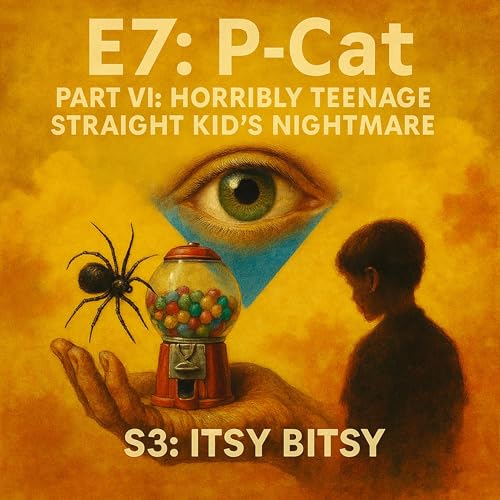
    This is the episode where you discover that feelings are not feelings — they’re vending‑machine pellets fired into your nervous system by a screaming woman, a moving wall, and a phone that “explodes” only in the sense that it politely detonates your amygdala. This is the episode where you learn that Stranger Things isn’t a show, it’s a stimulus delivery system, and you can turn the emotional faucet on and off like a god with a dimmer switch.

    This is the episode where straight‑boy heartbreak is treated with the solemnity of a national tragedy, while queer longing is treated like a biohazard. Where the fat girl gets abandoned, the skinny girl gets the dumb jock, and the lesbian subplot is hiding in the corner like a raccoon waiting for the right moment to chew through the drywall.

    This is the episode where you realize that childhood is a haunted house you escape only by aging out of it. Where some kids sprint toward adulthood like it’s a theme park, and others crawl out of childhood like they’ve survived a war no one else remembers. Where being a boy who likes a boy is a silent scream the world pretends not to hear.

    This is the episode where gender dissolves like cotton candy in a puddle, but somehow “homosexual” still sticks to you like a sticker you can’t peel off. Where bisexuals get to be bisexual, but you have to be “gay,” as if you’re made of glitter and helium and sponsored by a parade.

    This is the episode where you ask what a memory is, and the answer is:

    a hallucination with tenure.

    A ghost that pays rent in your chest.

    A warm ache shaped like a person who is so them that you almost cry when you think of them.

    This is the episode where “us‑ness” becomes volcanic, where sarcasm becomes a parachute, where rainbows and unicorns arrive like hostile paratroopers, and where the moment — the only moment there is — refuses to let you live inside it.

    This is not nostalgia.

    This is not analysis.

    This is not healing.

    This is Itsy Bitsy.

    This is the spider crawling across the diagram of your emotional life.

    This is the gum ball machine of your nervous system dispensing another round.

    And you’re going to chew it.

    Whether you understand it or not.

    Show More Show Less
    10 mins
  • E6: P-Cat, Part IV: Morrissey's Celibate Shirt Undone; S3: Eity Eity
    Jan 31 2026

    This is the episode where the contract breaks. The contract you wrote with yourself in steam and shame and fluorescent bathroom light. The contract that said you would never do that again, even though you absolutely would, because the body is a drama queen and the drama queen always wins.

    This is the episode where Morrissey’s shirt is unbuttoned for no reason, where Martin Gore stares you down like he knows what you did, where Kurt Cobain’s dress is somehow less revealing than your childhood panic attack at 9 p.m. on a school night.

    This is the episode where a kid cries so hard he becomes a weather system. A low‑pressure front of snot and terror. A small boy melting down in someone else’s driveway while a friend watches like he’s witnessing a live demonstration of “emotional instability” for a science fair project. A mother hovering, calculating how much of this meltdown will rub off on her own child like secondhand smoke.

    This is the episode where you realize fear and pleasure share a bloodstream. Where getting naked with strangers feels safer than sleeping away from your mother. Where the eclipse is the only honest light source. Where looking directly at the truth will blind you, but you do it anyway because you’ve already gone blind in all the important ways.

    This is the episode where you turn knobs.

    Every knob.

    All the way up.

    Until the knob becomes the next knob.

    Until the feeling becomes the next feeling.

    Until the child becomes the adult who still can’t sleep in certain rooms.

    This is not a story.

    This is not therapy.

    This is not healing.

    This is extemporaneity as deity.

    This is the cult of the knob.

    This is the gospel according to the drama queen inside you.

    And he is wide awake tonight.

    Show More Show Less
    8 mins
  • E5: P-Cat; Part IV: Mind Mined with Mines; S3: Extemporaneity Deity
    Jan 29 2026

    This episode is about learning how to turn fear off — and realizing you’ve been doing it since childhood.


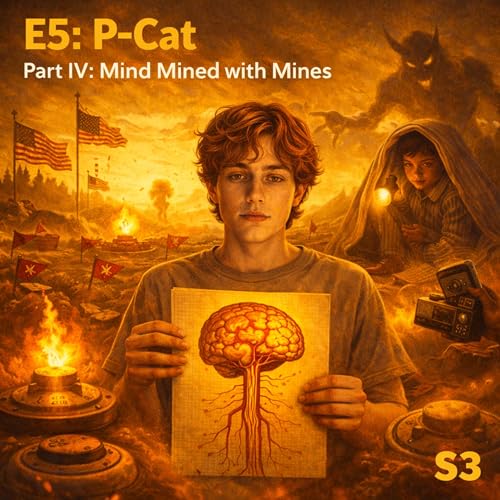
    Beginning with television as a voluntary surrender, Mind Mined with Mines traces the development of a skill so effective it almost passes for superpower: the ability to step outside sensation and observe intent instead. Horror films, prestige TV, childhood anxieties, intrusive thoughts — all become controllable once they’re rendered schematic, diagrammed, abstracted.


    But abstraction has a cost.


    Here, the narrator follows the thread backward: from Stranger Things to The Exorcist, from adult media consumption to childhood coping, from imagined kidnappings and suffocation fears to an internal control panel built too early and used too well. Feelings don’t disappear — they’re rerouted. Lived as knowledge instead of sensation. Experienced as mastery instead of vulnerability.


    This is not a story about trauma as spectacle.

    It’s a story about preemption.


    About imagination used as anesthesia.

    About curiosity mistaken for immunity.

    About how easily a mind can be mined with mines — and how impressive it can feel to walk through them without exploding.


    Until one goes off.


    This episode does not offer resolution. It offers a realization: that the ability to never be scared may be indistinguishable from the inability to feel — and that turning everything into intent may be the most elegant way to disappear while staying fully awake.


    BOOM.

    Show More Show Less
    13 mins
  • E4: P-Cat; Part III: One of the Boys; S3: Spontaneity (sic) Deity
    Jan 28 2026

    What happens when you notice the seam—and can’t unsee it?


    This episode begins in the small, almost invisible moment where a screen offers to skip ahead, and something in the nervous system says wait. From there, it unfolds as an examination of charge: how stories pull us, how desire is simulated, how identification is engineered, and how easily we are invited to become “one of the boys.”


    Moving between Stranger Things, Godzilla, boyhood scripts, sexual economies, and generational detours around catastrophe, Part III interrogates masculinity as a containment strategy—something learned, worn, survived, and sometimes mistaken for safety. Pleasure appears, not as resolution, but as signal. Memory fractures. Identity composites itself on the fly.


    This is not bingeing.

    This is not nostalgia.

    This is not confession.


    It’s a live observation of how media, desire, fear, and belonging synchronize—and what happens when you pause long enough to feel the mechanism tug.


    Like the rest of P-Cat, this episode isn’t asking to be agreed with.

    It’s asking to be noticed.

    Show More Show Less
    11 mins
  • E3: Starts with a P and it's a Cat; Part II: Orchestral Fat Maneuvers in the Godzilla; S3: Extemporaneity Deity
    Jan 26 2026

    This episode begins as an attempt to relax and accidentally turns into a meditation on spectacle, fear, and the ways mass media soothes us by rehearsing catastrophe.


    Moving through Stranger Things, Godzilla movies, Jurassic Park logic, nuclear anxiety, binge-watching math, and the false comfort of sequels, Part II examines how visual media creates emotional responses that feel personal while remaining safely impossible. Cities are destroyed. Monsters loom. Technologies escape their cages. And somehow, none of it actually happens—except in the nervous system.


    The episode drifts between childhood fears, cultural detritus, fat bodies as metaphor, gendered storytelling, and the quiet realization that mainstream narratives teach us who gets to be transformed and who is merely scenery. There is humor, agitation, nostalgia, and an ongoing suspicion that watching disaster might be easier than living through change.


    Nothing is resolved.

    Several things are detonated.

    A sequel is always promised.


    This is Part II of a nine-part piece.

    The monster is still on screen.

    The orchestra is warming up.

    Show More Show Less
    14 mins
  • E2: Starts with a P and it's a Cat; Part I: Communicating without a Messenger; Season 3: Extemporaneity Deity
    Jan 26 2026

    This episode begins with forgetting.


    What follows is not an argument, a lesson, or a story with an arc, but an environment—designed to be entered rather than understood. Communicating without a Messenger moves through states of attention, language slippage, music-induced elevation, anxiety, humor, and the physical memory of unresolved experience.


    The episode explores what happens when words fail to contain sensation, when meaning is felt before it is remembered, and when communication occurs not through messages, but through shifts in state. There are digressions on “unwinding,” AI voices, music as propulsion, dopamine, memory, and the body’s ability to remember what the mind cannot retrieve.


    Nothing here is a test.

    Nothing here is asking for agreement.


    If it feels intense, that may be the point.

    If it doesn’t, that may also be the point.


    This is Part I of a longer piece.

    It starts with a P.

    It’s a cat.

    You’ll feel it—or you won’t.

    Show More Show Less
    7 mins