• Harry Horsfall with Peter Abilla on Flight3 and Crypto Marketing Innovations
    Dec 15 2025

    Summary


    In this conversation, Harry Horsfall, co-founder and CEO of Flight3, shares his insights on the current state of the crypto market, the challenges and opportunities in African crypto markets, and the regulatory landscape affecting the industry. He discusses his journey into crypto, the importance of community building, and how Flight3 serves various crypto projects through marketing and support. The conversation highlights the contrast between market sentiment and regulatory progress, as well as the innovative Super Team model for developer engagement in the Solana ecosystem. In this conversation, Harry discusses the evolving landscape of Web3 marketing, emphasizing the importance of community engagement, the challenges of navigating various social media channels, and the significance of building strong ambassador programs. He highlights the need for a clear understanding of the Web3 funnel and product market fit, while sharing insights from successful case studies in the industry. The conversation concludes with advice on authenticity in marketing strategies.


    Takeaways


    The crypto market is currently experiencing irrational negativity despite positive growth.

    Banking the unbanked presents significant opportunities in Africa.

    Capital controls in African countries hinder financial freedom.

    The SEC's loss against Ripple is a bullish sign for the industry.

    Mainstream mentions of Bitcoin are at an all-time low despite its price increase.

    Community building in crypto requires genuine engagement and reciprocity.

    The Super Team model is effective for fostering developer communities in Solana.

    Agencies can provide valuable expertise, but in-house teams are essential for success.

    The regulatory landscape is evolving positively for crypto in the US.

    Understanding local markets is crucial for successful crypto projects. Engaging communities is crucial in Web3 marketing.

    Different channels require tailored content strategies.

    Building ambassador programs takes time and effort.

    Understanding the Web3 funnel is complex but essential.

    Product market fit is about solving real problems.

    Successful projects often come with an MVP or prototype.

    Sports sponsorships can effectively reach crypto-curious audiences.

    Authenticity in marketing is key to success.

    Re-engagement strategies are vital for retaining users.

    Community feedback is essential for product development.


    Chapters


    00:00 Introduction to Harry Horsfall and Flight3

    01:00 Harry's Journey into Crypto and Market Insights

    05:31 Challenges and Opportunities in African Crypto Markets

    09:59 Regulatory Landscape and Market Sentiment in Crypto

    15:41 Overview of Flight3 and Its Services

    19:38 Building Developer Communities: The Super Team Model

    27:26 Engaging Communities in Web3

    30:36 Navigating Marketing Channels

    32:33 Building Strong Ambassador Programs

    35:57 Understanding the Web3 Funnel

    40:35 Defining Product Market Fit

    43:17 Case Studies: Success Stories in Web3

    Follow me @papiofficial on X for upcoming episodes and to get in touch with me.

    Watch these interviews and subscribe on Youtube Block by Block Show.

    See other Episodes Here. And thank you to all our crypto and blockchain guests.

    Show More Show Less
    53 mins
  • Jay Kurahashi-Sofue with Peter Abilla on Stablecoins, Brand Marketing in Crypto, and Eco.com
    Dec 10 2025

    Summary


    In this conversation, Jay Kurahashi-Sofue, CMO of Eco Protocol, shares his journey from the music industry to the world of crypto marketing. He discusses his experiences at Ogilvy, the challenges of scaling marketing teams in the crypto space, and the importance of emotional messaging in technical industries. Jay also highlights the brand strategy behind Avalanche and introduces Eco Protocol, emphasizing its role in the stablecoin market. In this conversation, Jay Kurahashi-Sofue discusses the integration of middleware in enhancing user experience, the evolution and challenges faced by stablecoins, and the strategic development of the Eco Protocol. He emphasizes the importance of digital marketing and community engagement in building a successful brand, while also addressing the critical need for robust infrastructure to support stablecoin adoption. The conversation concludes with insights on community building and developer engagement as essential components for the future of Eco.


    Takeaways


    — Jay's journey into crypto began with a music publication.

    — He found passion in digital marketing through trial and error.

    — At Ogilvy, he learned the importance of brand strategy.

    — Emotional messaging is often overlooked in crypto marketing.

    — Avalanche's brand strategy focused on transaction finality.

    — Eco Protocol acts as middleware for stablecoin integration.

    — The stablecoin market is vast with clear product market fit.

    — Building a brand requires understanding the target audience.

    — Marketing teams in crypto need to scale efficiently.

    — Jay emphasizes the need for distinct strategies for each vertical.

    — User experience is crucial for the adoption of blockchain applications.

    — Middleware can simplify the integration process for developers.

    — Stablecoins have evolved significantly since their inception.

    — The Eco Protocol aims to streamline transactions on-chain.

    — Building a strong brand strategy is essential for market success.

    — Digital marketing strategies should focus on optimizing content for search engines.

    — Community engagement is vital for attracting developers and users.

    — Infrastructure must be prioritized to support stablecoin growth.

    — Testing copy and messaging is important for effective communication.

    — The Eco team is focused on creating a vibrant developer community.


    Chapters


    (00:00) Jay Kurahashi-Sofue's Journey into Crypto

    (04:11) Scaling Marketing Teams in Crypto

    (08:48) Lessons from Ogilvy: Messaging and Brand Strategy

    (12:42) Emotional Messaging in Technical Industries

    (16:18) Building the Avalanche Brand

    (24:44) Introducing Eco Protocol and Its Market Positioning

    (27:49) User Experience and Middleware Integration

    (30:00) The Evolution and Challenges of Stablecoins

    (33:06) Building the Eco Protocol and Brand Strategy

    (39:34) Digital Marketing Strategy and Community Engagement

    (46:57) The Importance of Infrastructure in Stablecoin Adoption

    (52:20) Community Building and Developer Engagement

    Follow me @papiofficial on X for upcoming episodes and to get in touch with me.

    Watch these interviews and subscribe on Youtube Block by Block Show.

    See other Episodes Here. And thank you to all our crypto and blockchain guests.

    Show More Show Less
    57 mins
  • Jim Chang - LiFi Protocol Acquires Catalyst Systems
    Dec 8 2025

    Summary

    In this conversation, Jim discusses his journey with Catalyst Systems, the challenges of interoperability in the crypto space, and the importance of customer development. He reflects on the ease of launching Layer 2 solutions, the need for differentiation, and the pivot towards focusing on alternative virtual machines (VMs) to better serve the market. Jim emphasizes the significance of understanding user needs and building products that cater to a broader audience rather than just the crypto enthusiasts. In this conversation, Jim discusses the evolution of Catalyst and its rebranding to focus on alt-VMs, the importance of storytelling in product development, and the personal journey of vulnerability as a founder. He shares insights on the acquisition of Catalyst by LiFi, the dynamics of customer segments in interoperability protocols, and the future directions for both Catalyst and LiFi.


    Takeaways

    Jim's journey with Catalyst Systems began with a focus on interoperability.
    The ease of launching Layer 2 solutions has led to market noise.
    Customer development is crucial for understanding user needs.
    Building for the lay person can lead to significant market opportunities.
    The pivot towards alternative VMs was driven by market research.
    Interoperability is often perceived as a solved problem in EVM chains.
    Differentiation in the crypto space is challenging due to similar offerings.
    Jim emphasizes the importance of self-reflection in entrepreneurship.
    The Karen and Darrell effect highlights the gap between enthusiasts and general users.
    Understanding the broader market context is essential for product development. The rebranding of Catalyst was essential for market differentiation.
    The journey to alt-VMs involved significant learning and adaptation.
    Storytelling is a critical component in product marketing and growth.
    Vulnerability as a founder can enhance personal and brand authenticity.
    The acquisition by LiFi was a strategic move that leveraged Catalyst's strengths.
    Understanding customer segments is vital for product success in interoperability.
    The future of Catalyst involves innovative solutions for cross-chain connections.
    Jim's mindset evolved from a purely intellectual founder to a more pragmatic one.
    The importance of community in transitioning to a new brand.
    The integration of Catalyst into LiFi aims to solve significant industry challenges.


    Chapters

    00:00 Introduction to Jim and LiFi Protocol
    01:55 The Journey of Catalyst Systems
    05:46 Differentiation in Interoperability
    09:54 Market Insights on Layer 2 Launches
    13:56 The Shift in Focus for Catalyst
    18:08 Customer Development and Market Research
    22:13 Building for the Lay Person
    25:53 The Pivot to Alt VMs
    32:30 Rebranding and Market Positioning
    34:49 The Journey to Alt-VMs
    39:00 The Importance of Storytelling in Product Development
    43:40 Navigating Vulnerability as a Founder
    44:10 The Acquisition of Catalyst by LiFi
    50:15 Understanding Customer Segments in Interoperability
    57:54 Future Directions for Catalyst and LiFi

    Follow me @papiofficial on X for upcoming episodes and to get in touch with me.

    Watch these interviews and subscribe on Youtube Block by Block Show.

    See other Episodes Here. And thank you to all our crypto and blockchain guests.

    Show More Show Less
    1 hr and 2 mins
  • Peter Abilla Speaks with Erbil Karaman on How Huma Finance Unlocks Trapped Liquidity
    Dec 5 2025

    Summary


    In this episode of Block by Block, Peter Abilla sits down with Erbil Karaman, co-founder of Huma Finance, to unpack PayFi, income-backed DeFi, and the broken state of cross-border payments. Erbil explains how PayFi uses blockchain and stablecoins to give merchants instant access to cash flows that today are trapped in legacy rails for days or even weeks. They dig into remittances, trillions of dollars locked in pre-funded bank accounts, and how Huma plugs DeFi liquidity into real-world payment flows. The conversation covers Huma’s partnerships, investor perspective, token design, privacy and compliance, and what it will take to scale PayFi into a global financial network.


    Takeaways


    — Huma Finance positions itself as the first PayFi network, focused on income-backed DeFi for real-world payments.

    — PayFi uses blockchain and stablecoins to accelerate global payments and free up trapped liquidity.

    — Traditional remittance rails leave trillions of dollars idle in pre-funded accounts and are slow and expensive.

    — Huma’s model gives merchants and platforms near-instant access to their incoming cash flows.

    — The team integrates with established partners for cross-border and last-mile payout coverage.

    — Liquidity is sourced by borrowing from DeFi, then routed into real-world transaction flows.

    — Building strong local and regional partnerships is core to solving last-mile delivery of funds.

    — A diverse investor base signals confidence in Huma’s category and long-term vision.

    — Token design is used to align incentives between liquidity providers, partners, and users.

    — Privacy, KYC, and regulatory compliance are treated as first-class requirements, not afterthoughts.


    Chapters


    00:00:00 Introduction to Huma Finance and PayFi

    00:04:32 Understanding PayFi and Its Use Cases

    00:10:20 The Liquidity Challenge in Traditional Systems

    00:14:52 The Shift from Traditional Banking to DeFi

    00:20:41 Building Partnerships for Last-Mile Solutions

    00:25:24 Navigating the Complexities of Huma Finance

    00:28:25 Scaling Infrastructure and Predictability

    00:29:02 Go-to-Market Strategy and Partnerships

    00:32:16 Privacy in Blockchain Transactions

    00:35:35 KYC and Compliance in Remittance

    00:37:01 Revenue Models and Liquidity Management

    00:44:23 Tokenomics and Community Engagement

    00:51:00 Future Vision for Huma Finance

    Follow me @papiofficial on X for upcoming episodes and to get in touch with me.

    Watch these interviews and subscribe on Youtube Block by Block Show.

    See other Episodes Here. And thank you to all our crypto and blockchain guests.

    Show More Show Less
    56 mins
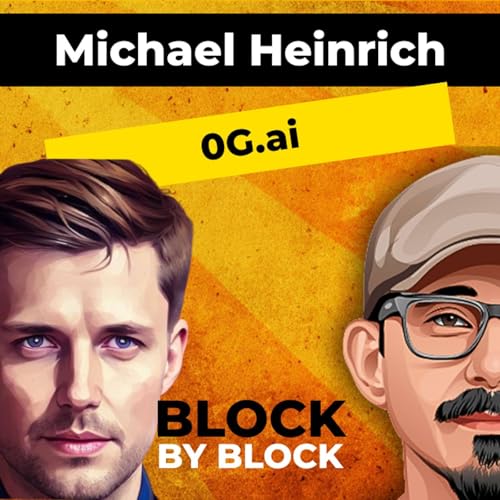
  • Michael Heinrich with Peter Abilla on 0G as the First AI Layer 1 Blockchain
    Dec 4 2025

    In this conversation, Michael Heinrich discusses his journey into the crypto space and the founding of 0G (Zero Gravity), the first AI Layer 1 blockchain. He elaborates on the unique features of 0G, including its developer-friendly ecosystem, key infrastructure components, and the importance of community engagement. Michael also addresses challenges related to data availability and scalability, blockchain marketing with Peter Abilla, as well as strategies for growth and building a vibrant community around 0G. The conversation highlights the significance of verifiability in AI and concludes with insights on the recent Kaito campaign and its impact on brand awareness.

    Takeaways

    Michael Heinrich's journey into crypto began with his interest in Bitcoin during graduate school.

    Zero G aims to be the first AI Layer 1 blockchain, designed specifically for on-chain AI applications.

    The team behind Zero G has strong backgrounds in computer science and engineering.

    Zero G offers a one-stop shop experience for developers transitioning from Web2 to Web3.

    Community engagement is crucial for the success of Zero G, with a focus on mission alignment.

    Data availability and scalability are key challenges that Zero G is addressing.
    The Zero G ecosystem includes a service marketplace for various AI applications.

    Michael emphasizes the importance of building unique experiences for users on Zero G.

    The Kaito campaign was a significant success for Zero G, boosting community involvement.

    Verifiability in AI is a major concern, and Zero G is exploring practical solutions.

    Timeline

    00:00 Introduction and Background
    03:02 The Birth of 0G
    05:53 Understanding AI Layer 1 and Zero G's Unique Position
    14:17 Key Components of Zero G's Ecosystem
    25:16 Growth Strategies and Mainnet Launch
    27:02 Building on Zero G: Ecosystem and Support
    29:58 Strategic Approaches to Application Development
    32:42 Community Engagement and Growth Strategies
    34:58 The Zero G Panda: A Fun Mascot Story
    36:53 Community Building: From Curiosity to Engagement
    39:08 Visionary Thinking: Trust and AI
    41:09 Data Verifiability: Approaches and Challenges
    43:47 The Kaito Campaign: Community Rallying and Growth
    48:03 Future Goals: Leveraging the Kaito Leaderboard

    Follow me @papiofficial on X for upcoming episodes and to get in touch with me.

    Watch these interviews and subscribe on Youtube Block by Block Show.

    See other Episodes Here. And thank you to all our crypto and blockchain guests.

    Show More Show Less
    46 mins
  • Mihir Kulkarni - Spectral Labs, Crypto AI Agents, Crypto Marketing with Peter Abilla
    Dec 3 2025

    Summary


    In this conversation, Mihir Kulkarni from Spectral Labs discusses his journey in the Web3 space, particularly his experiences at Coinbase and how they shaped his current role. He delves into the concept of AI agents in the crypto industry, emphasizing their utility and potential to enhance user experience. The discussion covers the development of Spectral Labs' products, including the collaborative nature of autonomous agents and the importance of trust in their operations. Kulkarni also explains the distinction between their products, Syntax for retail users and Lux for developers, and the collaborative ecosystem of AI agents. In this conversation, Mihir Kulkarni discusses the evolution of AI workflows, blockchain marketing with Peter Abilla, the importance of community engagement in crypto projects, and the need for self-awareness within the industry. He emphasizes the significance of user experience and the future of multi-agent technology, highlighting how these elements can drive innovation and accessibility in the crypto space.


    Takeaways


    — Mihir Kulkarni’s background in crypto began in 2017.

    — His experience at Coinbase was pivotal for his current role.

    — AI agents are designed to perform useful tasks in crypto.

    — The complexity of crypto transactions can be simplified by AI.

    — Spectral Labs focuses on creating user-friendly AI solutions.

    — Trust in AI agents is crucial for user adoption.

    — The future of agents includes ownership and profit-sharing models.

    — Syntax is aimed at retail users, while Lux targets developers.

    — Collaboration among AI agents can enhance decision-making.

    — AI agents are not competitors but collaborators in the ecosystem. Negotiation in AI workflows can enhance collaboration.

    — Community involvement is crucial for crypto project success.

    — Self-awareness in the crypto industry can lead to growth.

    — User experience should be prioritized in product design.

    — Multi-agent technology will shape the future of crypto applications.

    — Building for non-technical users is essential for adoption.

    — The crypto industry often underestimates its potential audience.

    — Bold decision-making is necessary for innovative product development.

    — AI can assist in parallel processing of ideas for content creation.

    — The future of crypto lies in simplifying user interactions.


    Chapters


    (00:00) Mihir Kulkarni’s Journey in Web3 and Coinbase

    (03:03) Introduction to Spectral Labs and AI Agents

    (06:11) The Utility of AI Agents in Crypto

    (09:03) Spectral Labs Product Overview and Development

    (12:01) Building Autonomous Agents and Community Collaboration

    (15:06) The Future of Agent Ownership and Trust

    (17:56) Syntax and Lux: Products for Retail and Developers

    (20:49) Collaboration Among AI Agents

    (23:49) The Role of Trust in AI Agent Operations

    (30:44) Negotiation and Collaboration in AI Workflows

    (34:34) Building Community in Crypto Projects

    (39:04) Self-Awareness and Industry Growth

    (43:41) The Future of User Experience in Crypto

    (47:06) Innovations in Multi-Agent Technology

    Follow me @papiofficial on X for upcoming episodes and to get in touch with me.

    Watch these interviews and subscribe on Youtube Block by Block Show.

    See other Episodes Here. And thank you to all our crypto and blockchain guests.

    Show More Show Less
    54 mins
  • Tokenizing AI Compute: Peter Abilla speaks with Kony on How Gaib Turns GPUs Into Onchain Yield
    Dec 2 2025

    Summary

    In this Block by Block episode, Peter Abilla sits down with Kony, CEO and co-founder of Gaib, to unpack how GPU tokenization can create real yield at the intersection of AI, DeFi and zero-knowledge crypto. Kony explains how his mix of finance, AI engineering and running an actual cloud business led him to see a gap: AI cloud providers have huge demand for GPUs but limited access to private credit, while crypto investors are starved for sustainable, cash flow–backed yield.


    Gaib steps into that gap by financing enterprise-grade GPU deployments, securing their cash flows, and wrapping both into tokenized products that anyone can buy on-chain. Kony walks through their two-stage due diligence, risk controls, and how they work with cloud partners, OEMs and third-party custodians to verify hardware and revenue. The conversation covers Gaib’s $2B+ pipeline, DeFi integrations like Pendle’s PT/YT structures, and the long-term plan to bridge Web2 capital markets and Web3, starting with GPUs and eventually expanding into other real-world, productive assets.


    Takeaways

    — Kony blends finance, AI engineering and cloud-operator experience, which shapes how Gaib designs GPU-backed yield products.

    — Gaib’s core mission is to deliver real yield in crypto, funded by AI infrastructure revenues instead of token emissions.

    — The team treats GPUs and their cash flows as a new on-chain asset class that can be structured, financed and traded.

    — There is a big market gap: many AI cloud providers cannot tap traditional private credit, despite strong demand for their GPUs.

    — Gaib pre-finances enterprise-grade GPUs, then gets repaid from the cloud provider’s customer revenues over time.

    — A strict, two-stage due diligence process screens partners on company data, clients, revenues, hardware and security.

    — Gaib leverages industry networks, OEM/ODM relationships and third-party custodians to verify that GPUs exist and stay where they should.

    — Current integrations like Pendle let investors split principal and yield, and more DeFi money markets are planned.

    — The GPU pipeline already exceeds 2 billion dollars in assets, still a tiny share of a rapidly growing AI compute market.

    — Long term, Gaib wants to bridge TradFi and Web3 and extend the same model to other real-world, revenue-producing assets.


    Keywords

    Gaib,GPU tokenization,AI infrastructure,real yield,DeFi,Kony,Block by Block podcast,enterprise GPUs,AI compute,Web3,TradFi,private credit,tokenized real world assets,Pendle Finance,PT YT structure,AI cloud providers,structured finance,cash flow backed tokens,zero knowledge cryptography,AI DeFi


    Chapters

    00:00:00 Introduction to Gaib, Kony’s Background and the AI x DeFi Opportunity

    00:05:56 Why Crypto Needs Real Yield and How GPU Tokenization Fills the Gap

    00:12:02 Financing Models for GPU Acquisition and Gaib’s Credit Structure

    00:17:52 Due Diligence, Risk Management and the Scale of AI GPU Demand

    00:23:57 Gaib’s DeFi Integrations, TradFi Bridge and Expansion Beyond GPUs

    Follow me @papiofficial on X for upcoming episodes and to get in touch with me.

    Watch these interviews and subscribe on Youtube Block by Block Show.

    See other Episodes Here. And thank you to all our crypto and blockchain guests.

    Show More Show Less
    43 mins
  • Naruto - Avail Project and Tips for Crypto Developer Marketing
    Dec 1 2025

    Summary


    In this conversation, Naruto, a Developer Relations professional at Avail, discusses the challenges and strategies of marketing to developers in the crypto space. He shares insights on how he transitioned from a software engineer to a DevRel role, the importance of understanding different types of developers, and the effectiveness of hackathons and hacker houses in attracting serious talent. Naruto emphasizes the need for a strong personal brand and collaborative marketing efforts with partners to reach the right audience. In this conversation, Naruto discusses the importance of building relationships with developers through individual conversations and the support provided to them in their projects. He emphasizes the cautious approach to funding and grants, focusing on genuine builders rather than grant seekers. The conversation also highlights the significance of vetting developers through due diligence, the competitive landscape of developer solutions, and the critical role of customer service in retaining developers. Naruto shares insights on the structure of developer relations within his organization and the strategies for creating content that resonates with developers.

    Takeaways

    Naruto got into crypto in 2017 and became a software engineer.

    Avail is a data availability layer that aims to improve UX and liquidity.

    Attracting developers is challenging due to the technical nature of Avail's products.

    Hackathons are not the best way to find serious developers.

    Hacker houses provide focused environments for developers to build.

    Building a personal brand on Twitter is crucial for DevRel.

    Collaborating with partners helps in reaching a wider developer audience.

    Due diligence is essential when selecting participants for hacker houses.

    Identifying long-term builders is more valuable than short-term bounty hunters.

    Engaging with developers through Discord and direct feedback is important. Building relationships with developers is crucial for success.

    Cautious funding strategies are essential to avoid grant seekers.

    Vetting developers requires a mix of subjective and objective assessments.

    Customer service plays a vital role in developer retention.

    Developer relations should ideally sit under product or engineering.

    Creating timely and relevant content attracts developers.

    Support for developers includes operational logistics and introductions to investors.

    The developer experience is critical for ecosystem loyalty.

    Engaging with the developer community fosters trust and collaboration.

    The current market presents opportunities for builders to innovate.

    Chapters


    00:00 Introduction to Developer Relations in Crypto

    03:03 Understanding Avail and Its Products

    05:58 Attracting Developers to Avail

    08:47 The Role of Hackathons and Hacker Houses

    11:59 Identifying Serious Developers

    14:53 Marketing Strategies for Hacker Houses

    17:55 Building a Personal Brand in Developer Relations

    27:59 Building Relationships Through Individual Conversations

    28:54 Funding and Support for Developer Projects

    30:29 The Importance of Developer Support

    31:40 Vetting Developers: The Due Diligence Process

    36:50 Differentiating Avail in a Competitive Market

    41:11 The Role of Customer Service in Developer Retention

    43:27 The Structure of Developer Relati

    Follow me @papiofficial on X for upcoming episodes and to get in touch with me.

    Watch these interviews and subscribe on Youtube Block by Block Show.

    See other Episodes Here. And thank you to all our crypto and blockchain guests.

    Show More Show Less
    56 mins