Around the School Table cover art

Around the School Table

Around the School Table

By: Auscast Network
Listen for free

Around the School Table" brings together the many voices shaping primary and secondary education across Australia, from principals and teachers to education thought leaders and system innovators. Whether you're in the classroom, the staff room or the boardroom, this is your podcast to be informed, inspired and connected.

About Xuno

Xuno Suite is an all-in-one school management system for Australian K–12 schools. It simplifies administration, boosts communication, and supports student wellbeing. Core features include attendance, reporting, payments, incident tracking, and a parent app for real-time updates. Teachers can manage assessments, schedules, and contact families through the platform. Additional modules like Accelerus (advanced reporting) and Student Maps (learning analytics) offer deeper insights. Xuno complies with ACARA and ST4S standards, is locally supported, and trusted by over 500,000 users nationwide.

Website: https://xuno.com.au/

Email: info@xuno.com.au

Education Language Learning Personal Development Personal Success
Episodes
  • Episode 38: Paul Matthews - Wise AI and the Future of Human Intelligence - Around the School Table by Xuno Suite
    Jun 21 2026

    In this episode of Around the School Table (xuno.com.au/podcasts), host Steve Davis is joined by Paul Matthews, Author and Education Consultant at Paul Matthews.ai (paulmatthews.ai), to explore how educators can embrace artificial intelligence without losing the human qualities that make teaching meaningful.

    Drawing on his background in humanities, leadership, and classroom teaching, Paul Matthews shares a thoughtful perspective on the opportunities and challenges AI presents for schools. Rather than viewing AI as a replacement for human thinking, Paul argues that it should be used to strengthen productivity while preserving wisdom, judgement, creativity, and authentic relationships.

    Throughout the conversation, Paul explains the difference between technological capability and wisdom. He highlights how AI can save time on routine tasks. However, he also warns that technology can intensify workloads when used without clear purpose. As a result, educators are encouraged to develop habits that align with their values and educational goals.

    The discussion also explores the concept of “organic intelligence” and why deep knowledge remains essential in an AI-powered world. Paul explains that effective AI use depends on strong domain expertise. Without that foundation, teachers and students may struggle to evaluate AI-generated content critically.

    In addition, Steve and Paul examine practical ways schools can support students. They discuss teaching responsible AI use, maintaining opportunities for pen-and-paper learning, and ensuring students continue to build confidence through cognitive effort. Furthermore, Paul shares how AI can help teachers implement evidence-based literacy practices more efficiently, making it easier for every teacher to become a literacy teacher.

    The episode also considers the future of education, the importance of intentional change, and the growing value of genuine human connection. Paul introduces his concept of “Matthews Law”, which suggests that if AI change is not intentional, it becomes accidental.

    Whether you are a classroom teacher, school leader, or education innovator, this conversation offers practical insights for navigating AI with confidence, purpose, and wisdom. Above all, Paul demonstrates how schools can use technology to support learning while keeping humanity at the centre of education.

    Powered by: xuno.com.au

    See omnystudio.com/listener for privacy information.

    Show More Show Less
    34 mins
  • Episode 37: Dr. Gina Biancarosa - Measuring Reading Growth with DIBELS - Around the School Table by Xuno Suite
    Jun 14 2026

    In this episode of Around the School Table, produced by Xuno, host Steve Davis is joined by Dr. Gina Biancarosa, Ann Swindells Chair in Education, Professor in the Department of Special Education and Clinical Sciences, and Director of the Center on Teaching and Learning at the University of Oregon (uoregon.edu), to explore the origins, purpose, and growing impact of DIBELS (Dynamic Indicators of Basic Early Literacy Skills) in schools across Australia and beyond.

    Throughout the conversation, Gina explains how DIBELS was developed to help educators identify students who may need additional support with reading. Rather than relying solely on lengthy assessments, DIBELS uses brief, targeted measures that provide valuable insights into a student's literacy development. As a result, teachers can monitor progress more frequently and make informed instructional decisions.

    The discussion explores the science behind key DIBELS assessments, including letter naming fluency, phonemic awareness, nonsense word fluency, oral reading fluency, and comprehension measures. Furthermore, Gina explains how each assessment aligns with the research on how children learn to read and develop reading comprehension over time.

    Steve and Gina also examine the importance of reading for meaning. While decoding words is essential, comprehension remains the ultimate goal. Consequently, the episode highlights why effective literacy instruction must support both accurate word recognition and deep understanding of text.

    In addition, listeners will learn how Australian educators have embraced DIBELS through professional learning communities, including the highly active DIBELS in Oz network. Gina reflects on the collaborative efforts that led to the development of an Australasian version of DIBELS, ensuring greater relevance for Australian and New Zealand students.

    The conversation also explores how literacy data can be used responsibly within broader school improvement strategies. While assessment data can guide intervention and goal-setting, Gina emphasises the importance of using DIBELS for its intended purpose rather than as a blunt accountability tool. The discussion also touches on how DIBELS data can be analysed and interpreted within broader school improvement processes using tools such as Student Maps.

    Beyond assessment, Gina shares her personal reflections on reading as a lifelong gift. From childhood favourites to supporting readers with vision impairment, she highlights the profound opportunities that literacy creates throughout life.

    This episode offers valuable insights for teachers, school leaders, literacy specialists, and education professionals seeking practical ways to support reading growth while maintaining a strong focus on student understanding and success.

    Powered by: xuno.com.au

    See omnystudio.com/listener for privacy information.

    Show More Show Less
    43 mins
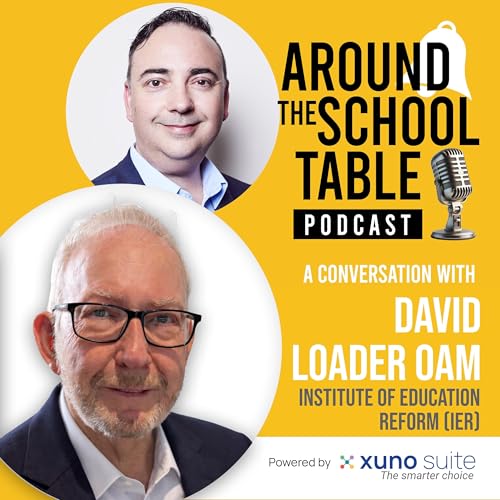
  • Episode 36: David Loader OAM - Rethinking Student Engagement in Australian Schools - Around the School Table by Xuno Suite
    May 17 2026

    In this episode of Around the School Table (xuno.com.au/podcasts), host Steve Davis is joined by David Loader OAM, Chair of the Institute of Education Reform (IER) (educationalreform.org.au), to explore one of the most urgent challenges facing Australian education: Student Disengagement.

    With research suggesting that between 30% and 50% of students are disengaged at school, David argues that attendance alone does not equal learning. Many students are physically present in classrooms, yet emotionally disconnected from their education. Others are refusing school altogether. As a result, he believes the current system must rethink how success is measured.

    Drawing on his decades of experience as former principal of Methodist Ladies’ College and Wesley College, David reflects on introducing one-to-one laptops in schools in 1989 — long before digital learning became mainstream. However, he explains that technology alone was never the solution. Instead, the real goal was creating more agency, creativity and independence for students.

    Throughout the conversation, David challenges traditional models of teaching that position students as passive learners. Instead, he advocates for schools that encourage curiosity, exploration and student voice. He also examines the growing gap between what students are taught and what they genuinely want to learn, particularly during the critical middle years of schooling.

    Furthermore, he discusses why teachers need greater freedom, why rigid curriculum structures may be limiting innovation, and how education systems must better respond to individual student needs. The episode also explores the role of educational technology, alternative schooling models, residential learning programs, and why future-ready schools must become more flexible and personalised.

    This thought-provoking conversation challenges long-held assumptions about education and offers a compelling vision for schools that prioritise engagement, agency and meaningful learning for every student.

    Powered by: xuno.com.au

    See omnystudio.com/listener for privacy information.

    Show More Show Less
    39 mins
adbl_web_anon_alc_button_suppression_t1
No reviews yet