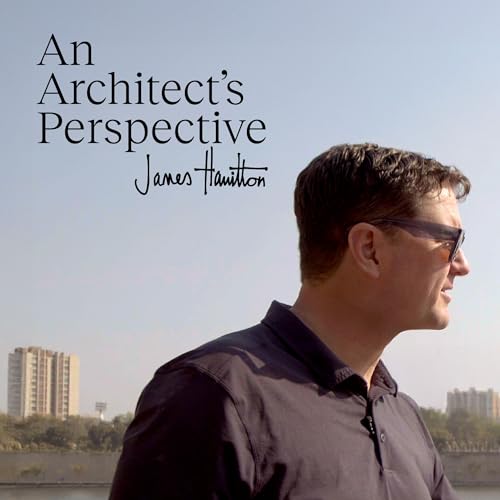
An Architect's Perspective cover art

An Architect's Perspective

An Architect's Perspective

By: James Hamilton Architects
Listen for free

Summary

An Architect's PerspectiveCopyright 2026 James Hamilton Architects Art Social Sciences Travel Writing & Commentary World
Episodes
  • The modernist buildings of India
    May 19 2026

    I’m James Hamilton, and in this episode, we turn our attention to B. V. Doshi — one of India’s most revered architects, and the first from the country to win the Pritzker Prize.

    This conversation took place in 2018, at his home in Ahmedabad. What unfolded was more than a professional interview. It was a rare, personal insight into the philosophy and life story of a man who saw architecture not just as construction, but as culture.

    Doshi speaks about his early years working with Le Corbusier and Louis Kahn, his love of Indian tradition, and his belief in architecture as a social act. We talk about the importance of shade and breeze, the meaning of thresholds, and why life—not form—should always be the starting point for design.

    This episode isn’t just about buildings. It’s about attention. About values. About how we choose to live, and what architecture can do to support that.

    Key Moments & Topics of Conversation

    ● Working under Le Corbusier and how it shaped Doshi’s sensibility

    ● Founding School of Architecture and CEPT University in Ahmedabad

    ● Why he believed modernism must be adapted to Indian culture and climate

    ● Reflections on Aranya Housing, Sangath, and IIM Bangalore

    ● Architecture as a form of storytelling and spatial choreography

    ● The body, the senses, and the everyday as foundations of design

    ● A deep commitment to community, humility, and place

    Balkrishna Vithaldas Doshi (1927–2023) was an architect, educator, and urbanist whose work defined post-independence architecture in India. Known for combining modernist principles with vernacular sensitivity, his legacy includes over 100 built projects and generations of students. He was awarded the Pritzker Prize in 2018.


    Host Info

    James Hamilton, founder of James Hamilton Architects. Trained at Cambridge and Harvard, James brings a practitioner’s eye to every episode - offering grounded insight, clear storytelling, and a deep respect for the buildings under discussion.


    Links and Resources

    ● James Hamilton Architects

    ● Watch the full episode on YouTube

    ● CEPT University

    ● Sangath Studio Project Page (Vastushilpa Foundation)

    ● Aranya Low Cost Housing


    Quotes

    “Architecture is not the building. It’s the space between the buildings. It’s the thresholds. The breeze. The possibility of meeting.”

    “You don’t design from the mind. You design from the body — from the senses, from experience, from life itself.”

    “What we need is not monuments. We need memories. And memory comes from living well.”


    Website: www.jameshamiltonarchitects.com

    Instagram: @jameshamiltonarchitects

    Production: OneFinePlay.com

    Show More Show Less
    11 mins
  • The most radical cricket stadium in India
    May 12 2026

    This is a conversation about more than just sports architecture. It’s about the intersection of land, politics, and public life. Correa’s stadium doesn’t dominate its site—it rests lightly on it, more pavilion than monument. It invites people in, rather than fencing them out. And it’s shaped as much by the climate as it is by the culture.

    We’re in Ahmedabad, at the Sardar Vallabhbhai Patel Stadium, designed by Charles Correa in the early 1980s. It’s one of his most radical works—at once minimal, monumental, and deeply democratic. To unpack this building’s meaning and its legacy, I’m joined by architect, urbanist, and professor Rahul Mehrotra.

    Rahul brings an insightful and generous reading of the project, drawing connections between Correa’s design principles and broader questions of civic space in India today.

    If you’ve ever thought stadiums were all about scale and spectacle, this episode might just change your mind.

    Key Moments & Topics of Conversation

    ● The design logic and spatial strategy of the Patel Stadium

    ● How Correa subverted conventional stadium typologies

    ● The relationship between the architecture and the Ahmedabad landscape

    ● Rahul’s personal experiences at the stadium growing up

    ● Shade, breeze, and climate as structuring forces in tropical architecture

    ● Civic architecture as a platform for democracy and inclusion

    ● Correa’s legacy as seen through the lens of the stadium


    Guest Info

    Rahul Mehrotra is an architect, urbanist, and educator. He is the founder of RMA Architects and Professor of Urban Design and Planning at Harvard GSD. Rahul’s work spans design,

    research, and activism, with a deep commitment to the built environment of India and the global South.


    Links and Resources

    ● James Hamilton Architects

    ● RMA Architects

    ● Charles Correa Foundation

    ● Sardar Patel Stadium Project Page

    ● Watch the full episode on YouTube


    Quotes

    “It’s a building that breathes with the land. Not something you arrive at, but something you’re already in.”

    “There’s a generosity to the design—a refusal to monumentalise, a willingness to serve.”

    “This is a stadium where cricket is an event, yes, but it’s also a gathering, a celebration of community.”


    Website: www.jameshamiltonarchitects.com

    Instagram: @jameshamiltonarchitects

    Production: OneFinePlay.com

    Show More Show Less
    40 mins
  • Nondita Mehrotra on Correa's living legacy
    May 5 2026

    I’m James Hamilton, and in this episode, we explore a building that transcends architecture to touch on something far deeper: dignity, restraint, and national memory.

    We’re in Ahmedabad, India, at the Gandhi Ashram - designed by Charles Correa, one of the most influential figures in tropical modernism. And joining me is Nondita Mehrotra, an architect and academic whose life and work intersect closely with Correa’s legacy.

    What does it mean to build a space that honours a life like Gandhi’s? How do you design without ego, while still creating something resonant and lasting? In this conversation, Nondita helps unpack the nuanced genius of Correa’s ashram - a building that manages to be both modest and monumental.

    Together, we explore themes of cultural memory, architecture’s role in healing, and the ethics of representation. This is not just a story about one building. It’s about architecture as a form of empathy - and about what modernism can look like when it’s rooted in context, not ideology.

    So let’s step inside this space of quiet power.

    Key Moments & Topics of Conversation

    ● Charles Correa’s design philosophy and lifelong commitment to human-centric architecture

    ● The Gandhi Ashram as a case study in restraint, symbolism, and architectural humility

    ● Nondita’s perspective on working with legacy and place as an Indian woman architect

    ● The spatial rhythm of the ashram, and how it shapes visitor experience

    ● Reflections on climate, materiality, and spiritual atmosphere in Correa’s work

    ● What it means to design for national memory without monumentality

    ● The evolving relevance of tropical modernism today


    Guest Info

    Nondita Mehrotra is an architect and educator whose work focuses on contemporary architecture in India, with a special interest in cultural institutions and the legacy of post-independence modernism. She is the daughter of Charles Correa and works actively to advance his architectural and civic vision.


    Links and Resources

    ● James Hamilton Architects

    ● Charles Correa Foundation

    ● Gandhi Ashram, Ahmedabad

    ● An Architect’s Perspective on YouTube


    Quotes

    “He didn’t try to replicate Gandhi’s life in the form. He let the light, the air, the silence do the work.”

    “It’s one of the only national memorials I know that doesn’t feel like it’s trying to impress you.”

    “The building never says ‘look at me.’ But somehow, you do.”


    Website: www.jameshamiltonarchitects.com

    Instagram: @jameshamiltonarchitects

    Production: OneFinePlay.com

    Show More Show Less
    41 mins
adbl_web_anon_alc_button_suppression_c
No reviews yet