About Bees, Culture & Curiosity cover art

About Bees, Culture & Curiosity

About Bees, Culture & Curiosity

By: Ron Miksha
Listen for free

Season's Savings | £0.99/mo for 3 months

£5.99/mo after 3 months - terms apply. Cancel monthly
Bees of all sorts are the engines of agriculture and the glue of ecology. Join us as we explore everything About Bees, Culture, and Curiosity.2025 Nature & Ecology Science Social Sciences
Episodes
  • Why Join a Bee Society? Scott Steinfeldt on WAS
    Oct 18 2026

    Season 10 Episode 4: About Bees, Culture & Curiosity Podcast – Why Join a Bee Society? Scott Steinfeldt on WAS

    What does a bee society offer when beekeeping advice is already everywhere online?

    Scott Steinfeldt, president of the Western Apicultural Society of North America (WAS), joins me, Ron Miksha, to discuss trusted information, practical education, and the value of a beekeeping community.

    Scott describes keeping bees high in Montana's mountains, growing a queen and nucleus-colony business, and stepping into WAS leadership when the organization's future was uncertain.

    In this conversation:
    • Scott's journey from one package of bees to around 100 hives
    • Why regional beekeeping knowledge matters
    • WAS's vetted resources and interactive online mini-conferences
    • Educational support and speakers for local bee clubs
    • Reaching younger beekeepers
    • Research, scholarships, volunteers, and funding
    • Native pollinator habitat
    • Plans for a virtual vendor hall and a hybrid conference in 2028

    Learn more about WAS:
    https://www.westernapiculturalsociety.org/

    This podcast was

    Recorded October 2026 in Calgary.

    Please subscribe, like, love, and follow. We live or die by your adulation.

    Podcast website: https://sites.libsyn.com/540327/site
    About Ron Miksha: miksha.com

    Finally: email your questions, comments, and angst: miksha@gmail.com

    Show More Show Less
    1 hr and 15 mins
  • More Sugar, Less Protein: Rising CO₂ in Plants and Pollen
    Oct 15 2026

    Season 10 Episode 3: About Bees, Culture & Curiosity Podcast – More Sugar, Less Protein: Rising CO₂ in Plants and Pollen

    More carbon dioxide helps plants grow.

    But does more plant growth mean more nutritious food?

    In this episode of About Bees, Culture, and Curiosity, we look at what rising atmospheric CO₂ may be doing to plant chemistry. And to the food eaten by people, insects, and bees.

    Some plants accumulate more sugars and starch while containing less protein, nitrogen, iron, zinc, and other nutrients. Vegetables can become sweeter while becoming less nutrient-dense. Leaf-eating insects may consume more plant material yet grow more slowly.

    And then there is pollen.

    A remarkable study of Canada goldenrod found that pollen protein declined sharply as atmospheric CO₂ rose. But newer research complicates the story: buckwheat pollen did not follow the same pattern, and sunflower pollen showed dramatic changes in compounds such as quercetin.

    Along the way, we meet Shakespeare's Rosalind, revisit the claim that "CO₂ is plant food," look at C3 and C4 plants, and ask:

    Can one desire too much of a good thing?

    The answer, as usual in biology, is complicated.

    This podcast was

    Recorded October 2026 in Calgary.

    Please subscribe, like, love, and follow. We live or die by your adulation.

    Podcast website: https://sites.libsyn.com/540327/site
    About Ron Miksha: miksha.com

    Finally: email your questions, comments, and angst: miksha@gmail.com

    Show More Show Less
    50 mins
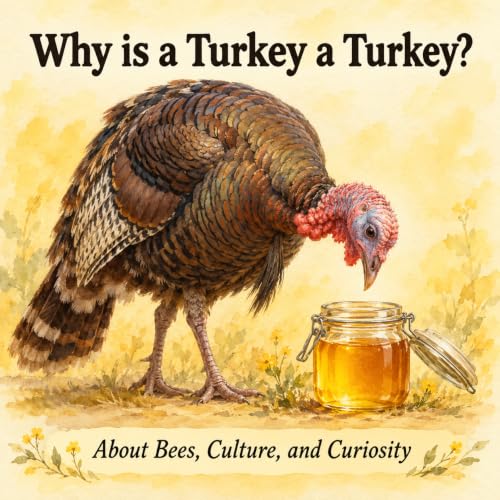
  • Why is a Turkey a Turkey?
    Oct 10 2026

    Season 10 Episode 2: About Bees, Culture & Curiosity Podcast – Why is a Turkey a Turkey?

    Why is a bird native to North America called a turkey?

    The answer takes us from Mexico to Spain, Africa, the Ottoman Empire (Turkey), France, England, and eventually back across the Atlantic on the Mayflower. Along the way, an American bird gets mistaken for an African one, the English name it after Turkey, the French send it linguistically to India, while the Turks call the Turkey the Hindi, the Indian.

    With Canadian Thanksgiving approaching, I follow that strange history back to the Thanksgiving table.

    We meet the Wampanoag and Massasoit, look at what probably happened at the Plymouth harvest celebration of 1621, and ask how English settlers and Indigenous people who spoke completely different languages managed to talk to each other.

    We also look north. Why does Canada celebrate Thanksgiving in October while Americans wait until November? And why do the two holidays feel a little different?

    Then there is the honey.

    Honey on Thanksgiving buns. Honey-glazed carrots and sweet potatoes. Honey ham. Honey mustard. But enormous quantities of honey also disappear almost unnoticed into cereal, bread, crackers, granola bars and hundreds of other manufactured foods.

    A Thanksgiving meal looks familiar and local. Look more closely, though, and it becomes a map of migration, agriculture, trade, language—and bees.

    This podcast was

    Recorded October 2026 in Calgary.

    Please subscribe, like, love, and follow. We live or die by your adulation.

    Podcast website: https://sites.libsyn.com/540327/site
    About Ron Miksha: miksha.com

    Finally: email your questions, comments, and angst: miksha@gmail.com

    Show More Show Less
    38 mins
adbl_web_anon_alc_button_suppression_t1
No reviews yet