• Canada's Beekeepers at a Crossroads, with Connie Phillips
    4 Nov 2026

    Behind commercial beekeeping are beekeepers managing colonies, replacing losses, providing pollination and trying to keep their businesses viable.

    In this episode of About Bees Culture and Curiosity, Ron welcomes Connie Phillips, Executive Director of the Canadian Beekeepers Federation, for a conversation about the people, policies and practical challenges shaping Canadian beekeeping.

    Connie describes her path from public service into agricultural advocacy and her work with the Alberta Beekeepers Commission. We explore the Canadian Beekeepers Federation's priorities, the long-running debate over U.S. package bees, and efforts to develop dependable replacement stock and regionally adapted bees.

    Our conversation also considers honey authenticity, consumer education and Connie's call for greater recognition of pollination in food-security policy. Along the way, we touch on her involvement in wildlife rehabilitation and the importance of understanding animals before trying to help them.

    What might Canadian beekeepers accomplish by working together on shared concerns? And how can consumers better understand the work behind a jar (or barrel) of honey?

    In this episode

    • Connie's route into beekeeping advocacy

    • The Canadian Beekeepers Federation's priorities

    • Agricultural commissions and industry organizations

    • The history and debate surrounding U.S. package-bee imports

    • Winter losses, replacement colonies and regional breeding

    • Honey authenticity and consumer confidence

    • Pollination, farming and food security

    • Cooperation across the Canadian beekeeping industry

    Learn more about the Canadian Beekeepers Federation:
    https://canadianbeekeepers.ca/

    Season 10 Episode 8: About Bees, Culture & Curiosity Podcast – Canada's Beekeepers at a Crossroads, with Connie Phillips

    Support this Podcast! Like, Follow, and buy me Gallons of Coffee here: ko-fi.com/miksha

    This podcast was

    Recorded and produced by Ron Miksha in November 2026 in Calgary.

    Please subscribe, like, love, and follow. We live or die by your adulation.

    Podcast website: https://sites.libsyn.com/540327/site
    About Ron Miksha: miksha.com

    Finally: email your questions, comments, and angst: miksha@gmail.com

    Daha fazlasını göster Daha Az Göster
    51 dk.
  • A Little Halloween Buzz
    30 Oct 2026

    A little Halloween history, a little honey, and some little bees at the door. This short episode chats about the origins of Halloween, honey as a Halloween treat, and dressing unfortunate little children as bees for trick-or-treating. A short, seasonal listen with a bee-themed twist.

    Season 10 Episode 7: About Bees, Culture & Curiosity Podcast – A Little Halloween Buzz

    Support this Podcast! Like, Follow, and buy me Gallons of Coffee here: ko-fi.com/miksha

    This podcast was

    Recorded and produced by Ron Miksha in October 2026 in Calgary.

    Please subscribe, like, love, and follow. We live or die by your adulation.

    Podcast website: https://sites.libsyn.com/540327/site
    About Ron Miksha: miksha.com

    Finally: email your questions, comments, and angst: miksha@gmail.com

    Daha fazlasını göster Daha Az Göster
    10 dk.
  • Honey Bump and Pumpkin Bust with Joe
    28 Oct 2026

    Season 10 Episode 6: About Bees, Culture & Curiosity Podcast – Honey Bump and Pumpkin Bust with Joe

    Support this Podcast! Like, Follow, and buy me Gallons of Coffee here: ko-fi.com/miksha

    What makes a great honey year? And why can the same season be difficult for pumpkins?

    Joe McShaw, owner of Honeymoon Acres in Wisconsin, joins his brother Ron Miksha for a conversation about farming, beekeeping, and adapting to changing conditions. Joe reports harvesting approximately 1,800 pounds of honey from 12 hives in 2026. He explains why he thinks the weather suited his bees, even as drought complicated his pumpkin crop.

    The brothers discuss the loss of clover and alfalfa forage, Joe's concerns about agricultural chemicals, and the practical work of preparing colonies for winter. Joe also describes his compact honey-extraction setup and his approach to finding new horticultural products for his business.

    The conversation ranges beyond the apiary, from a plant that attracted monarch butterflies to the challenges of organic certification and Joe's proposal for testing produce for chemical residues.

    A candid conversation between brothers about what worked, what struggled, and what they're still trying to understand.

    Episode highlights
    • Joe's reported 1,800-pound honey harvest from 12 hives

    • Why weather that helped the bees challenged the pumpkin crop

    • Squash bees, honeybees, and pumpkin pollination

    • Clover, alfalfa, and Wisconsin's changing agricultural landscape

    • Honey removal, sugar feeding, and winter preparation

    • Extracting honey in a small workspace

    • Monarch-attracting plants and experiments with new nursery products

    • Joe's ideas about food labels and residue testing

    This podcast was

    Recorded and produced by Ron Miksha in October 2026 in Calgary.

    Please subscribe, like, love, and follow. We live or die by your adulation.

    Podcast website: https://sites.libsyn.com/540327/site
    About Ron Miksha: miksha.com

    Finally: email your questions, comments, and angst: miksha@gmail.com

    Daha fazlasını göster Daha Az Göster
    1 sa. ve 22 dk.
  • Yellow-Legged Hornets: Why Bees Stop Foraging
    25 Oct 2026

    Season 10 Episode 5: About Bees, Culture & Curiosity Podcast – Yellow-Legged Hornets: Why Bees Stop Foraging

    A hornet hovers outside a hive. It catches a bee. Then something less obvious happens: fewer bees leave to forage. The flowers may still be there, but the colony's food supply begins to falter. The bees have been watching and are paralyzed by fright.

    In this episode of About Bees, Culture, and Curiosity, we follow the yellow-legged hornet, Vespa velutina, from its Asian origins to its European invasion and its first confirmed U.S. detection near Savannah, Georgia, in 2023. What makes this predator a problem for honey bees? Why is it different from the so-called "murder hornet"? And how far might it spread across North America?

    We explore foraging paralysis, overwintering queens, the limits of climate maps, and the challenge of finding nests before new queens disperse. We also consider risks to people, ways to protect apiaries, and why indiscriminate trapping can harm the insects we hope to protect.

    A story about invasive species, careful observation, and the surprising amount of ecology taking place at a hive entrance.

    This podcast was

    Recorded and produced by Ron Miksha in October 2026 in Calgary.

    Please subscribe, like, love, and follow. We live or die by your adulation.

    Podcast website: https://sites.libsyn.com/540327/site
    About Ron Miksha: miksha.com

    Finally: email your questions, comments, and angst: miksha@gmail.com

    Daha fazlasını göster Daha Az Göster
    51 dk.
  • Why Join a Bee Society? Scott Steinfeldt on WAS
    18 Oct 2026

    Season 10 Episode 4: About Bees, Culture & Curiosity Podcast – Why Join a Bee Society? Scott Steinfeldt on WAS

    What does a bee society offer when beekeeping advice is already everywhere online?

    Scott Steinfeldt, president of the Western Apicultural Society of North America (WAS), joins me, Ron Miksha, to discuss trusted information, practical education, and the value of a beekeeping community.

    Scott describes keeping bees high in Montana's mountains, growing a queen and nucleus-colony business, and stepping into WAS leadership when the organization's future was uncertain.

    In this conversation:
    • Scott's journey from one package of bees to around 100 hives
    • Why regional beekeeping knowledge matters
    • WAS's vetted resources and interactive online mini-conferences
    • Educational support and speakers for local bee clubs
    • Reaching younger beekeepers
    • Research, scholarships, volunteers, and funding
    • Native pollinator habitat
    • Plans for a virtual vendor hall and a hybrid conference in 2028

    Learn more about WAS:
    https://www.westernapiculturalsociety.org/

    This podcast was

    Recorded October 2026 in Calgary.

    Please subscribe, like, love, and follow. We live or die by your adulation.

    Podcast website: https://sites.libsyn.com/540327/site
    About Ron Miksha: miksha.com

    Finally: email your questions, comments, and angst: miksha@gmail.com

    Daha fazlasını göster Daha Az Göster
    1 sa. ve 15 dk.
  • More Sugar, Less Protein: Rising CO₂ in Plants and Pollen
    15 Oct 2026

    Season 10 Episode 3: About Bees, Culture & Curiosity Podcast – More Sugar, Less Protein: Rising CO₂ in Plants and Pollen

    More carbon dioxide helps plants grow.

    But does more plant growth mean more nutritious food?

    In this episode of About Bees, Culture, and Curiosity, we look at what rising atmospheric CO₂ may be doing to plant chemistry. And to the food eaten by people, insects, and bees.

    Some plants accumulate more sugars and starch while containing less protein, nitrogen, iron, zinc, and other nutrients. Vegetables can become sweeter while becoming less nutrient-dense. Leaf-eating insects may consume more plant material yet grow more slowly.

    And then there is pollen.

    A remarkable study of Canada goldenrod found that pollen protein declined sharply as atmospheric CO₂ rose. But newer research complicates the story: buckwheat pollen did not follow the same pattern, and sunflower pollen showed dramatic changes in compounds such as quercetin.

    Along the way, we meet Shakespeare's Rosalind, revisit the claim that "CO₂ is plant food," look at C3 and C4 plants, and ask:

    Can one desire too much of a good thing?

    The answer, as usual in biology, is complicated.

    This podcast was

    Recorded October 2026 in Calgary.

    Please subscribe, like, love, and follow. We live or die by your adulation.

    Podcast website: https://sites.libsyn.com/540327/site
    About Ron Miksha: miksha.com

    Finally: email your questions, comments, and angst: miksha@gmail.com

    Daha fazlasını göster Daha Az Göster
    50 dk.
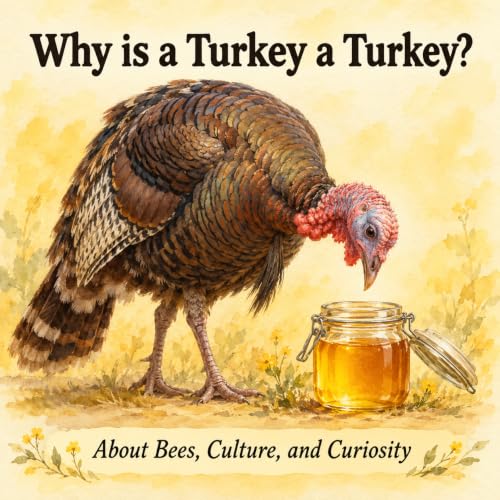
  • Why is a Turkey a Turkey?
    10 Oct 2026

    Season 10 Episode 2: About Bees, Culture & Curiosity Podcast – Why is a Turkey a Turkey?

    Why is a bird native to North America called a turkey?

    The answer takes us from Mexico to Spain, Africa, the Ottoman Empire (Turkey), France, England, and eventually back across the Atlantic on the Mayflower. Along the way, an American bird gets mistaken for an African one, the English name it after Turkey, the French send it linguistically to India, while the Turks call the Turkey the Hindi, the Indian.

    With Canadian Thanksgiving approaching, I follow that strange history back to the Thanksgiving table.

    We meet the Wampanoag and Massasoit, look at what probably happened at the Plymouth harvest celebration of 1621, and ask how English settlers and Indigenous people who spoke completely different languages managed to talk to each other.

    We also look north. Why does Canada celebrate Thanksgiving in October while Americans wait until November? And why do the two holidays feel a little different?

    Then there is the honey.

    Honey on Thanksgiving buns. Honey-glazed carrots and sweet potatoes. Honey ham. Honey mustard. But enormous quantities of honey also disappear almost unnoticed into cereal, bread, crackers, granola bars and hundreds of other manufactured foods.

    A Thanksgiving meal looks familiar and local. Look more closely, though, and it becomes a map of migration, agriculture, trade, language—and bees.

    This podcast was

    Recorded October 2026 in Calgary.

    Please subscribe, like, love, and follow. We live or die by your adulation.

    Podcast website: https://sites.libsyn.com/540327/site
    About Ron Miksha: miksha.com

    Finally: email your questions, comments, and angst: miksha@gmail.com

    Daha fazlasını göster Daha Az Göster
    38 dk.
  • Killing the Drones
    8 Oct 2026

    Season 10 Episode 1: About Bees, Culture & Curiosity Podcast – Killing the Drones

    As autumn arrives, worker honey bees turn against the drones they fed and tolerated all summer. But what triggers their eviction? Is it cold, shorter days, dwindling forage or something else? We explore the strange seasonal ritual known as the killing of the drones, including what happens in tropical colonies and whether an expelled drone understands what is happening to him.

    This podcast was

    Recorded October 2026 in Calgary.

    Please subscribe, like, love, and follow. We live or die by your adulation.

    Podcast website: https://sites.libsyn.com/540327/site
    About Ron Miksha: miksha.com

    Finally: email your questions, comments, and angst: miksha@gmail.com

    Daha fazlasını göster Daha Az Göster
    35 dk.