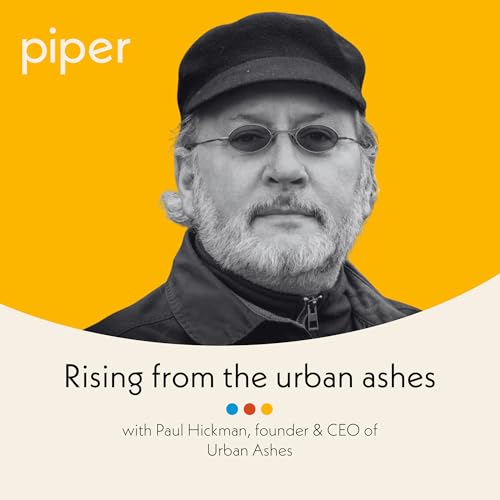
• Rising from the urban ashes with Paul Hickman
    Jan 20 2026

    According to the US Forest Service, 36 million trees are removed from urban areas every year. These trees offer a tremendous opportunity to reduce some of the demand on forests. But, this quality wood that could be used in furniture or the built environment, is more commonly chipped, incinerated or landfilled. Luckily, there are people working to change that.

    Paul Hickman, founder of the urban wood consultancy company Urban Ashes, is one such person. Through Urban Ashes, he's working with municipalities throughout the country to create the systems that maximize the life and value of fallen urban trees.

    In this episode, Paul shares how going from a design project manager in the Midwest to a forklift driver in the Bay Area opened his eyes to urban lumber and the impact it can have on the planet.

    Show More Show Less
    35 mins
  • Five innovators from Greenbuild '25
    Jan 1 2026

    What do a battery-operated induction range, hemp insulation, a straw-based structural insulated panel (SIP), a whole-life carbon visualization tool, and product transparency software have in common?

    Well, for starters, they were all at this year's Greenbuild conference. But more importantly, they're all key pieces of the puzzle when it comes to reducing the carbon footprint of the built environment––and making it healthier and more resilient.

    From the products and solutions on the expo floor to the session topics at Greenbuild this year, it was clear that there is a resounding urgency to adopt whole lifecycle design thinking, and simplify and streamline the specification and procurement of sustainable, healthy materials. And Copper, Green Fox, Verdant Panel, C. Scale and Sustainable Minds are some of the innovators working to pave that path.

    Show More Show Less
    22 mins
  • Understanding materials through the lens of data with Melanie De Cola
    Dec 11 2025

    In 2009, the American Institute of Architects launched the AIA 2030 Commitment, a strategy and framework that takes direct aim at reaching net-zero emissions in the built environment.

    Naturally, design and building materials are bedrock to achieving that goal. And so, in 2018, the AIA introduced the Architecture & Design (A&D) Materials Pledge and formally adopted it in 2020. Since then, more than 300 firms have committed to improving their material selection process across the pledge's five impact areas: human health, social health and equity, ecosystem health, climate health and circular economy.

    And holding true to the old adage, "You can't manage what you don't measure," in 2023, the AIA opened voluntary reporting to signatory firms with the goal of tracking trends and better understanding optimization strategies to help the industry as a whole progress.

    And as Melanie De Cola, director of climate action pledge programs at the AIA, explains, despite only having two years of data to reflect on, their still starting to see some insightful patterns emerge.

    Show More Show Less
    12 mins
  • LEED v5: The path to building product transparency with Wes Sullens
    Nov 14 2025

    Responsible material selection and procurement is keystone to lowering the environmental impact of the built environment and improving occupant health over the entire life cycle of the building.

    In recognizing this, most green building certifying bodies are continuously evaluating how to rate and measure materials, and how to reward projects for prioritizing the use of those that are multi-attribute––in other words, materials that address carbon, ecosystem and human health, equity and circularity.

    In fact, under LEED v5, the USGBC just rolled out its Building Product Selection and Procurement credit, which provides a framework for material selection––and it was the topic du jour at this year's Green Build conference.

    Naturally, it was met with equal parts excitement and questions. Luckily, Wes Sullens, director of materials and resources at USGBC, was there to unpack the details.

    Show More Show Less
    21 mins
  • From Story to Seed to Shelter: A Library Emerges from the Badlands
    Oct 31 2025

    The badlands of North Dakota, much like a library, are rich with story. The layers of mineral deposits visible in the buttes and hoodoos that make up the region are like raconteurs of the ancient inland seas, floodplains and volcanic ash that once covered the area 28 to 75 million years ago. But while the badlands are now cherished for their beauty and history, they were given that name long ago for a reason. They're rigid, arid and harsh––a beautiful place to visit, a difficult place to traverse.

    But in the 1880s, when Theodore Roosevelt arrived in the region, he saw something different. To him, the Badlands became a place of reflection, introspection, healing, and deep connection to nature. In fact, Roosevelt said his time in the North Dakota Badlands was one of the foundational experiences of his life. And so, it was fitting that the area would become the home of the Theodore Roosevelt Presidential Library. And that's where the architecture and design firm Snohetta comes into the picture.

    Not only did the team see the rich story embedded in the landscape, they saw various pathways to connect people to TR's legacy and the historical significance of the land, while restoring the diminished ecology of the Badlands prairie. It was likely this vision and deep respect for the landscape that contributed to Snohetta being selected out of some 40 other candidates.

    From that point, the team embarked on an ambitious journey that would entail a rigorous set of sustainability goals––zero energy, zero water, zero emissions, zero waste––a number of firsts and the creation of the Native Plant Project.

    It's been said that the badlands are a great place to learn about geology, and that, in large part, was where Matt McMahon, director of landscape architecture, and Aaron Dorf, director of architecture at Snohetta, started their journey.

    Show More Show Less
    51 mins
  • Reimagining buildings as circular systems with Marcus Hopper
    Oct 23 2025

    Can buildings be circular systems? Unlocking overlooked opportunity

    If we were to think of buildings as living beings, how might that change the way we approach their design? Rather than thinking of them as static objects, they might become dynamic, responsive and adaptive systems––designed to continuously evolve and regenerate. They might have metabolisms in which their resources are reused in a closed-loop system rather than introducing a constant stream of new materials.

    They might be designed for adaptability to adjust to the needs of their occupants over time. And, their full lifecycle might be considered from the start, where components are designed for disassembly and can be reused or recycled at the end of their useful life.

    And that's exactly what Marcus Hopper, project director and senior associate in the Gensler San Francisco office, urges designers to consider––design with the end in mind. What is the second life of that material or component?

    Show More Show Less
    56 mins
  • Turning to history to decarbonize the future with Carl Elefante
    Oct 16 2025

    Are we too quick to turn to technology and novelty to solve today's most pressing challenges? Perhaps history and nature hold the answers to modern-day dilemmas––particularly those related to environmental degradation.

    That is the stance architect, past AIA president and now author, Carl Elefante takes. Though he's been preaching that message for more than a decade now, he didn't begin his architectural career with that mentality. In fact, it was about midway through his career that an important shift occurred for him. He began to see historic buildings in a new light––suddenly they had something to teach him rather than the other way around.

    He began to see the inherent flaws in modern-day cities and buildings––that they've been built around machines rather than people and planet. And he began to see how historic buildings actually addressed the carbon conundrum better than most of the buildings of the last half century. And now he's working to rally his peers to rethink some of the assumptions born out of the modern era.

    In this episode, Carl shares the significance of existing buildings in sustainability, the evolution of carbon awareness in architecture, and the lessons that can be learned from historic architecture. He emphasizes the role of architects in promoting sustainability, the complexities of carbon emissions and the need for operational efficiency in building design. He also highlights the importance of shifting towards people-centric design in urban planning.

    Show More Show Less
    1 hr and 9 mins
  • Carbon smart: Is all wood good? with Jason Grant
    Oct 9 2025

    We need forests. They're the lungs of the earth. They're also home to more plants and animals than any other terrestrial biome. They protect watersheds and mitigate flooding. Provide us humans with recreation, inspiration and well-being. And, of course, they contain vast amounts of carbon and the ability to draw down much of the carbon currently in the atmosphere.

    And it's because of this carbon-sequestering quality that wood products––particularly those in the building industry––have come to be deemed as "carbon neutral" or "carbon negative". And while wood may be the lower-carbon option compared to concrete or steel, there's much more to the story.

    As Jason Grant, manager for corporate engagement on the forest team at the World Wildlife Fund, explains, not all wood is created equal. In fact, not all wood is good. To truly understand the carbon impact of a wood product, one first has to understand the forestry practices used to harvest it and how carbon flows through various types of forests––something Jason often illustrates through his leaky-bucket analogy.

    In this episode, Jason shares how management practices impact carbon, why lifecycle assessments (LCAs) don't provide the full picture and how to source climate-smart wood.

    Show More Show Less
    47 mins