Work Forces cover art

Work Forces

Work Forces

By: Work Forces
Listen for free

Only £0.99 a month for the first 3 months. Pay £0.99 for the first 3 months, and £8.99/month thereafter. Renews automatically. Terms apply. Start my membership

About this listen

Seeking to optimize your organization for the future of work and learning? Join workforce and education strategists Julian Alssid and Kaitlin LeMoine as they speak with the innovators who are shaping the future of workforce and career preparation. Together, they will unpack the big problems these individuals are solving and discuss the strategies and tactics that really work. This bi-weekly show is for practitioners and policymakers looking for practical workforce and learning solutions that can be scaled and sustained.2025 Economics
Episodes
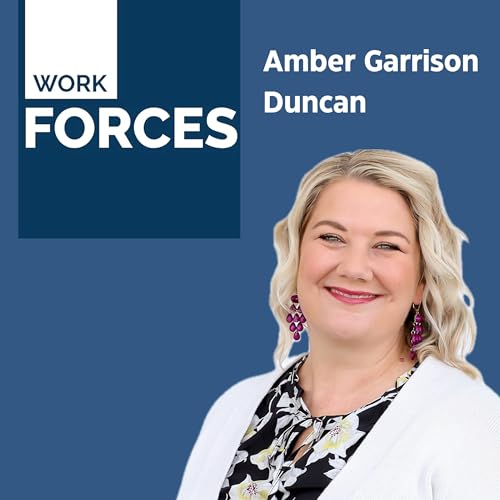
  • Amber Garrison Duncan: Advancing Competency-Based Education
    Dec 2 2025
    Amber Garrison Duncan, Executive Vice President and Chief Operating Officer of the Competency-Based Education Network (C-BEN), discusses the evolution of competency-based education from seven pioneering institutions in 2013 to over 600 institutions and 1,000 programs today. Drawing from her experience assessing co-curricular learning outcomes in traditional higher education and later as a grantmaker at Lumina Foundation, Garrison Duncan explains how CBE restores the promise of economic mobility by focusing on mastery of skills rather than seat time. She details C-BEN's systems-level work through initiatives like the Center for Skills and the Partnership for Skills Validation, which build consensus across K-12, higher education, and employers on quality standards for skills assessment and validation. The conversation explores how policy shifts like Workforce Pell and state-level innovations in Alabama, Arkansas, and Texas are accelerating the movement toward skills-based credentials, financial aid, and talent management systems. Duncan emphasizes the urgency of iterative innovation, comparing the current moment to the iPhone era where institutions must test and adapt quickly rather than waiting for lengthy pilot programs, and offers practical guidance for institutions to begin their CBE journey using C-BEN's Quality Framework while building authentic connections between learning outcomes and employer needs. Transcript Julian Alssid: Welcome to the Work Forces Podcast. I'm Julian Alssid. Kaitlin LeMoine: And I'm Kaitlin LeMoine, and we speak with innovators who are shaping the future of work and learning. Julian Alssid: Together, we unpack the complex elements of workforce and career preparation and offer practical solutions that can be scaled and sustained. Kaitlin LeMoine: This podcast is an outgrowth of our Work Forces Consulting practice. Through weekly discussions, we seek to share the trends and themes we see in our work and amplify impactful efforts happening in higher education industry and workforce development all across the country. We are grateful to Lumina Foundation for its past support during the initial development and launch of this podcast, and invite future sponsors of this effort, please check out our workforces podcast website to learn more. And so with that, let's dive in. Julian Alssid: You know, Kaitlin, it feels like just yesterday, but it was actually over a dozen years ago now that we were helping to launch College for America at Southern New Hampshire University, which was one of the very first competency-based education models. And back then CBE, it felt like a radical experiment, you know, trying to prove that demonstrating mastery of competencies and not seat time in a course was the key metric to helping people advance their education and careers. Kaitlin LeMoine: Yeah, it's true. And while it does feel like that was just yesterday, the competency based movement has come so far in so many years. While CBE is still viewed as an alternative, non traditional approach by some in the field of education and training, many institutions have and are continuing to holistically implement competency based models to go beyond the traditional credit hour and ensure a curricular emphasis on what learners can do with what they know, and as we think about the intersection of work and learning in which we're all operating, this movement has only been further strengthened as employers further focus on skills based hiring and learners seek to clearly communicate their skills and abilities in a competitive job market. Julian Alssid: Yes, and our guest today is with an organization that's been central to growing the CBE field, Amber Garrison Duncan is Executive Vice President and Chief Operating Officer of the Competency-Based Education Network, or C-BEN. In her role, Amber spearheads initiatives to strengthen collaboration between education and workforce partners with a focus on competency and skill taxonomies and quality assurance before C-BEN, Amber spent eight years as a grant maker at Lumina Foundation, focusing on higher education success. And in her early career, she served in numerous Student Affairs roles at the University of Oregon, Florida State University, the University of Michigan, Hope College, and Texas A&M University. Amber, we're so excited to welcome you to the podcast. Thanks so much for joining us. Amber Garrison Duncan: Well, thank you for having me. It's so exciting to think back to those early days and just also how far we've come. So it's a good moment to reflect. And so thank you for this opportunity. Kaitlin LeMoine: Well, thank you for joining us and for taking this moment in time to both reflect, and I guess maybe, you know, we'll spend a little time thinking about what's ahead as well. So I'm really glad to see you today for this conversation. Amber, and as we get started, we'd love to hear a little bit more about your background and what led you to your role at...
    Show More Show Less
    29 mins
  • Dan Gonzalez: Scaling a Reimagined Approach to Internships
    Nov 18 2025
    Dan Gonzalez, Co-founder and CEO of District C, discusses how his nonprofit is democratizing access to authentic workplace learning through Teamship, a reimagined internship model where teams of high school students solve real business problems. Drawing from his background as a physics teacher and education entrepreneur, Gonzalez explains how District C emerged from early conversations about AI's impact on work and the need to develop uniquely human, durable skills. He details the program's innovative design—breaking abstract concepts like "teamwork" into observable behaviors and coaching protocols—and shares how they've made the model accessible to over 7,000 students by embedding it in Career and Technical Education courses. Gonzalez describes their low-lift, high-impact approach to employer engagement that requires just five hours of business partner time across four to five weeks, enabling 700 employers to participate without the complications of traditional internships. The conversation explores their test-and-learn philosophy from startup through scaling, the dramatic student improvement across multiple cycles, and practical strategies for both educators seeking to implement experiential learning and employers wanting to support youth development while addressing real business challenges. Transcript Julian Alssid Welcome to the Work Forces Podcast. I'm Julian Alssid. Kaitlin LeMoine And I'm Kaitlin LeMoine, and we speak with innovators who are shaping the future of work and learning. Julian Alssid Together, we unpack the complex elements of workforce and career preparation and offer practical solutions that can be scaled and sustained. Kaitlin LeMoine: This podcast is an outgrowth of our Work Forces consulting practice through weekly discussions, we seek to share the trends and themes we see in our work and amplify impactful efforts happening in higher education, industry, and workforce development all across the country. We are grateful to Lumina Foundation for its past support during the initial development and launch of this podcast, and invite future sponsors of this effort. Please check out our Work Forces Podcast website to learn more. And so with that, let's dive in. Welcome to today's show. It feels like every day we're both reading and hearing about the importance of experiential learning opportunities for students while enrolled in college, and more and more so in K through 12 education, while the importance of these opportunities has been recognized for many years, efforts to develop authentic applied learning in real world contexts at scale have become front and center. Julian Alssid: It's so true, Kaitlin, we're seeing a significant alignment around this. More employers are actively seeking practical, applied skills earlier in the talent pipeline, and educators and learners alike are seeing the value of academic learning applied in real world work environments. Authentic projects are becoming an integral and essential part of the learning experience. Kaitlin LeMoine: Exactly, and with all that being said, we're really looking forward to our discussion today with Dan Gonzalez, co-founder and CEO of District C, a national nonprofit that prepares the next generation of diverse talent for modern work. District C offers a unique program called Teamship, which is a reimagined internship where teams of students solve real problems for real businesses. Julian Alssid: To provide a bit of background. Dan studied engineering at Dartmouth College before becoming a high school physics teacher. After teaching, Dan joined Manhattan Prep, a global leader in test preparation, and became president of the company in 2011 shortly after it was acquired by Kaplan. In 2017, Dan co-founded District C and has been working on its build out since. We're thrilled to have you on the podcast, Dan, and thanks so much for joining us. Dan Gonzalez: My gosh, thanks for having me. I'm excited to be here. Kaitlin LeMoine: We're really excited to have the chance to speak with you today, Dan. So as we get started today, we'd love to learn a little bit more about your background and what led you to founding District C. Tell us the story. Dan Gonzalez: Yeah, so one, one interesting, what I think is an interesting kind of founding story about the founding is my wife and I started District C together as co-founders. We started our research back in 2016 and we both quit our jobs at the same time to invest full time in District C. And I think what we were seeing at the time was, you know, obviously people have been talking about artificial intelligence for many, many decades, but around 2016, 2017 the conversation started to come into the national forefront as it relates to work and preparing for work. And we were kind of trying to look ahead and imagine what do we need to be preparing students for if we are kind of confronting this reality of an AI dominated workplace, and so, you know, at the time, this was a...
    Show More Show Less
    29 mins
  • Rick Laferriere: Building Talent Pipelines at CVS Health
    Nov 4 2025
    Rick Laferriere, Lead Director of Workforce Initiatives at CVS Health, discusses his team's 25-year commitment to building what he calls "non-traditional talent pipelines" by partnering with workforce systems, educators, and community organizations to reach individuals who face barriers to employment. Drawing from his own journey starting as a CVScashier in high school and spending over 30 years with the company, Laferriere shares the philosophy behind creating relationships rather than transactions with community partners. He explores the complexities of operating across all 50 states where workforce systems, funding priorities, and political landscapes differ dramatically, emphasizing why customization matters more than one-size-fits-all approaches. The conversation delves into practical strategies for employers looking to engage in workforce development, including the importance of sharing curriculum and training rather than keeping it proprietary, offering work-based learning experiences before hiring, and dedicating resources to build genuine partnerships. Laferriere also addresses the challenge of measuring success in work that carries both quantitative and qualitative value, explaining why his team takes pride in the fact that only 30% of program participants come to work for CVS while the other 70% strengthen the broader community workforce. He calls on employers to get curious, join workforce boards, and find champions within their organizations who can balance passion for community impact with demonstrating business value. Transcript Julian Alssid: Welcome to the Work Forces Podcast. I'm Julian Alssid Kaitlin LeMoine: And I'm Kaitlin LeMoine, and we speak with innovators who are shaping the future of work and learning. Julian Alssid: Together, we unpack the complex elements of workforce and career preparation and offer practical solutions that can be scaled and sustained. Kaitlin LeMoine: This podcast is an outgrowth of our Work Forces consulting practice through weekly discussions, we seek to share the trends and themes we see in our work and amplify impactful efforts happening in higher education industry and workforce development all across the country. We are grateful to Lumina Foundation for its past support during the initial development and launch of this podcast, and invite future sponsors of this effort, please check out our workforce's podcast website to learn more. And so with that, let's dive in. Julian Alssid: Welcome back. For a long time, the education and workforce system was tasked with preparing people for jobs, with employers often playing a more passive role. But that dynamic has shifted, with employers increasingly leading the way on workforce development. Kaitlin LeMoine: It's true, Julian employers have stepped into that gap, not just to solve their own talent gaps through internal training and upskilling initiatives, but also through broader partnership initiatives designed to expand the overall talent pipeline, to reach and educate those who may otherwise not know about those career opportunities, or those who previously faced barriers to employment or educational attainment? Julian Alssid: Yes, absolutely Kaitlin. And as more companies are seeking to innovate in this space, it's helpful to look at models that are established and continuing to respond to the evolving needs of their industries and the labor market. Our guest today is Rick LaFerriere, Lead Director of Workforce Initiatives at CVS Health. Rick leads CVS award winning programs that are designed to create opportunities for people facing barriers to employment, partnering with education, community organizations and government agencies to build bridges to meaningful careers. Rick serves as the advisor to CVS Health Abilities in Abundance programming, and has oversight of CVS, highly regarded Workforce Innovation and Talent Center concept. He also contributes his time and expertise in the workforce space to several advisory and workforce boards locally and nationally. Rick, welcome to Work Forces. Rick Laferriere: Thanks, Julian, Kaitlin, nice to see you both and glad to join you today here. This is great. Kaitlin LeMoine: Yes, thanks so much for being with us today, Rick. It's great to see you as well, and looking forward to jumping into this conversation today. So as we get started, could you please tell us a bit more about your background, your trajectory, and what led you to your current role at CVS Health? Rick Laferriere: I've been with CVS Health for over 30 years. I actually started in a local CVS Pharmacy store when I was in high school as a cashier. And so my career here started at entry level in our stores, doing customer service. And at the time for me it was, it was a job to make money, to save money to go to college. And interestingly enough, it turned out to be a lot more than that. I ended up staying with CVS throughout my time at college. I went to school at Boston College ...
    Show More Show Less
    41 mins
No reviews yet