Who Arted: Weekly Art History for All Ages cover art

Who Arted: Weekly Art History for All Ages

Who Arted: Weekly Art History for All Ages

By: Kyle Wood
Listen for free

Who Arted is art history and art education for everyone. While most art history podcasts focus on the traditional "fine art" we see in museums around the world, Who ARTed celebrates art in all of its forms and in terms anyone can understand. Each episode tells the story of a different artist and artwork including the traditional big names like Leonardo da Vinci, Pablo Picasso and Andy Warhol along with lesser-known artists working in such diverse media as video game design, dance, the culinary arts, and more. Who Arted is written and produced by an art teacher with the goal of creating a classroom resource that makes art history fun and accessible to everyone. Whether you are cramming for your AP Art History exam, trying to learn a few facts so you can sound smart at fashionable dinner parties, or just looking to hear something with a more positive tone, we’ve got you covered with episodes every Monday and Friday.Copyright 2024 All rights reserved. Art Social Sciences World
Episodes
  • Jack Kirby (encore)
    Jun 29 2026
    Jack Kirby created some of the biggest names in the golden age of comics including: Fantastic Four, the X-Men, Iron Man, Black Panther, The Incredible Hulk. He basically populated the Marvel Universe. In 1970 though he felt like he wasn't getting the credit he deserved there and left Marvel for DC. There he created a series, Fourth World which I imagine he thought would demonstrate his brilliance and make Marvel wish they hadn’t blown it with him. The series was a commercial flop so maybe not the great “I told you so” he likely envisioned as he left Marvel for their rival, but some of the New Gods from the series live on in the DC Universe. ⁠Listen Ad-Free on Patreon. ⁠ For just $3 per month, you can get ad-free versions of Fun Facts Daily, Who ARTed and Art Smart. Head over to ⁠https://www.patreon.com/cw/FunFactsDailyPod⁠ if you are interested. Check out my other podcasts Fun Facts Daily | Art Smart | Rainbow Puppy Science Lab Who ARTed is an Airwave Media Podcast. If you are interested in advertising on this or any other Airwave Media show, email: advertising@airwavemedia.com Learn more about your ad choices. Visit megaphone.fm/adchoices
    Show More Show Less
    9 mins
  • TLDR Sol LeWitt
    Jun 26 2026
    Sol LeWitt was a pioneering American artist who played a crucial role in defining the Minimalist and Conceptual art movements. Born in Hartford, Connecticut, in 1928 to Russian immigrant parents, LeWitt pursued his early education in fine arts at Syracuse University before serving in the U.S. Army during the Korean War. Following his military service, he moved to New York City in 1953, where he immersed himself in the shifting art scene, studying at the School of Visual Arts and working as a graphic designer for the architect I.M. Pei. While working at the Museum of Modern Art in 1960 alongside other emerging artists like Dan Flavin and Robert Ryman, LeWitt began to actively reject the emotional subjectivity of Abstract Expressionism. His theories shifted the focus of artmaking from physical craftsmanship to intellectual concept, famously asserting that the idea behind a piece serves as a machine that generates the artwork itself. LeWitt’s revolutionary style took the form of three-dimensional "structures" often utilizing open geometric progressions based on the cube and his famous, large-scale wall drawings. Beginning in 1968, he stopped executing these wall drawings himself, instead authoring sets of instructions and diagrams for assistants or gallery technicians to follow. A prime example of this methodology is Wall Drawing #118, first executed in 1971, which relies on a strict instruction to place 50 random points on a wall and connect them all with straight lines, mathematically yielding exactly 1,225 lines regardless of who installs it. Beyond his independent creative output, LeWitt was deeply integrated into the artistic community as an avid collector, amassing thousands of pieces primarily by trading his own work with contemporaries. He continued his influential practice in Connecticut until his death in 2007 at the age of 78. ⁠Listen Ad-Free on Patreon. ⁠ For just $3 per month, you can get ad-free versions of Fun Facts Daily, Who ARTed and Art Smart. Head over to ⁠https://www.patreon.com/cw/FunFactsDailyPod⁠ if you are interested. Check out my other podcasts Fun Facts Daily | Art Smart | Rainbow Puppy Science Lab Who ARTed is an Airwave Media Podcast. If you are interested in advertising on this or any other Airwave Media show, email: advertising@airwavemedia.com Learn more about your ad choices. Visit megaphone.fm/adchoices
    Show More Show Less
    14 mins
  • TLDR Hatshepsut's Mortuary Temple
    Jun 22 2026
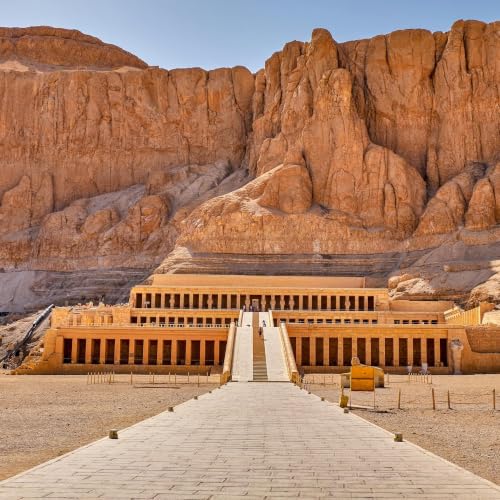
    Queen Hatshepsut reigned as the fifth pharaoh of the Eighteenth Dynasty during Egypt’s New Kingdom period. Initially occupying the traditional role of queen consort to her half-brother Thutmose II, she assumed the regency for her infant stepson, Thutmose III, following her husband's death around 1479 BCE. By the seventh year of her regency, she broke with Egyptian tradition by officially crowning herself pharaoh and establishing a co-regency that lasted for two decades. To legitimize her authority within a political theology historically tied to male deities and the preservation of cosmic order (ma'at), Hatshepsut utilized art as a powerful tool of political propaganda. She commissioned hundreds of statues depicting her with masculine physical traits including a muscular torso, traditional royal kilt, and ceremonial false beard, while intentionally maintaining feminine titles, pronouns, and grammatical endings in accompanying written inscriptions. Her reign prioritized domestic stability, international trade revitalization, and an extensive monumental building campaign over military expansion. The crowning achievement of her building campaign is her mortuary temple, Djeser-Djeseru ("Holy of Holies"), located on the west bank of the Nile River across from the ancient religious capital of Thebes. Designed by her chief architect and closest advisor, Senenmut, this multi-tiered complex rises 80 feet high and features three broad, stacked terraces connected by central ramps that integrate seamlessly into the surrounding limestone cliffs. The temple walls are adorned with detailed relief carvings documenting her divine birth narrative which claimed she was the biological daughter of the supreme god Amun-Re, as well as her famous Year 9 maritime expedition to the Land of Punt, which returned with luxury goods and 31 live myrrh trees. Late in his independent reign, roughly 20 years after her death, her successor Thutmose III enacted a systematic campaign of damnatio memoriae, defacing her monuments and smashing her statues to preserve a strict line of male succession. This targeted vandalism successfully obscured her legacy for millennia until late 19th and early 20th-century archaeological excavations uncovered the fragments, allowing modern scholars to learn more about her true significance. ⁠Listen Ad-Free on Patreon. ⁠ For just $3 per month, you can get ad-free versions of Fun Facts Daily, Who ARTed and Art Smart. Head over to ⁠https://www.patreon.com/cw/FunFactsDailyPod⁠ if you are interested. Check out my other podcasts Fun Facts Daily | Art Smart | Rainbow Puppy Science Lab Who ARTed is an Airwave Media Podcast. If you are interested in advertising on this or any other Airwave Media show, email: advertising@airwavemedia.com Learn more about your ad choices. Visit megaphone.fm/adchoices
    Show More Show Less
    16 mins
adbl_web_anon_alc_button_suppression_t1
No reviews yet