

When Everyone Agrees But Nobody Acts
Failed to add items
Add to basket failed.
Add to wishlist failed.
Remove from wishlist failed.
Adding to library failed
Follow podcast failed
Unfollow podcast failed

When Everyone Agrees But Nobody Acts
-
Narrated by:
-
By:
About this listen
We often assume that once we get everyone in a room and reach agreement on an architecture, the hard part is over. But what happens when the workshop goes perfectly, everyone nods along, puts their sticky note on "Yes, I support this," and then four weeks later... nobody has shipped anything?
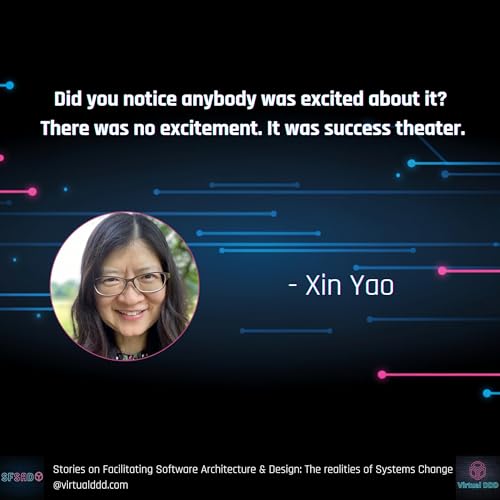
That's the pattern Xin Yao encountered twice in her career—separated by seven years and what should have been much better facilitation techniques the second time around. In her first story, Xin orchestrated a multi-day integration architecture workshop for a major financial institution. Cross-functional teams aligned on APIs, event-driven patterns, and walked away with a clear action list. Four weeks later, an engineering manager asked the question nobody wanted to hear: "Did you notice anybody was excited about it?" The answer was no. The work? Also no.
Seven years later, armed with Event Storming and collaborative modeling techniques, Xin tried again. This time it was a DDD workshop during COVID, with real-time collaboration and all the right practices. But the timeline wouldn't merge, participants couldn't walk through the model without Xin taking over, and the board ended up more red (hotspots and conflicts) than orange (domain events). In the retrospective, someone said: "The whiteboard doesn't compile." Another admitted: "We didn't want to ruin it for you—you had so much passion."
This conversation explores the gap between facilitation techniques and the emotional safety required to make them work. We dig into why "success theater" happens, how to invite dissent from the very beginning, and why architects need to remember they're "feeling machines that think"—not thinking machines that feel.
Key Discussion Points
* [00:01] The Flying Squad: Xin's role as an integration architect parachuting into a multi-day workshop for a major CRM integration project
* [06:00] Agreement Without Excitement: Four weeks after a "successful" workshop, the action list sits untouched—nobody shipped
* [08:00] The Event Storming That Wouldn't Merge: Seven years later with better techniques, but the timeline clusters, the facilitator becomes the bottleneck, and the board turns red
* [12:00] "The Whiteboard Doesn't Compile": Why participants stayed silent when the entry and exit events were wrong from the start
* [16:00] Taking the Authority Out: How Xin learned to say "I'm a couple steps ahead, not the expert—trust your own experience"
* [21:00] Inviting Dissent Early: The heuristic of pausing every 10 minutes to ask "What would you say if you didn't have to be polite?"
* [36:00] Connection Before Content: Why breaking into small groups of three creates the safety to surface real concerns
* [38:00] Feeling Machines That Think: The role of emotion in architectural decision-making and why facilitators need to invite emotional language into the room
**Guest:** Xin Yao
**Hosts:** Andrew Harmel-Law, Kenny Schwegler, Andrea Magnorsky
*Part of the Stories on Facilitating Software Architecture and Design series from Virtual DDD.*