• Season 4 episode 3: How to talk about suicide in Veterans. An interview with Jennifer Van Tiem and Nicole Johnson
    Nov 14 2024

    Content warning: This episode contains conversations on self-harm.

    In this episode of the Vets First Podcast, Levi Sowers is joined by guest-turned-cohost, Louis Kolling. If you’re interested in learning more about Louis Kolling’s story, listen to Season 4: Episode 2 to hear about his journey from army veteran to molecular biophysicist. Now join the two as they speak with Jennifer Van Tiem and Nicole Johnson who dive into their qualitative research on how to discuss suicide with veterans. Nicole is a senior quantitative research specialist at the VA with the Office of Rural Health with a PhD in health communication from Indiana University. Jen Van Tiem is a PhD in applied anthropology from Columbia University and a principal investigator on a project aimed at providing practitioners with better tools for communicating with veterans.

    Together, the pair explain how tools like theirs are designed to bridge the gap in communicating with veterans and specifically in regards to approaching the conversation of suicide. While no one tool can have all of the answers or say the perfect thing, their “conversation tool” guides practitioners towards desirable outcomes during difficult conversations.

    There is also a focus on the rise of qualitative research and how it is used in a research setting to add context to the statistics of quantitative research. Despite the differences in their research practices, every one agrees that each form of research can be used to provide background, inform, and further the other.

    Finally Louis speaks to his experiences speaking with other veterans about mental health and the difficulty in broaching that subject with health care providers out of fear. Louis focuses on a veteran’s fear of being labeled and forced into an unknown processes that may further strip them of their rights. The focus shifts to how dispelling the myths and stigma around mental health hospitalization could improve outcomes in these conversations.

    Show More Show Less
    48 mins
  • Louis Kolling: From the Army to Science, How an Army Veteran found a career in science
    Apr 9 2024

    Content warning: This episode contains conversations on addiction and self-harm.

    In this episode of the Vets First Podcast, our host Levi Sowers tackles his first solo interview as Brandon takes time away to focus on his education. Join us as Levi speaks with our guest, Louis Kolling.

    Louis Kolling has a PhD in molecular biophysics and is also a US Army veteran, having served from 2006 to 2012 as a sergeant during Operation Iraqi Freedom. Kolling currently conducts research as a postdoctoral scientist at the University of Iowa department of Neuroscience and Pharmacology. Recreationally, he is also powerlifter with four national and eleven state records.

    Kolling’s unique perspective is the highlight of this episode. As both a veteran in need of the VA’s services and a researcher working to tackle problems those like him could face, Kolling is uniquely poised to be a perfect guest for the Vets First Podcast.

    This interview centers around Louis’s personal history with enlisting in the military at a young age and searching for a purpose within its ranks and within the world of higher education. Kolling explains how his experiences led to struggles with alcohol dependency and depression and how, like many veterans, he was hesitant to seek help from the VA at a time when its services were undergoing major changes. Kolling explains the stigma that veterans face when confronting mental health issues and how his experiences have taught him how to help other veterans face their own hesitations.

    Show More Show Less
    47 mins
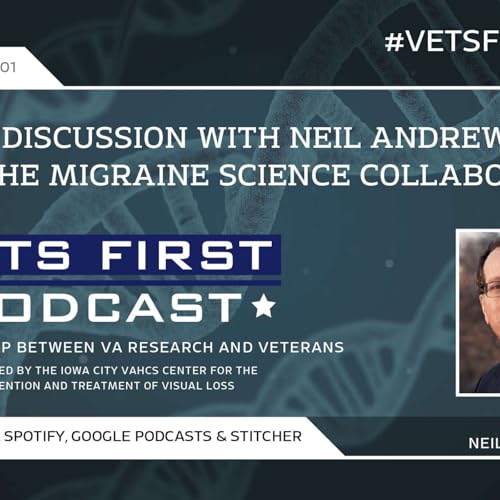
  • A Discussion with Neil Andrews From the Migraine Science Collaborative
    Jan 12 2024

    In this episode of the Vets First Podcast, Dr. Levi Sowers and Brandon Rea are joined by Neil Andrews for a collaborative interview.

    Niel Andrews is the executive editor and science journalist for the Migraine Science Collaborative, which serves as an online platform dedicated to a wide array of migraine-related research in pursuit of their mission statement, “To accelerate research advances in migraine and headache diseases.” Andrews explains how they aim to bridge the gap between complex scientific findings and a wider audience, ensuring that their content is accessible and informative for both experts and non-experts alike.

    With a twist on our usual format, Neil Andrews conducts the first half of the interview and questions our hosts on the origins of the Vets First Podcast, which was created with a similar goal in communicating complex scientific issues to veterans and to better understand the issues they face. Levi and Brandon reflect on their interactions with veterans and the strength and resiliency of dealing with unseen diseases like migraines. Our hosts explain how, in contrast to other areas of pain research, migraine research has seen continued innovations. Despite this, they emphasize the need for more scientists dedicated to the field.

    In the second half of the interview, Brandon and Levi question Neil Andrews about his life as a science journalist and the challenges faced by the Migraine Science Collaborative. Having shared similar experiences in their pursuits of communicating research, the trio discusses the difficulties in conveying intricate scientific methodologies and techniques to non-specialists but emphasizes the importance of making these studies more accessible and understandable.

    Overall, the episode offers a look into the complexities of migraine research, the challenges of communicating basic science, and the collaborative efforts aimed at advancing understanding and treatment for individuals affected by migraines.

    Show More Show Less
    41 mins
  • Season 3 Episode 3: Investigating visual disfunction in blast traumatic brain injury: Dr. Steven Fliesler
    May 26 2023

    In this episode of the Vets First Podcast, hosts Dr. Levi Sowers and Brandon Rea interview Dr. Steven Fliesler, a SUNY Distinguished Professor at the University of Buffalo and a career scientist at the VA in Buffalo, New York. Dr. Fliesler holds positions as an endowed Chair of Ophthalmology and Director of Research in the Department of Ophthalmology.

    Dr. Fliesler was born and raised in New York and moved to California at the age of 15. He attended the College of San Mateo, the University of California in San Diego, and the University of California Berkeley during his undergraduate education and later obtained his PhD in Biochemistry at Rice University. During his time at Rice, his professor in neurobiology needed someone, particularly a chemist, to give a lecture about the chemistry of vision. This led Dr. Fliesler to an opportunity at the Baylor College of Medicine, where he did a postdoctoral fellowship in the Department of Ophthalmology. From there, he has distinguished himself in research and teaching within the vision field and has since been interested in research towards helping Veterans with mild traumatic brain injury (TBI).

    Throughout this episode, Dr. Fliesler discusses how he started researching TBI and why it interests him. First, he talks about what inspired him to enter blast injury research and highlights his collaboration with one of his colleagues. He then talks about utilizing animal models to better understand visual abnormalities found in trauma patients at the VA and converses about the methodology he used to quantify the visual effects of TBI, both behaviorally and physiologically.

    Later, Dr. Fliesler further describes his exploration into blast research with a professor at the University of Buffalo. He comments on the effects of auditory blasts that cause trauma in mice and how that affects visual function. Then, he discusses the various mechanisms that causes visual deficits and how it is important to understand in the context of TBI in order to rescue visual impairments. Finally, he hypothesizes on how the human body reacts to TBI.

    If you are a Veteran or you know a Veteran needing help with visual loss, contact the Visual Impairment Services Team coordinator at your nearest VA medical center or contact the Blind Rehabilitation Service Program by phone which can be found here. There are 13 Blind Rehabilitation Centers around the country, which can help with things like mobility, communication, and living with vision loss.

    Show More Show Less
    46 mins
  • Season 3 Episode 2: Guiding the way to meaningful research for Veterans: Dr. Lina Kubli
    May 26 2023

    In this episode Dr. Levi Sowers and Brandon Rea interview Dr. Lina Kubli. Dr. Kubli is the RR&D Scientific Program Manager for Sensory Systems/Communication Disorders. Dr. Kubli was born in India and lived there until age 7 before moving the United States and settling in Maryland. She attended college at the University of Maryland initially majoring in Biochemistry, then switching to Hearing and Speech. In this time, Dr Kubli learned that she wanted to not only participate in clinical work but also interact with people while staying within research. She continued her education with earning her Master's in Audiology from the University of Maryland and worked with Veterans at Walter Reed National Military Medical Center (WRNMMC) as a Research Scientist and served as a Subject Matter Expert on Central Auditory Processing disorders and Traumatic Brain Injury. Initially reluctant to leave such an engaging research project, the director of the clinic encouraged Dr. Kubli to find a PhD program that could accommodate her schedule. She was able to find this balance at Gallaudet University, where she earned her PhD in Audiology. Dr. Kubli served on the Executive Committee of the Medical Staff as Chair for the Patient and Family Centered Care Steering Committee at Walter Reed National Military Medical Center.

    Together with Levi and Brandon, Dr. Kubli explains what it means to be a Scientific Program Manager and how she oversees the program within the Rehabilitation Research and Development Service. She evaluates a broad range of funding applications for research that include vision, hearing, balance, communication, and more. Additionally, she recruits individuals with expertise to best evaluate the funding applications. Many of the panel members are from outside of the VA to ensure that the most knowledgeable reviewers help navigate a project being implemented in the VA. Dr. Kubli shares about all the work that goes into supporting important research for the benefit of Veterans.

    Show More Show Less
    37 mins
  • Season 3 episode 9: Navigating life with glaucoma related vision loss: Liz Holmes
    May 26 2023

    In this episode of the Vets First Podcast Dr. Levi Sowers and Brandon Rea interview Elizabeth Holmes. Elizabeth “Liz” Holmes is the Blinded Veterans Association National Secretary and is part of the Georgia regional group. She is an Army Veteran and during her career she attended both basic and advanced ordinance courses and airborne school. Liz was born and raised in the south side of Chicago about 15 minutes from Indiana. She went to DePaul University and didn’t initially have plans to join the military. However, seeing that the ROTC program there did not have any women and knowing she could do anything a man could, Liz decided to join the ROTC program in 1975 and received her training at Fort Riley, Kansas. Following college, she joined the service as a reserve officer and then went on active duty for 11 years where she traveled all over the states, Korea, and Germany. Liz served from 1976 to 1987, where in 1976 she was commissioned to be a Second Lieutenant in the ordinant specialty. Following her military service, Liz worked in the United States Postal Service serving in a variety of different ways until retirement in 2014 due to vision loss because of glaucoma. She had never noticed a change in her vision until she went to an eye exam where her glaucoma was diagnosed. Liz had surgery on her left eye but continued to experience issues. She began seeing a specialist that worked to save her right eye’s vision. Liz was referred to the VA for further care and joined other programs to help navigate life with vision loss. While in blind rehabilitation in Birmingham, Alabama, Liz joined the Blinded Veterans Association and became an active member. She shares about her experiences in the military, vision loss with glaucoma, and her involvement in the Blinded Veterans Association.

    If you are a Veteran or you know a Veteran needing help with visual loss, contact the Visual Impairment Services Team coordinator at your nearest VA medical center or contact the Blind Rehabilitation Service Program by phone which can be found here. There are 13 Blind Rehabilitation Centers around the country, which can help with things like mobility, communication, and living with vision loss.

    Show More Show Less
    39 mins
  • Season 3 Episode 6: Connecting sight loss, TBI, the importance of building a care network: Dr. Eric Singman
    May 26 2023

    In this episode of the Vets First Podcast, hosts Dr. Levi Sowers and Brandon Rea interview Dr. Eric Singman, a neuro-ophthalmologist working at the Department of Defense Vision Center of Excellence in Baltimore, Maryland. He has been working with Veterans and active-duty military for 20 years. Prior to his position at the VA, Dr. Singman spent most of his academic career in the greater New York City area, obtaining his MD and PhD with a focus on vision problems associated with optic nerve damage from brain injury.

    During this episode, Dr. Singman discusses his clinical role at the VA and explains how he directly works with patients suffering from brain injury induced vision problems. He touches on topics like using stem cells to regenerate affected areas of the nervous system and utilizing different colored NoIR sunglasses to allow visually impaired patients to be more comfortable. He then explains at length about the importance of choosing the right color and how it relates to the optic nerve and its circuitries in the brain.

    Later in the episode, Dr. Singman elaborates on injury induced by impacts and talks about what happens physiologically, particularly with the optic nerve. He differentiates the effects on the nerve among blunt, ballistic, and blast injury, and discusses how protection may play a role in vision health depending on the injury. Then, Dr. Singman talks about the potential for brain tissue to have regenerative properties like other organs in the body such as the kidneys and the liver. Lastly, he talks about the social and economic impact of brain injury in Veterans, how he builds a network of physicians and caretakers for his patients to ensure correct treatment, and how traumatic brain injury is likely the key player for many other diseases and disorders outside of the brain injury itself.

    If you are a Veteran or you know a Veteran needing help with visual loss, contact the Visual Impairment Services Team coordinator at your nearest VA medical center or contact the Blind Rehabilitation Service Program by phone which can be found here. There are 13 Blind Rehabilitation Centers around the country, which can help with things like mobility, communication, and living with vision loss.

    Show More Show Less
    46 mins
  • Season 3 episode 5: Providing support and community with sight loss: Dr. Laura Peters
    May 26 2023

    In this episode of the Vets First Podcast, hosts Dr. Levi Sowers and Brandon Rea interview Dr. Laura Peters. Dr. Peters currently works as a licensed counselling psychologist at the VA Blind Rehabilitation Center in Palo Alto, California. Originally from California, Dr. Peters completed her graduate degree in counseling psychology at University of Utah. She began working with the VA during a practicum in which she focused on geriatric psychology, the psychology of aging, and worked at an outpatient mental health program in Salt Lake City, Utah. Eventually, she found her way to Palo Alto, California where she currently lives.

    Dr. Peters goes on to discuss her path to her current career at the Blind Rehabilitation Center and her role in helping visually impaired Veterans as a licensed counselling psychologist. She further discusses the diverse causes and symptoms of vision loss that impact Veterans, and the general population. Dr. Peters talks more in-depth on the prevalence of age-related vision loss and how Veterans learn to adapt with sudden or progressive blindness. Levi, Brandon, and Dr. Peters examine the impact of both physical and mental aspects of vision loss on Veterans’ daily activities, and several tools that assist individuals with varied spectrums of visual impairment.

    Dr. Peters discusses the benefits of using a whole-person approach in treatment of vision impaired Veterans. She further highlights the inter-professional collaboration between counsellors, social workers, physicians, and other healthcare professionals when a Veteran seeks care within the Blind Rehabilitation Center. Lastly, Brandon, Levi, and Dr. Peters briefly discuss recent research around visual loss and Veterans, as well as Veteran testimonials regarding Blind Rehabilitation Centers. As Dr. Peters mentions in this episode, there are a total of thirteen VA Blind Rehabilitation Centers as well as several non-VA facilities throughout the United States that a Veteran can access if experiencing vision loss.

    If you are a Veteran or you know a Veteran needing help with visual loss, contact the Visual Impairment Services Team coordinator at your nearest VA medical center or contact the Blind Rehabilitation Service Program by phone which can be found here.

    Show More Show Less
    36 mins