Episodes

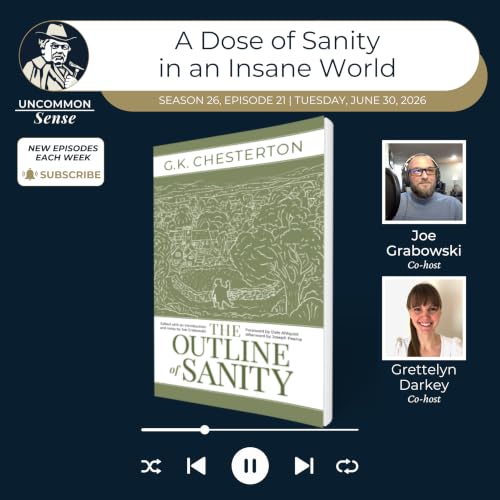
  • How Chesterton Saw Big Business and Big Government Becoming Allies Before Anyone Else Did
    Jun 30 2026
    G.K. Chesterton published The Outline of Sanity in 1926—a blueprint for a third way between capitalism and socialism, grounded in widespread property ownership, local accountability, and the rejection of mass dependence. A century later, the argument reads less like a footnote and more like a forecast. In this episode, hosts Grettelyn Darkey and Joe Grabowski—who wrote the introduction to the new ACS Books centennial edition—walk through Chesterton's economic vision section by section and make the case that his outline is still waiting to be built. In This Episode: Why G.K. Chesterton refused to let "capitalism" stand for what he meant and what the naming problem reveals about the false choice between two economic systemsHow G.K. Chesterton identified big business and big government as natural allies before anyone else did and why he saw their collusion coming as early as 1926What G.K. Chesterton actually proposed: the section-by-section case for small ownership, fair regulation, and buying local over buying cheapWhy G.K. Chesterton's warnings about advertising, standardization, and machinery anticipate the AI moment better than most things written in the last decadeThe tension G.K. Chesterton resolved that most economic thinkers never address: the difference between idealism, cynicism, and what he called sanity Chapters: 00:00: Introduction and Welcome 01:09: The ACS Centennial Edition and Why This Year 03:15: The Origins of Distributism and G.K.'s Weekly 08:58: What to Expect from The Outline of Sanity 11:08: Defining Capitalism—Why the Name Was Stolen 18:22: Big Business and Big Government in League 24:30: What Chesterton Actually Proposes: Regulation and Reform 28:40: Vote with Your Wallet: Boycotts, Advertising, and Snake Oil 39:58: The Land, the Machine, and Chesterton's Prophetic Vision 45:15: The Practicality of Idealism: Not Cynicism, Not Naïveté Resources Mentioned: The Outline of Sanity by G.K. Chesterton (ACS Books) FOLLOW US Instagram Facebook X SUPPORT Consider making a donation Visit our Shop Produced by Saint Kolbe Studios
    Show More Show Less
    49 mins
  • How One Line from G.K. Chesterton's The Everlasting Man Sent an Artist Around the World
    Jun 23 2026
    G.K. Chesterton wrote that there are two ways of getting home—stay there, or walk around the entire world until you arrive from the other direction. For graphic novelist Ben Hatke, that line from The Everlasting Man wasn't simply a meditation on returning with fresh eyes: it became a commission. In this episode, Joe Grabowski sits down with Hatke—author of the forthcoming graphic memoir Home/World—to trace how one Chestertonian passage sent him east for 55 days across twelve countries, and how Chesterton's deepest convictions about man, story, and homecoming turned out to be more true the farther from home he traveled. In This Episode: How a single passage from G.K. Chesterton's The Everlasting Man—the two ways of getting home—became the animating vision behind a 55-day circumnavigation of the globeWhat Chesterton understood about encountering the world with fresh eyes: the generosity of strangers, the power of a story to cross any language barrier, and the world that waits beyond the screenHow Ben Hatke wove historical figures—Ibn Battuta, Nellie Bly, Saint Francis—into the narrative as "ghosts," and why the Chestertonian idea of the communion of saints gives this technique its deepest meaningG.K. Chesterton's imagery of the circle and the line—from The Everlasting Man to Orthodoxy to The Man Who Was Thursday—and what it reveals about why a first encounter with any place is irrepeatableWhy creating the book proved as life-changing as the journey itself and what Ben discovered about story, memory, and the difference between what is factual and what is true Chapters: 00:00: Welcome and Introduction 02:25: The Everlasting Man Quote Behind the Journey 06:01: Memory, Story, and How a Journey Becomes True 08:05: The Generosity of Strangers 13:37: Turkey and the Moment It Became an Adventure 22:33: Circumnavigating Post-COVID: The When and Why 31:02: "I Admire Your Life—It Looks Like Freedom" 35:03: Making the Book: Falling in Love with Storytelling Again 39:09: Historical Ghosts: Inviting the Past into the Journey 44:58: Circles and Lines: Chesterton's Vision of Coming Home Resources Mentioned: Home/World: A Circumnavigation of Our Shared Earth — Ben Hatke (forthcoming) Ben Hatke's website Ben Hatke on Patreon Ben Hatke on Instagram The Everlasting Man — G.K. Chesterton "Drawing Inspiration from Chesterton, with Ben Hatke" — previous Uncommon Sense appearance 2026 Chesterton Conference FOLLOW US: Instagram Facebook X SUPPORT: Donate Shop Produced by Saint Kolbe Studios
    Show More Show Less
    49 mins
  • What G.K. Chesterton Might Have Said about America's Consecration to the Sacred Heart
    Jun 16 2026
    G.K. Chesterton wrote in 1926 that "the heart of Christendom is a heart" and in this episode, Joe and Grettelyn discover that this single line unlocks his entire approach to apologetics. Recording just before the U.S. bishops' historic consecration of America to the Sacred Heart on the nation's 250th anniversary, they trace the providential thread connecting two Pope Leos, a 1926 essay from GK's Weekly, and Chesterton's lifelong practice of winning opponents through friendship and wonder. In This Episode: How a 1926 essay in GK's Weekly reveals the theological principle behind G.K. Chesterton's entire method of winning hearts and mindsWhat Chesterton's contrast of Saint Michael and Saint Gabriel teaches about "the softening of strength by chivalry and charity"—and what it means for how the Church evangelizes todayWhy G.K. Chesterton's observation that "madmen are logical" explains his insistence on appealing to beauty, wonder, and friendship rather than syllogismsHow G.K. Chesterton's famous friendships with his opponents—and the characters of The Ball on the Cross—embody the theology of the Sacred Heart before he ever named itWhat Pope Leo XIII's 1899 encyclical Annum Sacrum reveals about the providential timing of the USCCB's consecration and the arrival of a new Pope Leo Chapters: 00:00: Introduction—The Sacred Heart and America at 250 02:29: The Providential Coincidence of Two Pope Leos 04:00: Background on the Sacred Heart Devotion 11:50: Why Consecrate a Nation? 13:57: Pope Leo XIII's Encyclical—What He Foretold About America 19:55: Reparations and the Burning Desire of Christ 23:22: What G.K. Chesterton Said About the Sacred Heart in 1926 26:43: Chesterton's Method—Apologetics of the Heart 33:31: Madmen, Small Circles, and Leading With Love 45:20: The Witness Consecration Calls Us To Resources Mentioned: What I Saw in America—Special Semiquincentennial Edition USCCB Consecration Resources Annum Sacrum—Pope Leo XIII, 1899 Dilexi te—Pope Leo XIV 2026 Chesterton Conference—Ave Maria FOLLOW US: Instagram Facebook X SUPPORT: Donate Shop Produced by Saint Kolbe Studios
    Show More Show Less
    49 mins
  • How G.K. Chesterton Saw Through False Progress, Freud, and the Screen Age — and Why the World Is Still Catching Up
    Jun 9 2026
    Two of G.K. Chesterton's most unexpectedly prophetic essays take center stage in this issue of Gilbert Magazine: "An Architect's Nightmare," a 1928 piece that anticipates nearly everything being said today about AI, passive technology, and false progress, and "Freud on Slips of the Pen," a recently unearthed 1921 Daily Express article in which Chesterton dismantles psychoanalysis with surgical wit. Joe Grabowski and Grettelyn Darkey walk through the current issue of Gilbert—the official publication of the Society of G.K. Chesterton —drawing out what Chesterton saw about passive entertainment, the cyclical delusions of optimists and pessimists, and why art remains the irreducible signature of man. In This Episode: What G.K. Chesterton's 1928 essay "An Architect's Nightmare" reveals about spaces built for man vs. spaces man is expected to serve—and why his critique of industrial-age optimism and pessimism maps almost perfectly onto today's conversations about AIThe pattern Chesterton exposed over a century ago: enthusiastic builders of terrible things who become pessimists insisting nothing can be done—and why Chesterton holds that human will, not historical inevitability, is what truly separates man from the octopus "Freud on Slips of the Pen": a newly unearthed 1921 essay in which G.K. Chesterton takes apart the Freudian slip using Hamlet, Punch and Judy, and the plain observation that a man who writes something down and doesn't cross it out intended to write it Chesterton on the standardizing effects of the cinema—how the same concerns raised about silent films in the 1920s echo in every conversation about video games, social media, and passive screen entertainment todayA tour of the current Gilbert: the Chesterton Schools Network's capstone Rome pilgrimage, an 11th-grader's essay on Dante, a takedown of Paul Ehrlich's famously wrong prophecies, and G.K. Chesterton's poem "After Reading a Book of Modern Verse" Chapters: 00:00: Welcome and Introduction 02:24: Gilbert Magazine and the Legacy of G.K. Chesterton's GK's Weekly 05:30: The Current Issue: Cover Art and the Rome Pilgrimage Feature 11:29: "An Architect's Nightmare": G.K. Chesterton's 1928 Essay on Space, Man, and False Progress 19:05: The Optimist–Pessimist Cycle and What Chesterton Says About the AI Age 23:14: Virginia de la Lastra at the UN and Joe's Editorial on Passive Entertainment 29:10: Chesterton on Cinema, the Toy Theater, and the Imaginative Life 32:14: "Freud on Slips of the Pen": A Newly Unearthed 1921 Chesterton Essay 40:30: A Chesterton Poem, a Student's Essay on Dante, and Paul Ehrlich's Prophecies 44:24: Closing and How to Subscribe to Gilbert Resources Mentioned: Gilbert Magazine 2026 Chesterton Conference—"The Outline of Sanity" What I Saw in America by G.K. Chesterton Chesterton Schools Network Become a Member of the Society FOLLOW US: Instagram Facebook X SUPPORT: Donate Shop Produced by Saint Kolbe Studios
    Show More Show Less
    47 mins
  • What G.K. Chesterton Knew About Technology That Took Science 15 Years to Prove
    Jun 2 2026
    G.K. Chesterton once observed that after learning to do a great many clever things, the next great task would be learning not to do them. That line, from an early essay on Queen Victoria, has taken on new force as American schools reverse decades of tech-first policies—test scores and students' mental health alike in decline. In this episode, Joe and Grettelyn trace the screen crisis back to first principles, exploring how Chesterton's warnings against educational fads, his conviction that machines make us like machines, and his insistence that a thing worth doing is worth doing badly all speak directly to what Jonathan Haidt's data is now confirming. In This Episode: The G.K. Chesterton quote from Varied Types that frames the whole conversation—and why his intuition about educational tinkering was more than a hunchHow the Chesterton Schools Network's longstanding tech-light philosophy has been vindicated by over 15 years of data, a UNESCO report, and the Fortune magazine story that started this episodeWhat Chesterton's insight about machines making us like machines explains about the neuroscience of distraction—and why phone-free classrooms alone aren't enoughWhy G.K. Chesterton's principle that a thing worth doing is worth doing badly is the most important counter-argument to AI in education and the arts Practical steps for parents: building social pacts with other families, the case for delaying smartphones, and the Chesterton Schools Network as a proven alternative Chapters: 00:00: Welcome and Introduction 01:15: The Chesterton Schools Network's Tech-Light Philosophy 03:38: G.K. Chesterton on Learning Not to Do Clever Things 05:42: Jonathan Haidt and the Books Behind the Movement 09:06: UNESCO's Findings on Technology and Learning 13:35: How Devices Short-Circuit Attention and Memory 19:47: Embodied Learning—Handwriting, Doodling, and What Screens Miss 28:21: Schools Reversing Course: The Fortune Magazine Story 35:11: A Thing Worth Doing Badly: Chesterton vs. AI 44:13: Practical Steps for Parents and a Path Forward Resources Mentioned: Varied Types — G.K. Chesterton The Anxious Generation — Jonathan Haidt The Coddling of the American Mind — Greg Lukianoff and Jonathan Haidt Anxious Generation Action Resources Chesterton Schools Network FOLLOW US: Instagram Facebook X SUPPORT: Donate Shop Produced by Saint Kolbe Studios
    Show More Show Less
    53 mins
  • The Edwardian Socrates: G.K. Chesterton as Philosopher
    May 26 2026
    Landon Loftin, editor of Chesterton and the Philosophers and a speaker at this summer's Chesterton Conference, joins Joe Grabowski to discuss the first book to put G.K. Chesterton in direct conversation with figures of the Western philosophical tradition. Together they trace how G.K. Chesterton's literary and journalistic genius concealed a rigorous philosophical mind that professional academia has been slow to recognize—and why that neglect says more about the academy than about Chesterton. In This Episode: How a peer-reviewed journal's rejection of an essay on G.K. Chesterton and Hume sparked the idea for an entire edited volumeWhy G.K. Chesterton's best philosophical arguments are embedded in fiction and journalism rather than technical prose, and why that's a compliment to him, not a liabilityThe essay on Chesterton and Aristotle, and how G.K. Chesterton understood virtue as a furious clash of opposites rather than a mild Aristotelian meanG.K. Chesterton's distinctive philosophical method: taking thinkers like Hume and William James more seriously than they took themselves, thereby dismantling their own argumentsA preview of Loftin's Chesterton Conference talk on G.K. Chesterton as "the Edwardian Socrates," and what that comparison reveals about philosophy as a vocation versus a profession Chapters: 00:00: Introduction 00:26: Welcome and introducing Landon Loftin 01:25: Loftin's background: teaching, Owen Barfield, and G.K. Chesterton 03:03: Chesterton and the Philosophers: overview and contributors 04:43: Origin of the book: the rejected Hume essay 08:13: Book structure and Joe's essay on Chesterton and Kierkegaard 14:20: Chesterton and Aristotle: virtue as furious clash of opposites 18:30: G.K. Chesterton's philosophical method: out-Huming Hume 24:46: G.K. Chesterton as defender of philosophy 30:35: G.K. Chesterton's model of disagreement: furious friendship 33:52: Conference preview: "The Edwardian Socrates" Resources Mentioned: Chesterton and the Philosophers, ed. Landon Loftin (Wipf & Stock) 2026 Chesterton Conference — "The Outline of Sanity," June 25–27, Ave Maria, FL FOLLOW US Instagram Facebook X SUPPORT Donate Shop Produced by Saint Kolbe Studios
    Show More Show Less
    37 mins
  • How Frances Chesterton Found Her Way to Rome
    May 19 2026
    One hundred years ago, Frances Chesterton quietly entered the Catholic Church on All Saints Day—the feast she chose for herself. In this episode, Grettelyn and Joe sit down with Nancy Carpentier Brown, author of The Woman Who Was Chesterton, to explore Frances's spiritual journey ahead of Nancy's talk at the 2026 Chesterton Conference. In This Episode: How Frances Blogg became a devout Anglican through the Clewer Sisters at St. Stephen's College—and why that formation made her path to Rome harder, not easierThe branch theory, and why Frances's emotional attachment to Anglicanism was every bit as powerful as G.K.'s intellectual arguments for Catholicism Gilbert's extraordinary patience: four years of waiting, never pressuring Frances—and how the Chestertons' story mirrors that of Scott and Kimberly HahnThe pivotal moments behind G.K.'s 1922 conversion: his near-death illness, Frances's anguished letter to Father O'Connor, and the death of his father Frances's reception into the Church on All Saints Day, 1926—quiet, discreet, in High Wycombe with Father Walker—and the New York Times headline that followed a week later Chapters: 00:00: Introduction & Welcome 01:00: Why 2026? The Year of Frances and St. Francis 03:24: G.K.'s Spiritual Formation Before They Met 06:29: Frances's Faith Journey and the Clewer Sisters 09:08: What Held Frances Back: Branch Theory and the Heart 13:22: G.K.'s Illness and Frances's Letter to Father O'Connor 16:27: G.K.'s Father, Cecil, and the Decision to Convert 20:09: Mutual Spiritual Freedom: Neither Held the Other Back 24:42: All Saints Day, 1926: Frances Enters the Church 30:00: Conference Preview and Closing Thoughts Resources Mentioned: The Woman Who Was Chesterton by Nancy Carpentier Brown 2026 Chesterton Conference Orthodoxy by G.K. Chesterton Rome Sweet Home by Scott and Kimberly Hahn FOLLOW US: Instagram Facebook X SUPPORT: Donate Shop Produced by Saint Kolbe Studios
    Show More Show Less
    33 mins
  • What Hangs Straight on a Crooked Wall: Chesterton's Marian Poetry
    May 12 2026
    In honor of May, Our Lady's Month, Joe and Gretalyn each bring a favorite Marian poem by G.K. Chesterton to share with the other—without any advance coordination. Gretalyn reads "Images," a meditation on six titles from the Litany of Loreto drawn from Chesterton's 1926 collection Queen of the Seven Swords, while Joe shares "Crooked," a lesser-known 1933 poem from GK's Weekly that captures a more introspective, mature side of his Marian devotion. Together they explore what these poems reveal about Chesterton's lifelong love for Our Lady, the apologetics of Marian devotion, and the paradox at the heart of his faith: that the world only looks right when you learn to see it through her. In This Episode: How Chesterton's "Images" weaves six titles from the Litany of Loreto—Mirror of Justice, Tower of David, House of Gold, Tower of Ivory, Ark of the Covenant, and Seat of Wisdom—into richly layered verseWhy 1926, the year Frances Chesterton entered the Church, gives "Images" a deeper biographical resonanceWhat it means when Marian devotion troubles someone, and why Joe and Gretalyn suggest that reaction is worth examining carefully Chesterton's Marian apologetics in Lepanto—and the single line that cuts to the heart of the controversyWhat "Crooked" reveals about a quieter, more subdued Chesterton in 1933, writing in the shadow of a world beginning to come apart Chapters: 00:00: Introduction & May as Our Lady's Month 02:36: Gretalyn Reads "Images" 07:06: Unpacking the Litany of Loreto 11:03: Chesterton's Lifelong Marian Devotion 14:38: Mary as a Touchpoint for Converts 21:16: Mary in Scripture: Luke and the Magnificat 23:59: Lepanto and the Defense of Mary 27:51: Joe Reads "Crooked" 28:17: Discussion of "Crooked" 33:16: Chesterton's Mature Mariology Resources Mentioned: I Also Had My Hour: An Alternative Autobiography of G.K. Chesterton by Dale Ahlquist Gilbert Magazine FOLLOW US Instagram Facebook X SUPPORT Consider making a donation Visit our Shop Produced by Saint Kolbe Studios
    Show More Show Less
    38 mins