• Very Good Is a Long Way from Perfect - Part 3 - Collapse, Inability, and the Logic of the Cross
    Feb 24 2026

    Episode 3

    In Part 3, we follow the implications of one foundational question:

    Did Genesis describe Adam as perfect — or as very good?

    We explore how imagining a perfected Adam logically leads to:

    • Collapse/Corpse anthropology
    • Inability to will salvific good
    • Monergistic grace
    • Meticulous providence
    • The “inevitability instinct”
    • Intensified penal substitution

    We then contrast this with the Orthodox diagnosis of the Fall as mortality, corruption, and fear of death — not metaphysical annihilation of the will.

    It is an examination of premises.

    Key Biblical Texts

    • Genesis 1:31 — “Very good” (tov me’od)
    • Romans 8:7–13 — “Those who are in the flesh cannot please God”
    • Hebrews 2:14–15 (KJV) — Fear of death and lifelong bondage

    Key Confessional Sources (Western)

    Thirty-Nine Articles (1563)

    Drafted during the English Reformation under Elizabeth I to define doctrine within the Church of England.

    Article IX:

    “Original sin… is the fault and corruption of the Nature of every man… whereby man is very far gone from original righteousness…”

    Westminster Confession of Faith (1646)

    “Man… hath wholly lost all ability of will to any spiritual good accompanying salvation.”

    1689 London Baptist Confession

    “Man… hath wholly lost all ability of will to any spiritual good accompanying salvation.”

    Arminian Sources

    John Wesley

    “By nature every man is dead in sin… void of all power to do good… and has no free will, unless it be to do evil.”

    Jacobus Arminius

    “In his lapsed and sinful state, man is not capable… to think, to will, or to do that which is really good… unless he be regenerated and renewed by God in Christ.”

    Evangelical Language of Inability

    Even outside confessional Calvinism, collapse anthropology persists in revival preaching:

    Chuck Smith

    “Man in his natural state is spiritually dead… incapable of coming to God apart from the work of the Holy Spirit.”

    The Logical Chain Examined

    Perfect Adam → Catastrophic collapse → Inability to will salvific good → Monergistic grace → Meticulous sovereignty → Inevitability instinct → Wrath-intensified penal substitution

    Orthodox Diagnosis

    Athanasius of Alexandria

    Humanity became “corruptible” and “held fast by the law of death.”

    Maximus the Confessor

    • Natural will remains.
    • Fallen mode of willing becomes distorted.
    • Inability is bondage under death, not ontological erasure.

    Analogy used in the episode:

    The will is like a compass near a magnet — still present, but pulled off course.

    Core Question Raised

    Does replacing inherited infinite guilt with mortality, corruption, Satan, and fear of death reduce the seriousness of sin?

    Or does it reframe it?

    “The question is not whether sin is serious. The question is what makes it serious — how it destroys, and why.”

    What This Episode Is Not

    • Not a denial of sin.
    • Not a denial of grace.
    • Not a denial of substitution.
    • Not an attack on Evangelicals or Catholics.
    • Not a rejection of Scripture.

    It is an examination of anthropology.

    Show More Show Less
    16 mins
  • Very Good Is a Long Way from Perfect - Part 2
    Feb 18 2026

    Episode 4

    If Adam was created perfect… why did he fall?

    And if God knew he would fall… what does that mean for evil?

    In Part 2 of Very Good Is Far from Perfect, we follow the logic of perfection all the way to the edge — into the question many people are afraid to ask:

    Does our theology accidentally make evil necessary?

    In this episode:

    • Why “perfect Adam” creates pressure in theodicy
    • A simple breakdown of free will: libertarianism, determinism, and compatibilism
    • Why Arminians and Calvinists may share more assumptions than they realize
    • What “God permitted the Fall” really means — and how that differs in Western and Orthodox theology
    • Leibniz and the “Best of All Possible Worlds”
    • Why evil becomes instrumental in some systems
    • Evil as parasitic, not necessary
    • “I am the Vine, you are the branches” — an organic vision of salvation

    This episode isn’t about attacking traditions.

    It’s about asking whether our starting assumptions — especially the idea that Adam was created perfect — force us into theological tensions that never fully resolve.

    What if the problem isn’t sovereignty versus free will?

    What if the problem is the assumption that Adam was perfect?

    Very good is far from perfect.

    And that difference changes how we speak about God.

    Show More Show Less
    12 mins
  • Very Good Is a Long Way from Perfect – Part 1
    Feb 16 2026

    Episode 3 - What if the entire Western understanding of salvation rests on a word the Bible never uses?

    Genesis does not say Adam was created perfect. It says he was very good.

    In this episode, we explore how that distinction reshapes everything:

    • Was Adam created finished — or with potential?
    • If humanity was perfect, why probation?
    • Why command Adam to subdue the earth if creation was already complete?
    • Why is Scripture filled with imagery of ascent — Jacob’s ladder, mountains, transformation “from glory to glory”?

    We examine:

    • The early Church Fathers (Irenaeus, Athanasius, Basil)
    • Conditional immortality and participation in divine life
    • Augustine’s shift toward inherited guilt
    • How Covenantal probation assumes growth
    • Calvin, decree, and the pressure toward inevitability
    • The Essence–Energies distinction and divine freedom

    We also ask uncomfortable questions:

    If you define the Gospel as “going from hell to heaven,” are you already operating inside the framework of inherited condemnation — even if you say you reject Original Sin?

    What does our treatment of children — communion, baptism, “age of accountability” — reveal about our anthropology?

    If Adam was not created perfect but called to grow into communion, then salvation is not merely legal acquittal.

    It is healing. Resurrection. Participation.

    Very good, not perfect. Communion, not probation. Freedom, not inevitability.

    And that difference changes everything.

    Show More Show Less
    14 mins
  • What Do Christians Mean by Original Sin?
    Feb 13 2026

    Episode 2 — What Do Christians Mean by Original Sin?

    Episode Overview

    The doctrine of Original Sin has shaped how Western Christianity understands salvation, grace, human nature, and the Gospel itself. But what exactly is Original Sin, and how did this doctrine develop?

    In this episode, we begin examining how different Christian traditions have understood humanity’s fall. We explore the historical development of Original Sin, how it became central to Western theology, and how Eastern Christianity approaches the problem of human brokenness differently.

    This episode lays the foundation for understanding why differences in the doctrine of the Fall lead to very different understandings of salvation.

    In This Episode

    • What the doctrine of Original Sin teaches • The historical development of Original Sin in Western Christianity • Differences between inherited guilt and ancestral corruption • How Augustine influenced Western views of sin and human nature • Why theology built on Original Sin shapes doctrines like grace, election, and atonement • How Eastern Christianity frames the human problem in terms of death, corruption, and the fear of death • Why diagnosing the human problem differently changes how salvation is understood

    Key Themes

    The Diagnosis Determines the Cure How Christians understand humanity’s fall directly shapes how they understand salvation and the Gospel.

    Historical Development of Doctrine The doctrine of Original Sin developed over time and became foundational to Western Christian theology.

    Eastern vs. Western Christian Anthropology Different understandings of sin, death, and human nature lead to different theological frameworks.

    Why This Matters

    If humanity’s primary problem is understood as inherited guilt, salvation will be understood primarily as legal forgiveness.

    If humanity’s primary problem is death and corruption, salvation becomes healing, restoration, and participation in divine life.

    Understanding this difference helps explain why Eastern Orthodoxy often approaches salvation differently than Western Christianity.

    Who This Episode Is For

    • Christians wanting to understand the doctrine of Original Sin • Listeners exploring the differences between Western and Eastern Christianity • Catechumens and theological inquirers • Anyone interested in the historical development of Christian doctrine

    Coming Next

    In the next episode, we begin exploring how early Christianity described humanity before the Fall, including the distinction between being “very good” and being fully perfected.

    Show More Show Less
    12 mins
  • When the Story Became Bigger Than I Expected
    Feb 13 2026

    Episode 1 — When the Story Became Bigger Than I Expected

    What if the version of Christianity you inherited is built on an assumption no one ever asked you to question?

    What if the way most Western Christians understand sin, salvation, and even the Gospel itself comes from a diagnosis of the human problem that might not be as universal—or as ancient—as we assume?

    In this opening episode, I share the crisis that forced me to confront those questions. What began as late-night research into biblical authority and denominational division turned into a complete unraveling of how I understood Christianity. Reformed theology once gave me certainty, clarity, and a system that seemed logically unbreakable—until I began discovering how much of it depended on one foundational idea: Original Sin.

    And when that foundation started to shift, everything connected to it started to shift too.

    This episode explores how doctrines like election, atonement, assurance, saints, and even how Christians understand children and human nature may all trace back to one assumption about the Fall—and why encountering Eastern Christianity challenged that assumption in ways I never expected.

    This is the podcast I wish existed when my faith felt like it was coming apart.

    Show More Show Less
    12 mins
  • Trailer - What if the Gospel is Bigger than Forgiveness?
    Feb 13 2026

    Podcast Trailer

    About This Podcast

    Most Western Christians are taught to understand salvation through guilt and forgiveness. But what if Christianity historically told a bigger story?

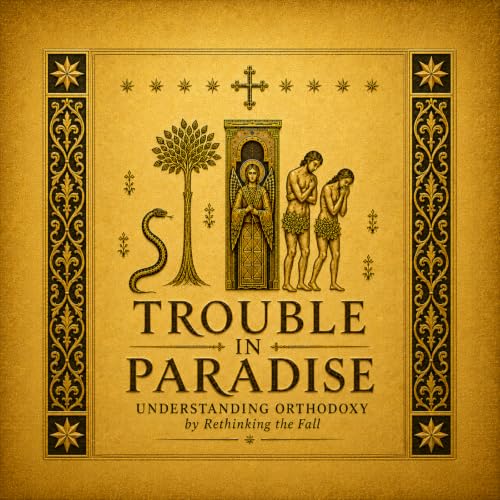
    Trouble in Paradise explores how assumptions about the Fall, Original Sin, and human nature shape how Christians understand salvation, grace, freedom, and the Gospel itself.

    Through personal story, historical theology, and honest reflection, this podcast examines why Eastern Orthodox Christianity often seems difficult for Western Christians to understand — and how reexamining humanity’s fall may reveal a deeper and more ancient vision of Christianity.

    What You’ll Hear in This Podcast

    • Personal journey through theological crisis and discovery • The history and development of Original Sin • Differences between Western and Eastern views of salvation • The relationship between sin, death, and human brokenness • Historical theology explained in accessible language • Honest wrestling with difficult theological questions

    Who This Podcast Is For

    • Christians wrestling with faith questions • Evangelical, Reformed, and Catholic listeners curious about Orthodoxy • Catechumens and Christian inquirers • Former Christians who stepped away because Christianity stopped making sense • Anyone interested in the historical development of Christian theology

    Why This Podcast Exists

    This is the podcast I wish existed when I began asking difficult theological questions — when answers were not simple, not systematic, and not easy to find.

    Coming Soon

    Early episodes explore:

    • What Original Sin is and how it developed • How Eastern Christianity understands the Fall • How those differences change how salvation itself is understood

    Show More Show Less
    6 mins
  • Is the Sovereign God Actually Free?
    Mar 4 2026

    Episode 7

    Is the Sovereign God Actually Free?

    Christians regularly affirm three things about God:

    God is sovereign. God is free. God is love.

    But those claims only hold their meaning if we clarify one deeper concept: necessity.

    When something happens necessarily, it means it could not have been otherwise. Not unlikely, not difficult, but impossible to be different. Two plus two equals four necessarily. A dropped stone falls necessarily.

    This episode asks a simple but far-reaching question: Is God’s willing like that?

    To illustrate the issue, imagine two kings.

    The first is King Ironlaw. Everything in his kingdom unfolds inevitably from who he is. No one forces him, and nothing compels him. But if you understood his nature perfectly, you could predict every decree forever. Nothing could have been otherwise. He is sovereign, but the future is inevitable.

    The second is King Artisan. He is just as powerful and wise, but when he surveys his kingdom he sees many genuine possibilities. He could build by the sea or in the mountains. None of these possibilities are inferior or forced. He chooses one simply because he wills it.

    Both kings are sovereign. But only one has real alternative possibility.

    This contrast helps frame a tension inside Western theology. Many traditions strongly emphasize that nothing happens outside God’s decree. Every salvation, every sin, every event falls within divine providence.

    But that raises a question: Could anything have happened differently?

    If the answer is no—not because God freely chose among real alternatives, but because it could never have been otherwise—then reality begins to look inevitable. God still acts from Himself, but the openness we normally associate with freedom disappears.

    The question becomes sharper when applied to election. Both Catholic and Reformed traditions affirm that God shows mercy to the elect while others remain outside salvation. There is a distinction between mercy and judgment.

    But if those outcomes were structurally necessary—if God could not have saved the reprobate or refrained from saving the elect—then what do we mean by grace or mercy?

    The distinction remains, but the openness seems to vanish.

    Interestingly, this conclusion can arise from two different directions.

    One path begins with metaphysics: ideas about divine simplicity and God as Pure Act, where God’s will flows necessarily from His nature.

    The other path begins with anthropology: the doctrine of original sin. If fallen humans cannot seek God and always act according to their nature, then freedom gets redefined as acting according to one’s desires rather than having the ability to do otherwise. Salvation must then come entirely from God’s initiative. From there, the logic of divine decree and providence expands until every event—including the Fall itself—lies within God’s will.

    Different starting points, but the same structural outcome: freedom defined as non-coercion, while alternative possibilities disappear.

    That brings us to the final question of the episode.

    When Christians say that God freely created, freely elected, and freely loves, what exactly does “freely” mean?

    If God could not have done otherwise, then divine action becomes inevitable. And inevitability is not the same thing as freedom.

    At the bottom of reality, does everything ultimately reduce to necessity? Or does explanation finally end with a personal act of will?

    The answer determines whether ultimate reality is best understood as a structure or as a sovereign mind—and that difference shapes how we understand creation, grace, and the nature of divine love.

    Show More Show Less
    18 mins
  • Born Afraid: The Engine of Sin
    Mar 3 2026

    Episode 6

    Born Afraid: The Engine of Sin

    What if we’ve misdiagnosed the human problem?

    Many Christian traditions begin with inherited depravity — the idea that we sin because we were born corrupt at the root. But Scripture may emphasize something even more foundational: death and the fear it produces.

    In this episode, we explore whether mortality — not metaphysical corruption — is the deeper engine beneath human sin.

    Core Question

    Do we sin because we are sinners?

    Or are we sinners because we sin?

    And if we sin, is it because we were born evil — or because we were born mortal?

    The Biblical Frame

    Hebrews 2:14–15

    Humanity is described as enslaved “through fear of death.” The bondage is existential and lifelong.

    Genesis 3

    The first recorded response after the fall is fear:

    “I was afraid… and I hid myself.” (Genesis 3:10)

    Death enters. Fear awakens. Hiding begins.

    Romans 5

    Paul emphasizes that:

    • Sin entered the world.
    • Death entered through sin.
    • Death “reigned.”

    The focus is not only corruption — but dominion.

    1 Corinthians 15

    “The last enemy that shall be destroyed is death.” If death is the last enemy, perhaps it is also the deepest one.

    A Provocative Thesis

    What if sin is self-preservation without trust?

    What if sin is self-medicating fear?

    • Lust quiets loneliness.
    • Greed quiets insecurity.
    • Control quiets vulnerability.
    • Religious performance quiets anxiety.

    If death is the atmosphere of fallen humanity, fear becomes instinct — and sin becomes anesthesia.

    Christ’s Reversal

    In Gethsemane:

    “My soul is exceeding sorrowful, even unto death…” (Matthew 26:38)

    On the cross:

    He refused the anesthetic (Matthew 27:34).

    Jesus does not numb fear. He enters death fully conscious — and breaks it from the inside.

    If death is the root problem, resurrection life must be the root solution.

    The Conclusion

    Our predicament does not require inherited depravity as the engine when we have already inherited death.

    If death reigned, then resurrection must reign stronger.

    If fear fueled sin, then the destruction of death removes fear’s leverage.

    If we share in Christ’s life, then fear no longer writes our prescriptions — and sin no longer defines our destiny.

    Scripture References

    • Hebrews 2:14–15
    • Genesis 3:10, 19
    • Romans 3:9
    • Romans 5:12–14
    • 1 Corinthians 15:22, 26, 55
    • Matthew 26:38–39
    • Matthew 27:34
    Show More Show Less
    9 mins