• Why You Are What You Worship | The Doxological Mission
    Jun 30 2026

    Are humans merely "brains on a stick," driven purely by logic and intellect? In this episode, we challenge the post-Enlightenment view of human nature and explore the profound reality that we are fundamentally homo liturgicus—liturgical, worshipping animals.Drawing from Augustinian anthropology and modern theological frameworks, we unpack why what you love is far more important than what you know. We discuss how every human is engaged in "unceasing worship," constantly pouring our desires toward a chosen god, whether that is the Creator or the idols of secular culture.We also dive into the doxological cycle of the Christian church's mission. Exploring John Piper's famous axiom that "Missions exists because worship doesn't", we reveal how evangelism, conversion, and the sacraments are all interdependent movements designed to recalibrate our hearts. Join us as we discover how the gathered church acts as a counter-formation against the exhausting "liturgies" of consumerism and modern pragmatism.Key Takeaways:

      • The Myth of the "Thinking Thing": Why Christian discipleship requires a "pedagogy of desire" rather than just an intellectual data download.
      • Cultural Liturgies: How the shopping mall, the stadium, and the digital world covertly miscalibrate our loves.
      • The Fuel of Missions: Why true evangelism is fundamentally a pursuit of global doxology, inviting the nations into the "white-hot enjoyment of God's glory".
      • The Liturgy After the Liturgy: How the Sabbath and the Eucharist propel believers back into the world for social action, justice, and ethical living.
      • Desiring the Kingdom by James K.A. Smith
      • Let the Nations Be Glad! by John Piper
      • The concepts of G.K. Beale regarding the theology of idolatry

    Resources Mentioned:

    Show More Show Less
    46 mins
  • The Local Church as an Embassy of the Kingdom
    Jun 29 2026

    Are the church and the Kingdom of God the exact same thing, or are they completely separate? For centuries, theology has frequently oscillated between heavily equating the institutional church with the Kingdom of Christ and radically severing the two entities entirely.In this episode, we dive deep into the profound theological intersection of the local church and the Kingdom of God. Moving beyond the extremes of secularized utopian social projects and escapist theology, we explore the dynamic framework of "inaugurated eschatology"—the "already and not yet" reality of God's redemptive reign. Discover how the local church functions not as the Kingdom itself, but as the localized embassy of heaven and the principal instrument through which the Kingdom is visibly manifested in the present age.Key themes and topics covered:

      • The Biblical Foundations: Unpacking the crucial difference between the Greek terms basileia (the sovereign, royal reign of God) and ekklesia (the called-out, localized assembly of citizens).
      • The Keys of the Kingdom: How various Christian traditions interpret Matthew 16, and what it practically means for the local church to authenticate citizenship in God's Kingdom before a watching world.
      • Competing Theological Paradigms: A breakdown of George Eldon Ladd's foundational synthesis, Lesslie Newbigin's Missional Ecclesiology, the ongoing debate between Two Kingdoms doctrine and Neo-Calvinist Transformationalism, and the Anabaptist vision of the church serving as a radical "alternative polis".
      • Pastoral Leadership & Liturgy: Why Kingdom governance demands humble servant leadership and dispersed authority rather than secular corporate models, and how the sacraments—especially Baptism and the Eucharist—act as the visible boundary markers and eschatological enactments of the Kingdom.
      • Soul Care in the "Not Yet": How a robust Kingdom theology equips pastors to counsel through suffering and modern crises, anchoring hope in the resurrection rather than the false promises of the prosperity gospel.
      • Mission and Social Justice: The critical role of church planting as the ultimate mechanism for Kingdom expansion and how the church pursues holistic reconciliation and restorative justice using the ELIJAH model for community development.

    Whether you are a church leader, a theology student, or a layperson seeking to bridge the gap between Sunday liturgy and Monday labor, this discussion offers a comprehensive look at how the church faithfully receives, visibly witnesses to, and eagerly anticipates the coming Kingdom.

    Show More Show Less
    44 mins
  • Why Modern Worship Silences Your Grief: Reclaiming Biblical Lament
    Jun 28 2026

    Have you ever felt like there is no room for your sorrow during Sunday morning worship? In thousands of contemporary evangelical and Baptist congregations, the weekly gathering is dominated by relentless positivity, upbeat music, and an aesthetic of spiritual success. But what happens when real life—filled with suffering, grief, and brokenness—collides with this unyielding liturgy of triumph?In this episode, we dive into the "costly silence" of the modern church. We explore how the systemic neglect of corporate lament is not just a stylistic choice, but a profound theological failure that leaves believers unequipped to navigate a fallen world. By examining historical shifts, psychological impacts, and biblical truths, we uncover why the church must reclaim the language of suffering.Key Topics Explored in This Episode:

      • The Theology of Glory vs. The Theology of the Cross: Discover how modern consumerism and the prosperity gospel have led the church to embrace a theologia gloriae (expecting God only in victory and success), completely abandoning Martin Luther's theologia crucis, which recognizes that God is paradoxically revealed in suffering and weakness.
      • The Fracture of Covenantal Care: Old Testament scholar Walter Brueggemann warns that when a congregation is only permitted to speak words of praise, the relationship with God becomes one of coercion and denial. We discuss how a lack of lament actively hinders the church's ability to "bear one another's burdens".
      • Muting the Prophetic Voice: A church that only praises God for the status quo implicitly baptizes oppressive systems. Learn how traditions like the Black church utilize lament as a vital form of faithful resistance, and why reclaiming this practice is essential for bridging racial divides and confronting systemic injustice.
      • The 4 Steps of Biblical Lament: Far from just venting, lament is a highly structured spiritual discipline. We break down pastor Mark Vroegop's four-step process—Turn, Complain, Ask, and Trust—which serves as the biblical vehicle designed to move the human soul from the paralysis of pain to genuine trust.
      • Pastoral Malpractice and the "Quick Fix": Why relying on therapeutic optimism, out-of-context bible verses (like Romans 8:28), and a rush to find the "silver lining" often inflicts secondary trauma on grieving believers.
      • Practical Steps for Reclaiming Sorrow: How worship leaders and pastors can integrate minor-key hymns, pastoral lament, and specialized "Blue Christmas" or "Longest Night" services to create safe, liturgical spaces for those navigating acute grief.

    The Bottom Line: To follow Jesus is to follow the "Man of Sorrows". The sinless Savior utilized the exact language of lament to navigate the brokenness of this world, weeping at the tomb of Lazarus and crying out from the cross. It is time for the local church to stop acting merely as a showroom for the victorious and become a hospital for the broken.Join us as we learn how to weep together, protest evil together, and boldly pray, "How long, O Lord?"

    Show More Show Less
    41 mins
  • The Antidote to Digital Exhaustion: Building a Theological Immune System
    Jun 27 2026

    Are you burned out by the endless outrage cycles of the 2026 digital landscape? In this episode, we explore why "vibe-based" spirituality and emotional subjectivism are leaving modern individuals uniquely vulnerable to exhaustion and anxiety.We dive deep into the philosophy of "expressive individualism"—the draining modern mandate to constantly curate and broadcast an authentic identity. We also unpack how social media algorithms exploit our negativity bias to induce cognitive overload and decision fatigue.The surprising antidote? The historic catechism. Far from being a sterile relic of rote memorization, systematic doctrinal instruction acts as vital "cognitive scaffolding". It provides a stationary anchor for our minds, helping us build a "theological immune system" to withstand both personal crises and algorithmic manipulation.Join us as we discuss:

      • How identity shifted from conforming to a transcendent order to fragile self-creation.
      • Inspiring historical case studies of resilience from the Early Church, the French Huguenots, and the Chinese House Church movement.
      • Practical ways to use modern Spaced Repetition Systems (SRS) for microlearning and theological anchoring.

    Trade the fragile exhaustion of subjective self-definition for the enduring weight of objective truth. Listen now!

    Show More Show Less
    52 mins
  • Reclaiming the Middle Distance: The Truth About Reformed Orthodoxy
    Jun 24 2026

    Are we misunderstanding the historical foundations of Reformed theology? For generations, the narrative has been dominated by the "Calvin against the Calvinists" theory, which claims that while John Calvin offered vibrant, pastorally sensitive theology, his successors devolved into rigid, deductive rationalism.In this episode, we journey into the "middle distance" of historical theology (1560–1750) to dismantle this modern myth. By returning directly to primary sources, we uncover how post-Reformation theologians actually utilized the rigorous pedagogical tools of scholasticism not to corrupt original Protestant simplicity, but to protect it against fragmentation and polemical attacks.Join us as we strip away modern mistranslations, deconstruct the simplistic "TULIP" caricature, and explore the architectonic brilliance of the Reformed tradition.Topics Covered in This Episode:

      • The Myth of "Calvin vs. The Calvinists": Why the "central dogma" theory is anachronistic reductionism.
      • Lost in Translation: How Renaissance Latin shaped orthodox thought, and why translating terms like habitus (infused disposition) and patior (Christ's active endurance of suffering) into modern English flattens profound dogmatic nuance.
      • The Maturation of Calvin: Tracing the evolution of Calvin's Institutes from a 1536 catechetical text to a comprehensive 1559 dogmatics, and why his placement of predestination is fundamentally pastoral.
      • Confessional Architecture: The existential "Guilt, Grace, Gratitude" framework of the Heidelberg Catechism.
      • Beyond TULIP: Why the Canons of Dort were never meant to be a complete systematic theology, and the danger of reducing Reformed thought to a 20th-century acronym.
      • Knowing the Unknowable God: Franciscus Junius and the profound epistemological boundary of the Archetypal-Ectypal distinction.
      • The Scholastic Method in Action: How Aristotelian causal analysis cleanly separated justification from sanctification to refute the Council of Trent.
      • Key Controversies: The Piscator debate on Christ's active obedience and understanding God's twofold will through divine concursus.
      • Reformed Catholicity: How figures like Amandus Polanus proved that Reformed theology is in symphonic harmony with the early church fathers.
      • The Digital Horizon: How the Post-Reformation Digital Library (PRDL) and computational philology are democratizing access to unread Latin treatises and fueling a historiographical renaissance.
      • Synopsis Purioris Theologiae (Synopsis of a Purer Theology, 1625)
      • Junius Institute for Digital Reformation Research
      • The Post-Reformation Digital Library (PRDL)

    Further Resources Mentioned:Subscribe & Follow: If you enjoyed this deep dive into historical theology, be sure to subscribe and leave a review! Let us know in the comments which scholastic concept you found most fascinating.

    Show More Show Less
    57 mins
  • The Interpreter’s House: Restoring Biblical Discernment in a Digital Age
    Jun 23 2026

    In this episode, we dive deeply into the profound psychological and theological toll the digital age is taking on the modern believer.As our minds become increasingly fragmented by the shallow consensus of social media algorithms, we explore how to reclaim the rigorous, disciplined art of biblical discernment before we lose our grip on truth entirely. We unpack the dangers of "algorithmic snobbery," the neuroplastic effects of smartphones, and how the internet's architecture—comprising hyperlinks, push notifications, and infinite feeds—is explicitly optimized for attention capture at the direct expense of deep thought.Key Topics Covered in This Episode:

      • The Digital Deluge & Brain Rewiring: How hyper-connected information streams rewrite our neural pathways, short-circuiting our "contemplative dimension" and fostering chronic distraction, weakened memory, and ambient anxiety.
      • The Sieve of Historical Orthodoxy: Drawing from John Bunyan's The Pilgrim's Progress, we discuss the necessity of "The Interpreter's House"—using historical church creeds and confessions to filter the chaos of modern "expressive individualism".
      • AI and "Digital Gnosticism": A look at the alarming statistic that 30% of U.S. adults (and 34% of practicing Christians) now trust artificial intelligence for spiritual advice as much as a pastor. We examine the spiritual peril of replacing incarnational, physical church community with transactional, soulless algorithms.
      • The Printed Bible vs. The Screen: Fascinating research by digital sociologist John Dyer showing how reading Scripture on a smartphone versus a physical printed page fundamentally alters the reader's perception of God's character.
      • Recovering Robust Exegesis: Why we must prioritize the grammatical-historical method to discover the original author's intent, rather than relying on the subjective, emotional proof-texting popularized by modernized Lectio Divina.
      • Practical Habits for the Drifting Mind: Actionable daily liturgies drawn from Justin Whitmel Earley’s The Common Rule, including the transformative practice of "Scripture before phone," digital fasting, kneeling prayer, and tethering oneself to an embodied local church.

    Join us as we step out of the endless digital feed, cure the disease of "chronological snobbery," and return to the slow, deliberate, and Spirit-led study of God's Word. It’s time to anchor your soul in the timeless marrow of historical orthodoxy

    Show More Show Less
    54 mins
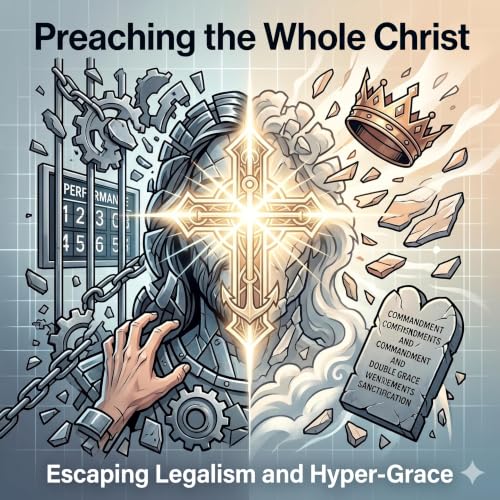
  • Preaching the Whole Christ: Escaping Legalism and Hyper-Grace
    Jun 23 2026

    Are we preaching a version of Jesus that doesn't actually exist?In this episode, we dive deep into the theological crisis fracturing the contemporary local church in 2026. As congregations navigate a complex landscape of Moralistic Therapeutic Deism, megachurch consumerism, and the rise of AI in spiritual formation, the Gospel is frequently being fragmented. We explore how modern believers are left trapped in a spiritual tug-of-war between two devastating extremes:On one side is the trap of legalism, fueled in places like Singapore by kiasu (the fear of losing out) culture, which turns salvation into a transaction and leads to severe pastoral and congregational burnout. On the other side is the illusion of antinomianism, popularized as "hyper-grace" theology, which dangerously severs Jesus as Savior from Jesus as Lord by treating God's moral commands as obsolete.Drawing on insights from the 18th-century Marrow Controversy, we reveal how legalism and antinomianism are actually "non-identical twins from the same womb," born from a failure to trust God's generous character. The only remedy for both errors is the robust preaching of the "Whole Christ". Join us as we unpack the beauty of union with Christ (unio cum Christo) and the "double grace" (duplex gratia) of justification and sanctification, proving that radical grace and the call to holiness are meant to be united.Key Takeaways in this Episode:

      • The 2026 Cultural Shift: How digital ecosystems, AI, and consumer-driven theology are shaping a highly susceptible Gen Z and creating a "cherry-picked" Jesus.
      • The Kiasu Epidemic: Why performance-driven spirituality is creating a crisis of chronic fatigue and severe mental health struggles among church leaders.
      • Deconstructing Hyper-Grace: A look at why removing the moral law and the need for ongoing confession produces a shallow faith entirely unprepared for suffering.
      • The Grammar of the Gospel: Practical strategies for local pastors to preach the "indicatives" (what God has done) before the "imperatives" (what we must do) to avoid both moralism and stagnation.
      • Ecclesiology that Heals: How expository preaching, plurality of leadership, Sabbath rest, and the sacraments anchor a church against cultural extremes.

    Don't forget to subscribe and leave a review if you found this episode helpful for your spiritual walk or pastoral ministry!

    Show More Show Less
    44 mins
  • The Great Evangelical Identity Crisis
    Jun 23 2026

    In this episode, we explore how modern evangelicalism traded its robust theological heritage for a pragmatic, "lowest common denominator" approach to faith. In the pursuit of cultural relevance and numerical growth, the contemporary church has systematically stripped away the historical denominational distinctives that once defined it. We dive into the rise of the nondenominational megachurch and the "seeker-sensitive" movement, discussing how traditional labels like "Baptist" or "Presbyterian" were discarded as mere marketing liabilities that might alienate unchurched consumers.Discover how this theological rebranding created a vacuum swiftly filled by "Moralistic Therapeutic Deism"—a shift that replaced biblical categories of sin, law, and gospel with the therapeutic language of self-improvement and behavioral modification. We also examine how modern digital satire, from Lutheran Satire to the fictional Landover Baptist Church, effectively exposes the doctrinal shallow waters of generic Christianity and its accidental embrace of ancient heresies. Finally, we discuss the urgent need to return to a robust, confessional theology rooted in the Protestant Reformation to protect the integrity of the local church

    Show More Show Less
    51 mins