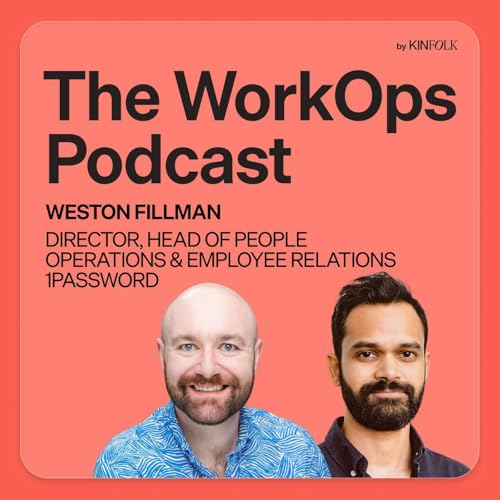
The WorkOps Podcast cover art

The WorkOps Podcast

The WorkOps Podcast

By: by Kinfolk
Listen for free

The WorkOps Podcast is your weekly conversation with HR leaders and People Ops practitioners doing the real work. In every episode we dig into one story. A process that went sideways, a system that just didn't work, and what someone actually did about it. Packed with practical lessons you'll want to bring back to your team. Whether you're supporting 500 employees or 5,000, this is how the best People leaders are building for what comes next.© 2026 by Kinfolk Economics Relationships Social Sciences
Episodes
  • Context is the new currency for HR
    May 26 2026

    Summary
    A top performer walks out the door at Qualtrics holding an outside offer for double their salary. Michael MacArthur, then Head of People, has a choice: pretend the market is wrong, or admit the comp process was. His read, years later from the COO seat at Recharge: the 2x counter-offer isn't a market signal. It's an audit finding.

    This is one of the cleanest diagnostics we've heard for whether a comp process is really working. And it's the same logic Michael applies to AI, engagement, and the build-versus-buy questions every HR leader is wrestling with right now. The unifying argument: context, not better tools, is the layer that separates the HR teams winning with AI from the ones spinning cycles.


    Timestamps
    01:00 Michael's path from sales comp to head of people at Qualtrics to COO at Recharge
    03:00 The Qualtrics dysfunction: forced curves and 18-month time-in-seat gates
    04:00 The "double their salary" diagnostic signal for a broken comp process
    06:30 Recharge's fix: 6-month cash cycle, no forced curve, multi-level calibration
    10:00 Process transparency versus salary transparency
    13:00 Nectar's anonymous follow-up and the context thesis for AI in HR
    14:30 Why Anthropic's engagement score doesn't matter to Recharge
    16:00 Build versus buy on the people side: when trust outweighs context
    21:30 The CEO move that put Recharge's exec team on terminals
    23:00 Audit the workflow before you prompt the model


    Takeaways
    - The fastest test that your comp process is broken: a leaving employee getting offered double their current salary at the next job.
    - Forced curves and time-in-seat promotion gates work at 250 employees. They quietly stop working at 2,500.
    - AI value in HR shows up in context-gathering, not dashboards. Anonymous follow-up conversations beat static survey scores.
    - Internal-historical engagement trends beat external benchmarks. Anthropic's engagement score doesn't tell you what's happening on your team.
    - Audit the workflow before you prompt the model. Most failed AI projects in HR are unmapped-workflow problems, not tooling problems.


    Connect with the Guest
    LinkedIn: https://www.linkedin.com/in/mimcarthur/
    Recharge: https://getrecharge.com/about/


    Sponsor
    This episode is brought to you by Kinfolk, the AI service desk built for HR.

    See more at kinfolkhq.com

    Show More Show Less
    26 mins
  • How to Fund Your HR Transformation
    May 19 2026

    Summary

    In this episode of The WorkOps Podcast, Jeet sits down with Weston Fillman, Director of People Operations and Employee Relations at 1Password, to unpack what it actually takes to get an HR transformation funded, and what changes when AI enters the room. Wes describes the months of pre-work that won him more executive budget than he asked for at a 10,000-person enterprise tech company, the reframe he'd apply to the same project today (people systems as infrastructure, not engagement), and the role-redesign conversations he's having on his team at 1Password as AI starts to automate the operational layer of HR ops. A field guide for any People leader heading into their next budget cycle.


    Timestamps

    00:00 Welcome and Wes's career path (TFA kindergarten to 1Password)

    02:45 Inheriting a broken hiring process at a 10,000-person company

    07:00 "You can build a new house, but the floor plan's wrong"

    08:00 The structured plan, executive buy-in, and a budget bigger than expected

    11:00 Sideways socialization: leading without authority across HR peers

    13:30 1Password rolls out org-wide agent-building, and modeling AI as a leader

    17:30 Build vs. buy in 2026 (and why it's really build AND buy)

    22:30 The role redesign conversation: AI rewrites the JD, doesn't cut the role

    26:00 The reframe Wes would apply today: people systems as infrastructure

    30:00 Where People leaders should start their own AI journey


    Takeaways

    - HR transformation budgets are won in the months of pre-work before the e-staff ask, not in the room itself.

    - The reframe from "employee experience" to "business infrastructure" is the single change that turns the same HR project from nice-to-have into board-level fundable.

    - AI lands well when leaders treat it as a role-redesign conversation, not a layoff conversation. Most operational work was never on the JD anyway.

    - Cross-functional buy-in (sideways across peer HR leaders) matters as much as executive sponsorship for any large People transformation.

    - The best AI on-ramp for an individual contributor is to start with the work they're not great at, not the work they already excel at.


    Connect with the Guest
    Weston Fillman on LinkedIn: https://www.linkedin.com/in/westonfillman/
    1Password: https://1password.com/


    Sponsor
    This episode is brought to you by Kinfolk, the AI service desk built for HR.

    See more at kinfolkhq.com

    Show More Show Less
    34 mins
  • The "Human API" problem hiding in your onboarding process
    May 13 2026

    Summary

    What looks like a warm, boutique onboarding experience on the outside is often powered by something much less glamorous on the inside: a person copy-pasting LinkedIn headshots into slides at midnight.

    In this episode of the WorkOps Podcast, host Jeet sits down with Amie Taylor, Senior Director of People Operations, Rewards and Technology, for a refreshingly honest conversation about the hidden cost of "human API" processes.


    Amie walks through a three-year saga at a previous hyper-growth tech consulting company where the entire day-zero-to-day-one new hire experience ran on Google Forms, manual IT tickets, and one very overworked TA coordinator hunting down headshots for the CMO's town hall slides. She shares how she eventually built the business case, the internal politics she had to navigate, why it took a team member filing overtime to finally break through, and the bittersweet twist at the end when she left right after getting the project approved.


    She and Jeet also get into how she's applying those lessons today—consolidating HR systems at her current company, using critical thought as the test for what to automate, and why some processes (like leave for someone facing a serious diagnosis) should stay stubbornly human. If you've ever inherited a process held together by goodwill and overtime, this one will hit close to home.


    Timestamps

    • 00:23 Amie's path from psychology to global payroll
    • 04:46 Inheriting a high-touch onboarding process powered by "human APIs"
    • 06:12 Google Forms, missed steps, and a candidate experience built on anxiety
    • 08:23 Hours spent hunting down headshots for town hall slides
    • 11:00 The three-year fight to get buy-in to automate
    • 13:00 Getting the project approved, then resigning right after
    • 15:13 Rebuilding similar processes today with full stakeholder buy-in
    • 19:47 The "critical thought vs. machine work" test for what to automate


    Takeaways

    • Audit the hidden labor inside "high-touch" processes before you call them culture
    • Quantify manual work in overtime and bottom-line impact, not just employee experience
    • Build stakeholder buy-in by making the decision feel like theirs, not yours
    • Use "critical thought vs. machine work" as your test for what AI and automation should touch
    • Protect the human moments—leave processes, serious diagnoses, tough conversations—no matter how advanced your tooling gets
    • Remember: if the process doesn't scale, it's not your culture, it's tech debt


    Guest LinkedIn: https://www.linkedin.com/in/amie-taylor-5b99b810/


    Sponsor
    This episode is brought to you by Kinfolk, the AI service desk built for HR.

    See more at kinfolkhq.com

    Show More Show Less
    23 mins
adbl_web_anon_alc_button_suppression_c
No reviews yet