Episodes

  • Scoring systems, games, and value capture, with Thi Nguyen and Scott Black
    Apr 21 2026

    How can scoring systems make games feel so joyful, fluid, and alive, yet drain the life from public institutions and everyday work? This is one of the central questions of a new book by University of Utah philosopher C. Thi Nguyen. In The Score: How to Stop Playing Somebody Else’s Game, published this year by Penguin, Nguyen traces the philosophical and ideological aspects of scoring systems when used outside of play. With Tanner Humanities Center Director Scott Black, Nguyen discusses games as forms of portable agency, the problem of value capture, and the ways gamification and institutional metrics can narrow and impoverish human life.

    Recent reviews of The Score:

    The New York Times — Jennifer Szalai, “Why Keeping Score Isn’t Fun Anymore”

    The Washington Post — Becca Rothfeld, “A philosopher’s case for living playfully without keeping score”

    The Guardian — Tim Clare, “A brilliant warning about the gamification of everyday life”

    The New Yorker — Joshua Rothman, “Is Life a Game?”

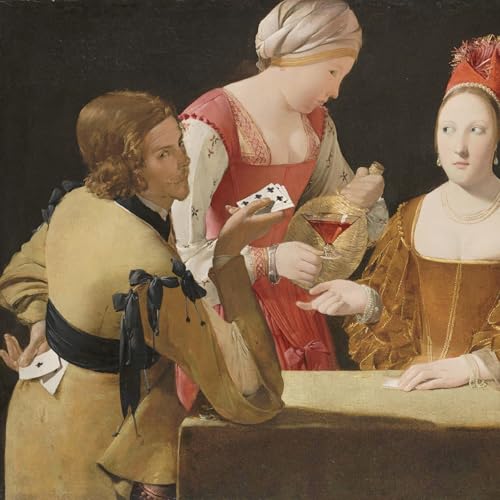
    Episode art: Detail from Georges de La Tour, The Cheat with the Ace of Clubs, c. 1630-34. Kimbell Art Gallery.

    Episode edited by Ethan Rauschkolb. Named after our seminar room, The Virtual Jewel Box hosts conversations at the Obert C. and Grace A. Tanner Humanities Center at the University of Utah. Views expressed on The Virtual Jewel Box do not represent the official views of the Center or University.

    Show More Show Less
    45 mins
  • Nora Lange, author of Day Care and Us Fools, with Erin Beeghly
    Apr 2 2026

    Nora Lange, author of Us Fools (2024), discusses her new collection of short stories, Day Care, with Erin Beeghly (Department of Philosophy). Their conversation touches on female desire, motherhood, mischief, and the strange pressures of contemporary life. They discuss the surreal charge of stories like “Hot Spot,” the autofictional elements of the title story, and Lange’s “careening” prose style, which moves through play, surprise, and sudden transformation without losing emotional depth.

    Along the way, they talk about siblings, marriage, daycare, deadlines, and the elastic feeling of time in parenting, as well as Lange’s interest in genre, from realism to the snow-globe science fiction of “Dog Star.”

    Episode art: Detail from Joris Hoefnagel, Seven Snails (c.1575/1590s), National Gallery of Art, Washington DC.

    Episode edited by Ethan Rauschkolb. Named after our seminar room, The Virtual Jewel Box hosts conversations at the Obert C. and Grace A. Tanner Humanities Center at the University of Utah. Views expressed on The Virtual Jewel Box do not represent the official views of the Center or University.

    Show More Show Less
    26 mins
  • How we watch The Real Housewives of Salt Lake City - Marcie Young-Cancio
    Mar 17 2026

    In anticipation of our symposium on The Real Housewives of Salt Lake City on April 10, Marcie Young-Cancio, Robert Carson, and Scott Black discuss the show from a humanities perspective, examining its treatment of faith, femininity, Utah culture, entrepreneurship, fan loyalty, and camp sensibility.

    Marcie Young-Cancio is Clinical Associate Professor in the Department of Communication and Founder and Executive Director of Amplify Utah.

    See also:

    • Receipts, Proof, Timeline: How We Watch the RHOSLC symposium program
    • Heather L. King, “Tanner Humanities Center presents a scholarly deep dive into ‘The Real Housewives of Salt Lake City’” @ the U
    • Susan Sontag, “Notes on Camp”

    Episode edited by Ethan Rauschkolb. Named after our seminar room, The Virtual Jewel Box hosts conversations at the Obert C. and Grace A. Tanner Humanities Center at the University of Utah. Views expressed on The Virtual Jewel Box do not represent the official views of the Center or University.

    Show More Show Less
    35 mins
  • Enshittification, with Cory Doctorow and Matthew Potolsky
    Mar 6 2026

    In this episode, Matt Potolsky (Professor of English) talks with writer and activist Cory Doctorow about digital privacy, platform decay, and the politics of monopoly.

    Drawing on his recent book, Enshittification: Why Everything Suddenly Got Worse and What to Do About It, Doctorow argues that the erosion of privacy is inseparable from the rise of unchecked commercial surveillance, and that many people care deeply about privacy without recognizing it as such.

    They also discuss

    • the three-stage collapse of digital platforms
    • Robert Bork and the Chicago School’s influence on antitrust law
    • the IBM antitrust case
    • Yanis Varoufakis’s theory of techno-feudalism
    • algorithmic wage discrimination
    • effective altruism and longtermism
    • AI as a fantasy of boss-without-workers
    • the surprising global resurgence of anti-monopoly politics as a source of hope.

    Cory Doctorow is a journalist, blogger, and the author of numerous works of fiction and nonfiction. He is a longtime contributor to the Electronic Frontier Foundation and blogs at pluralistic.net.

    Episode edited by Ethan Rauschkolb. Named after our seminar room, The Virtual Jewel Box hosts conversations at the Obert C. and Grace A. Tanner Humanities Center at the University of Utah. Views expressed on The Virtual Jewel Box do not represent the official views of the Center or University.

    Show More Show Less
    49 mins
  • Great Books: Mrs Dalloway by Virginia Woolf - Jessica Straley and Scott Black
    Feb 3 2026

    In a new series of episodes, The Virtual Jewel Box will feature conversations about great books.

    Scott Black and Jessica Straley discuss Mrs. Dalloway as a novel of thresholds: between past and present, sound and silence, intimacy and distance. Reading closely from the opening line through Big Ben’s leaden circles, they show how Woolf’s stream of consciousness turns a single June day, a walk through London, and a party into an inquiry into memory, war, love, and social life. They invite readers to consider how Woolf’s prose, down to its use of the semicolon, reflects on perception, privacy, and what it means to live with other minds.

    Jessica Straley is Associate Professor of English at the University of Utah.

    See also: Jenny Noice, “A Hundred Years of Mrs. Dalloway,” JSTOR Daily.

    Episode art: Photo of Virginia Woolf, circa 1927. Virginia Woolf Monk's House photographs, Houghton Library, Harvard University.

    Episode edited by Ethan Rauschkolb. Named after our seminar room, The Virtual Jewel Box hosts conversations at the Obert C. and Grace A. Tanner Humanities Center at the University of Utah. Views expressed on The Virtual Jewel Box do not represent the official views of the Center or University.

    Show More Show Less
    38 mins
  • Aesthetics and empathy, with Joseph Metz and Scott Black
    Jan 8 2026

    In this episode, Scott Black talks with literary scholar Joseph Metz about The Feeling of the Form: Empathy and Aesthetics from Büchner to Rilke (Cornell University Press), Metz’s cultural and intellectual history of empathy that traces the origins of the concept back to 19th-century German art theory. Drawing on close readings of Georg Büchner, Adalbert Stifter, and Rainer Maria Rilke, Metz shows how empathy originated as Einfühlung, a theory of bodily projection into objects and forms, before later becoming a model for interpersonal feeling.

    They also discuss Robert Vischer and Theodor Lipps, Kant and nineteenth-century neurophysiology, debates between vitalism and materialism, and the ethical limits of understanding others.

    Joseph Metz is Associate Professor of German in the Department of World Languages and Cultures at the University of Utah.

    Episode art: from Charles Le Brun, Expressions des passions de l’Ame, as a frontispiece to Henri Testelin, Sentimens des plus Habiles Peintres sur la Pratique de la Peinture et Sculpture, Metropolitan Museum of Art.

    Episode edited by Ethan Rauschkolb. Named after our seminar room, The Virtual Jewel Box hosts conversations at the Obert C. and Grace A. Tanner Humanities Center at the University of Utah. Views expressed on The Virtual Jewel Box do not represent the official views of the Center or University.

    Show More Show Less
    40 mins
  • Mentorship and solidarity, with Leandra Hernández and Omi Salas-SantaCruz
    Dec 4 2025

    In this episode, Omi Salas-SantaCruz talks with Leandra Hernández about Queer, Women of Color, and Critical Approaches to Feminist Mentorship and Pedagogy (University of Illinois Press), co-edited by Hernández, Stevie M. Munz, and Jessica Pauly. Along the way, they discuss the power of feminist mentorship, the ecological webs of care that sustain scholars and students, and the forms of solidarity that help communities thrive even in times of precarity.

    Leandra Hernández is Associate Professor in the Department of Communication, and Omi Salas-SantaCruz is Assistant Professor in the Department of Education, Culture and Society, at the University of Utah.

    See also:

    • Organization for the Study of Communication, Language, and Gender
    • Feminist Mentoring in Academia (Lexington Books)

    Episode art: Detail from Yreina D. Cervántez, Mujer de Mucha Enagua, PA' TI XICANA, 1999 Smithsonian American Art Museum.

    Episode edited by Ethan Rauschkolb. Named after our seminar room, The Virtual Jewel Box hosts conversations at the Obert C. and Grace A. Tanner Humanities Center at the University of Utah. Views expressed on The Virtual Jewel Box do not represent the official views of the Center or University.

    Show More Show Less
    47 mins
  • Tuning your ear to conceptual music, with Craig Dworkin and Scott Black
    Nov 20 2025

    In this episode, Scott Black talks with poet and critic Craig Dworkin about his new book, The Sound of Thinking: A Listener’s Companion to Conceptual Music (University of Chicago Press), on music made from rules, systems, and procedures rather than personal expression. They explore pieces like György Ligeti’s 100 metronomes, Steve Reich’s swinging-microphone Pendulum Music, Enrique Udo’s braille-based scores, Johannes Kreidler’s stock-market sonifications, and an uncanny note-for-note remake of Kind of Blue.

    Along the way, they discuss John Cage, the boundaries between noise and music, how listening becomes a cognitive practice, and why conceptual sound works challenge us to rethink creativity, difficulty, and the very definition of music.

    Craig Dworkin is Professor of English at the University of Utah.

    Episode art: Detail from Juan Gris, Le papier à musique (1913-1914), Musée National d'Art Moderne, Paris.

    Episode edited by Ethan Rauschkolb. Named after our seminar room, The Virtual Jewel Box hosts conversations at the Obert C. and Grace A. Tanner Humanities Center at the University of Utah. Views expressed on The Virtual Jewel Box do not represent the official views of the Center or University.

    Show More Show Less
    39 mins