• Innovating Development: The Future of GitHub Agents and AI in Rails
    Feb 24 2026

    In this episode of the Ruby AI Podcast, hosts Joe and Valentino welcome special guest, Kinsey Durham Grace, a prominent figure in the Ruby community and member of the GitHub team. The discussion covers a range of topics including the use of AI for generating episode artwork, the application of AI agents in coding tasks, and the recent developments at GitHub like the Agent HQ. Kinsey shares insights into her day-to-day work on the coding agent core team at GitHub, including the use of custom agents to enhance coding efficiency. They also delve into the impact of AI on software development, the importance of well-rounded developer skills, and Kinsey’s perspective on the future of Ruby in the AI landscape.

    00:00 Introduction and Guest Welcome
    00:30 AI-Generated Images and Their Drawbacks
    03:07 Kinsey's Role at GitHub
    06:33 Using AI Tools in Development
    11:26 Challenges in Large Monolith Apps
    18:23 Modular and Maintainable Agents
    24:47 AI's Role in Software Development
    25:29 Challenges with Current AI Tools
    26:50 Observational Memory in AI
    27:42 Open Claw and Heartbeat Concepts
    28:22 Collaborative AI and Future Prospects
    29:22 In-House vs. Third-Party Observability Tools
    29:54 New AI Products and Intent Capture
    31:08 Persisting Context in Software Development
    37:42 Custom Agents and Knowledge Management
    46:13 The Human Element in AI Collaboration
    47:20 Skills for the Future of AI in Engineering
    48:54 Ruby and AI: Staying Relevant
    50:50 Conclusion and Final Thoughts

    Show More Show Less
    51 mins
  • From Writing Code To Orchestrating It, Agentic Development with Ben Scofield
    Feb 10 2026

    In this episode of the Ruby AI Podcast, hosts Valentino Stoll and Joe Leo are joined by Ben Schofield, an accomplished author, open source contributor, and Ruby enthusiast. The discussion starts with thoughts on the upcoming RubyConf and the unique experience of conferences hosted in Las Vegas. Ben shares his recent experiences with Bento and the impact of layoffs. The conversation delves deep into the nature of expertise, exploring questions around achieving world-class performance and domain-specific skills. The hosts explore the goals of software development, the role of AI in coding, and the importance of intentionality in using agents. They also touch on the concept of default settings in development, the nuances of staff engineering, and strategies for training future staff engineers. The discussion concludes with ideas for improving the onboarding and training of engineers in the evolving landscape of AI tools.

    Mentioned in this episode:

    • RubyConf 2026 (Las Vegas)
    • RailsConf (context/history)
    • O’Reilly (RailsConf partner mentioned historically)
    • Bento (Ben’s recent company)
    • Gusto (host context)
    • Artificial Ruby / Ruby x AI NYC meetups
    • Agentic coding & tooling
      • Claude Code docs
      • Claude Code + MCP
    • Books, papers, and ideas
      • C. Thi Nguyen (background)
      • Games: Agency as Art (Oxford)
      • Ezra Klein Show episode (Nguyen)
      • Malcolm Gladwell, Outliers
      • Andy Hunt, Pragmatic Thinking and Learning (Refactor Your Wetware)
      • Ericsson et al. (1993) deliberate practice (DOI)
      • Macnamara & Maitra replication (2019) (DOI)
      • David Epstein, Range
      • Will Larson, Staff Engineer
      • Robert Cialdini, Influence resources
      • DHH on conceptual compression
      • Chad Fowler, The Phoenix Architecture (Leaflet)
      • Quote referenced (“How can I know what I think till I see what I say?”)
    • Ruby/Rails primitives referenced in Valentino's experiments
      • Ruby method_missing
      • Ruby define_method
      • Rails rescue_from
      • Valentino's experimental Ruby project (“Chaos to the Rescue”) that uses LLMs + runtime method definition
    Show More Show Less
    53 mins
  • New Year, New Ruby: Agents, Wishes, and a Calm Ruby 4
    Jan 27 2026

    Ruby turns 30, Ruby 4 quietly ships, and the AI tooling arms race shows signs of maturity. Valentino and Joe unpack what stability really means for a language in its third decade, debate agent-driven development, AI “slop,” binary distribution, and whether open source incentives are breaking down—or simply evolving.

    Mentioned In The Show

    A grab-bag of tools, projects, and references Valentino & Joe brought up.

    Ruby & Core Ecosystem

    • Ruby Gets A Fresh Look — Official Ruby programming language site (news, downloads, docs) now with a great new look.
    • Ruby Kaigi — Ruby’s flagship conference (talks, schedules, archives).
    • Bundler — Ruby dependency manager used across the ecosystem.

    AI Coding Tools

    • Claude Code — Anthropic’s CLI coding assistant workflow discussed heavily in the episode.
    • OpenAI Codex — OpenAI’s coding agent/tooling referenced as an alternative workflow.


    Ruby Web Frameworks & Architecture

    • Rails Framework — Ruby on Rails, referenced as the default baseline for many apps.
    • Jumpstart Rails — Rails starter kits/templates mentioned as a “pick a Rails” approach.
    • Roda Framework — Jeremy Evans’ web toolkit (lighter than Rails, bigger than Sinatra).
    • dry-rb Suite — Ruby gems for functional-ish architecture and explicit business logic.
    • Trailblazer — High-level architecture for operations, workflows, and domain logic.

    Quality, Testing, and Practice

    • Better Specs — Community-curated RSpec guidelines mentioned as a spec style target.
    • Datadog — Error monitoring referenced in the “well-defined bug + stack trace” workflow.

    Open Source Sustainability

    • GitHub Sponsors — Sponsorship mechanism discussed as one (partial) monetization path.

    People Mentioned

    • Sandi Metz — Referenced as the “code whisperer” ideal for idiomatic Ruby guidance.
    Show More Show Less
    51 mins
  • Real vs. Fake AI with Evan Phoenix
    Jan 6 2026

    In this episode of the Ruby AI podcast, hosts Valentino Stoll and Joe Leo engage with Evan Phoenix, a seasoned Ruby programmer and CEO of Mirren. The conversation explores Evan's unique name origin, his career trajectory, and the integration of AI in development workflows. They discuss the distinction between real and fake AI in products, the impact of AI on engineering practices, and the future of AI in development tools. Evan shares insights on performance optimization, human-centric AI interactions, and the role of AI in deployment and architecture detection. In this conversation, Joe, Evan Phoenix, and Valentino Stoll discuss the evolving landscape of software development, particularly focusing on the role of AI, automation, and the Ruby programming language. They explore how AI can assist in analyzing code bases, the future of development with ambient agents, and the potential resurgence of monolithic architectures. The discussion also touches on the importance of human-centric design in software, the significance of experimentation, and the unique strengths of Ruby in the current tech environment. The conversation concludes with predictions about the future of small teams in software development and the impact of AI on coding practices.

    Show More Show Less
    1 hr and 2 mins
  • Running Self-Hosted Models with Ruby and Chris Hasinski
    Dec 2 2025

    In this episode of the Ruby AI Podcast, hosts Valentino Stoll and Joe Leo
    welcome AI and Ruby expert Chris Hasinski. They delve into the benefits and
    challenges of self-hosting AI models, including control over model updates, cost
    considerations, and the ability to fine-tune models. Chris shares his journey
    from machine learning at UC Davis to his extensive work in AI and Ruby, touching
    upon his contributions to open source projects and the Ruby AI community. The
    discussion also covers the limitations of current LLMs (Large Language Models)
    in generating Ruby code, the importance of high-quality data for effective AI,
    and the potential for Ruby to become a strong contender in AI development.
    Whether you're a Ruby enthusiast or interested in the intersection of AI and
    software development, this episode offers valuable insights and practical
    advice.

    00:00 Introduction and Guest Welcome
    00:31 Why Self-Host Models?
    01:28 Challenges and Benefits of Self-Hosting
    03:14 Chris's Background in Machine Learning
    04:13 Applications Beyond Text
    06:39 Fine-Tuning Models
    12:27 Ruby in Machine Learning
    16:06 Distributed Training and Model Porting
    18:22 Choosing and Deploying Models
    25:19 Testing and Data Engineering in Ruby
    27:56 Database Naming Conventions in Different Languages
    28:19 Importance of Data Quality for AI
    18:03 Monitoring Locally Hosted AI Models
    29:37 Challenges with LLMs and Performance Tracking
    31:09 Improving Developer Experience in Ruby
    31:45 Ruby's Ecosystem for Machine Learning
    32:43 The Need for Investment in Ruby's AI Tools
    38:25 Challenges with AI Code Generation in Ruby
    43:35 Future Prospects for Ruby in AI
    51:26 Conclusion and Final Thoughts

    Show More Show Less
    54 mins
  • The Latent Spark: Carmine Paolino on Ruby’s AI Reboot
    Nov 18 2025

    In this episode of the Ruby AI Podcast, hosts Joe Leo and his co-host interview Carmine Paolino, the developer behind Ruby LLM. The discussion covers the significant strides and rapid adoption of Ruby LLM since its release, rooted in Paolino's philosophy of building simple, effective, and adaptable tools. The podcast delves into the nuances of upgrading Ruby LLM, its ever-expanding functionality, and the core principles driving its design. Paolino reflects on the personal motivations and community-driven contributions that have propelled the project to over 3.6 million downloads. Key topics include the philosophy of progressive disclosure, the challenges of multi-agent systems in AI, and innovative ways to manage contexts in LLMs. The episode also touches on improving Ruby’s concurrency handling using Async and Rectors, the future of AI app development in Ruby, and practical advice for developers leveraging AI in their applications.

    00:00 Introduction and Guest Welcome
    00:39 Depend Bot Upgrade Concerns
    01:22 Ruby LLM's Success and Philosophy
    05:03 Progressive Disclosure and Model Registry
    08:32 Challenges with Provider Mechanisms
    16:55 Multi-Agent AI Assisted Development
    27:09 Understanding Context Limitations in LLMs
    28:20 Exploring Context Engineering in Ruby LLM
    29:27 Benchmarking and Evaluation in Ruby LLM
    30:34 The Role of Agents in Ruby LLM
    39:09 The Future of AI Apps with Ruby
    39:58 Async and Ruby: Enhancing Performance
    45:12 Practical Applications and Challenges
    49:01 Conclusion and Final Thoughts

    Show More Show Less
    52 mins
  • Building Futures: AI, Careers & the Rails Ahead with Avi Flombaum
    Nov 4 2025

    In this episode of the Ruby AI Podcast, hosts Valentino Stoll and Joe Leo are joined by Avi Flombaum, the founder of Flatiron School. Avi talks about the origins of Flatiron, the success it achieved, and the educational methods used to teach programming, emphasizing on the importance of understanding code deeply and leveraging AI efficiently. He discusses the challenges and changes in the industry, particularly with the rise of AI, and provides insight into modern workflows and product development. The conversation also touches on the necessity of integrating product thinking into engineering and how automated workflows can improve consistency and efficiency in software creation.

    00:00 Introduction and Welcoming Avi Flombaum
    00:55 Avi's Journey to Founding Flatiron School
    02:22 The Impact and Growth of Flatiron School
    04:40 Challenges and Evolution in the Bootcamp Industry
    05:39 Transitioning from Education to AI
    06:39 The Role of AI in Modern Development
    08:14 Effective AI Workflows for Developers
    16:08 Teaching and Learning with AI
    20:47 Product Management and Engineering Collaboration
    27:31 Leveraging AI in Product Development
    28:35 Exploring AI-Driven Product Development
    29:42 Teaching Product Management Skills
    30:49 Innovative Solutions in Product Design
    32:25 Understanding User Needs and Problem Solving
    35:33 Learning Through Code and AI Tools
    42:38 The Future of Software Engineering

    Show More Show Less
    52 mins
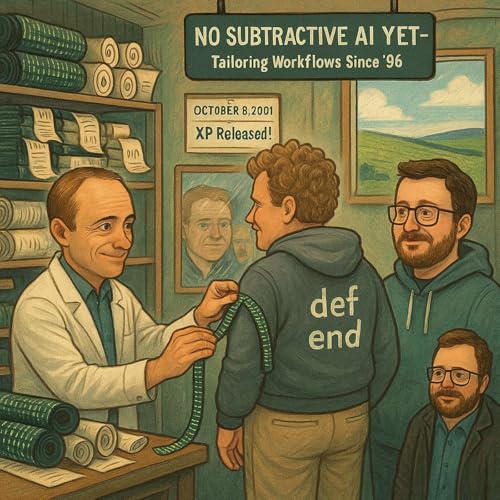
  • The TLDR of AI Dev: Real Workflows with Justin Searls
    Oct 21 2025

    In this episode of the Ruby AI Podcast, co-hosts Valentino Stoll and Joe Leo engage in a lively discussion with guest Justin Searls. They explore the evolving landscape of software development with agentic AI tools, comparing traditional agile methodologies with emerging AI-driven practices. Justin Searls his experiences with refactoring and the challenges of integrating AI tools into development workflows. The conversation touches on the suitability of AI in coding, philosophical perspectives on reinforcing proper software practices, and the future potential of these technologies. Justin also provides valuable insights on configuring AI tools for better productivity and discusses his personal coping strategies with the frustrations of modern AI capabilities.


    00:00 Introduction and Hosts Banter

    00:30 Guest Introduction: Justin Searls

    03:13 Justin's Career and Conference Talks

    07:52 The Evolution of Agile and Development Practices

    16:07 Challenges with AI and Iterative Development

    27:47 Recalibrating Development Processes

    28:00 Adoption of Pivotal Labs' Methods

    28:28 Continuous Integration and Testing

    29:21 AI in Development: Current State and Challenges

    30:16 The Role of AI Agents in Development

    32:17 Frustrations with AI Tools

    35:03 Philosophical Reflections on AI in Development

    36:16 Generative vs. Subtractive AI

    37:06 The Future of AI in Software Development

    39:27 Balancing Coding Enjoyment and Productivity

    44:02 Capability vs. Suitability in AI Tools

    46:35 Prompt Engineering Tips and Tricks

    52:39 Closing Thoughts and Plugs

    Show More Show Less
    55 mins