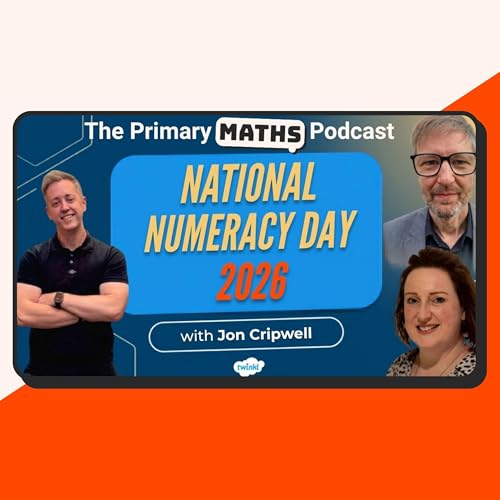
The Primary Maths Podcast cover art

The Primary Maths Podcast

The Primary Maths Podcast

By: Jon Cripwell
Listen for free

The Primary Maths Podcast is a year-round maths podcast for teachers, leaders and anyone interested in how children learn mathematics. Every Tuesday, join me, Jon Cripwell, for an in-depth interview with an expert voice from across education - teachers, leaders, researchers, authors and thinkers - as we explore what really works in primary maths. We dive into the big ideas shaping maths education, from maths anxiety and fluency to task design, curriculum, reasoning and problem solving. Then on Fridays, Becky Brown and I return for Aftermaths — a shorter, light-hearted, practical debrief where we unpack the week’s key insights, and share clear takeaways for the classroom.. We also share listener stories and discuss The Maths of Life, amongst other topics. Across the week, expect: - Insightful conversations with the people shaping maths education - Clear, actionable takeaways for teachers and maths leads - The Maths of Life — the surprising ways maths shows up in everyday moments - A weekly resource spotlight - New episodes every Tuesday and Friday, all year round If you’re looking for a thoughtful, practical teacher podcast that blends research, real classrooms and conversations that matter, this is the place to start.Copyright 2026 Jon Cripwell Mathematics Science
Episodes
  • Florence Nightingale: The Lady with the Graph
    Jun 5 2026

    In this lighter half-term Aftermaths episode, Jon and Becky take a wander through some of the unexpected maths hiding in everyday life.

    First up: Samba the escaped capybara, who, at the time of recording, was still causing confusion somewhere near Hampshire. Is it a capybara? Is it a muntjac deer? Has someone accidentally taken in the world’s largest “stray cat”? Hard to say.

    Becky then takes us into the very British world of weather watching, comparing forecasts, choosing the one we like best, and wondering what a “40% chance of rain” actually means. Along the way, there’s discussion of probability, percentages, wind speed, temperature, 24-hour time, tide times, and the slightly chaotic business of trying to predict British weather.

    Jon then shares the story of Florence Nightingale, not just as “the Lady with the Lamp”, but as something else entirely: the Lady with the Graph. Through her use of statistics, record keeping and visual data, Nightingale helped show that far more soldiers were dying from disease and poor hospital conditions than from battle wounds. Her famous polar area diagram became a powerful argument for reform, showing how maths can be used not just to describe the world, but to change it. The Science Museum describes her diagram as showing causes of soldiers’ deaths across two years in Crimea, while the National Army Museum notes the dire conditions at Scutari, where the hospital was dirty, vermin-ridden and lacking basic equipment.

    There’s also a Derbyshire connection, as Jon explains Florence Nightingale’s links to Lea Hurst near Matlock, the Nightingale family’s Derbyshire home.

    In this episode
    • The ongoing mystery of Samba the capybara
    • Why weather apps are full of maths
    • What “chance of rain” really means
    • British weather, rounding, chaos theory and hedging your bets
    • Florence Nightingale’s Derbyshire connections
    • How Nightingale used data visualisation to argue for hospital reform
    • Why graphs can sometimes tell a story more powerfully than tables of numbers

    Show More Show Less
    23 mins
  • Why Problem Solving Needs to be Taught - AfterMaths
    May 22 2026

    In this Aftermaths episode of The Primary Maths Podcast, Jon and Becky chat about the strange, busy, slightly chaotic stretch of the school year just before half term, from transition days and sports events to staffing conversations and year group changes.

    They reflect on how different primary teaching can feel from one year group to another, and why every phase, from EYFS and Key Stage 1 through to Year 6, needs strong subject knowledge and careful teaching.

    The main discussion focuses on working systematically as a key problem solving strategy in primary maths.

    Jon and Becky explore why pupils are often told to “work systematically” without necessarily being taught what that actually means. They discuss how the skill develops from early sorting and ordering in Key Stage 1, through to recording possibilities, finding combinations, identifying factor pairs, proving that all solutions have been found, and eventually supporting algebraic thinking.

    They also consider why working systematically is not just a SATs strategy, but an important part of pupils’ wider mathematical toolkit.

    Topics include:

    • why summer term can feel particularly busy in primary schools
    • the challenge of year group moves and staffing decisions
    • why early maths teaching matters so much
    • how gaps in Key Stage 1 can affect later success in Key Stage 2
    • what working systematically looks like in primary maths
    • why problem solving strategies need to be explicitly taught
    • using sorting, ordering and recording to support systematic thinking
    • factor pairs, common multiples and combinations
    • helping pupils prove they have found all possible solutions
    • the role of manipulatives, representations and talk
    • Twinkl’s new problem solving collection
    • upcoming TeachMeet CPD on working systematically and using models

    Show More Show Less
    34 mins
  • Building Maths Confidence with National Numeracy
    May 19 2026

    In this episode of The Primary Maths Podcast, Jon is joined by Paul Milner and Julie Pompa from National Numeracy to talk about number confidence, family engagement and the role schools can play in helping children and adults feel more positive about maths.

    Paul and Julie share the story behind National Numeracy’s work, including why adult numeracy matters and how confidence can be just as important as skill. They discuss the idea that many adults carry negative experiences of maths with them, and how those messages can shape the way children see themselves as mathematicians.

    The conversation explores National Numeracy’s model of value, belief and persistence, and why adults need to see a reason to improve, believe that improvement is possible, and understand that mistakes and discomfort are part of learning.

    Jon, Paul and Julie also discuss the Schools and Families Programme, which supports primary schools to work with families so that pupils feel more positive about maths and understand the value of numeracy beyond the classroom.

    There is also a focus on National Numeracy Day 2026, which takes place on Wednesday 20 May 2026. This year’s theme is Count on Your Community, encouraging schools, workplaces, organisations and community groups to help children and adults feel more confident with numbers at work, at home and at school.

    In this episode, we discuss:

    • why confidence is such an important part of numeracy
    • how adults’ experiences of maths can affect children
    • the difference between maths as a school subject and numeracy in daily life
    • why parents and carers do not need to be “maths people” to support their children
    • the role of mistakes, persistence and positive talk in maths learning
    • how schools can engage families without adding unnecessary workload
    • what National Numeracy Day offers to schools and communities

    Useful links

    National Numeracy

    National Numeracy Day 2026

    National Numeracy Day 2026 schools sign-up

    Schools and Families Programme

    To get in touch with the podcast, email primarymathspodcast@twinkl.co.uk. Becky and Jon will be back on Friday with another Aftermaths episode.

    Show More Show Less
    44 mins
adbl_web_anon_alc_button_suppression_t1
No reviews yet