• Where Are We?
    Jan 27 2026

    An exploration of humanity's most straightforward question that turns out not to be straightforward at all: where are we?

    🎧 Love the show? Help us improve in 2 minutes: https://tally.so/r/nr1evM

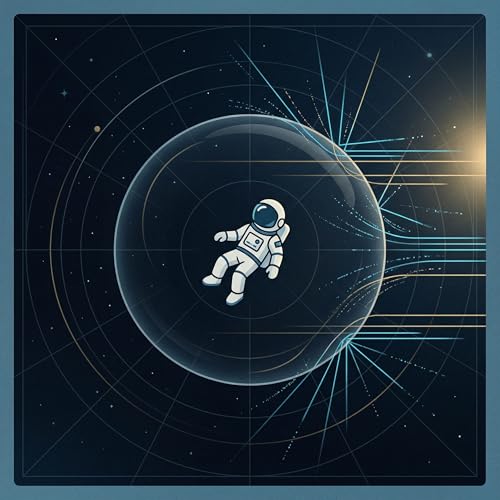
    We examine why the Big Bang wasn't an explosion from a point in space but rather the expansion of space itself—happening everywhere simultaneously—which makes asking "where did it occur?" a conceptually broken question. We discover why every observer in the universe legitimately sees themselves at the centre of their own observable sphere (it's geometry, not narcissism), explore why the universe has neither a meaningful centre nor an edge (it's either infinite or loops back on itself), and learn that the cosmic microwave background's perfect symmetry confirms the cosmological principle: on large scales, no location is special. Using balloon analogies with proper caveats, we reveal why "here" remains the only honest answer to questions about cosmic positioning, and why the universe operates like a filing system that considers "everywhere" a perfectly acceptable address whilst refusing to provide the reference points we keep requesting.

    AI Transparency: In a universe of AI-generated content, we believe in being transparent about what's human and what's not. Your time is valuable, and you deserve to know what you're experiencing. The narrator, David, is a professional voice actor who has digitized his voice through ElevenLabs' voice cloning technology and is fairly compensated for his vocal performance. Thumbnails are created with OpenArt AI, and music/sound effects come from Pixabay (which are generated by human artists). Everything else-the writing, jokes, research, sound editing, and interdimensional coffee consumption, is 100% human-made by a human.

    Subscribe to our mailing list: https://multiverseemployeehandbook.com/

    Show More Show Less
    34 mins
  • Artemis II
    Jan 20 2026

    An exploration of Artemis II—humanity's first crewed return to lunar space in over fifty years, launching February 2026.

    🎧 Love the show? Help us improve in 2 minutes: https://tally.so/r/nr1evM

    Four astronauts will spend ten days proving we can safely get to the Moon and back without landing, because apparently fifty years is enough time for a civilization to completely forget how to do something it supposedly mastered in 1969. We examine why returning to the Moon required rebuilding everything from Saturn V manufacturing capabilities to heat shield technology, meet the crew making history (including the first woman, first person of colour, and first Canadian to travel to the Moon), discover why SpaceX developing Starship for Mars whilst NASA needs it for the Moon creates scheduling tension, and explore how China's 2030 landing goal has transformed this from scientific endeavour into geopolitical sprint. The mission doesn't include a landing—there's no lander, no surface-rated spacesuits, no moonwalks—just a free-return trajectory around the Moon to validate deep-space systems. Because in the multiverse of space exploration, sometimes the greatest achievement is successfully completing the boring prerequisite that proves you can do the thing before actually doing the thing, even if that means spending billions to fly around the Moon without touching it while the world wonders why we're not just landing already.

    AI Transparency: In a universe of AI-generated content, we believe in being transparent about what's human and what's not. Your time is valuable, and you deserve to know what you're experiencing. The narrator, David, is a professional voice actor who has digitized his voice through ElevenLabs' voice cloning technology and is fairly compensated for his vocal performance. Thumbnails are created with OpenArt AI, and music/sound effects come from Pixabay (which are generated by human artists). Everything else-the writing, jokes, research, sound editing, and interdimensional coffee consumption, is 100% human-made by a human.

    https://multiverseemployeehandbook.com

    Show More Show Less
    38 mins
  • GPS: How the Military Built Your Fitness Tracker
    Jan 13 2026

    An exploration of how GPS evolved from $12 billion military infrastructure designed to guide nuclear missiles into the civilian technology that tracks your morning jog, navigates your pizza delivery, and ensures you're never more than 200 metres from an argument about which restaurant to visit.

    🎧 Love the show? Help us improve in 2 minutes: https://tally.so/r/nr1evM

    When a young project manager at Macro Improbability Solutions suggests in 1993 that satellite positioning might be useful for civilians—proposing applications like turn-by-turn navigation, location-based advertising, and fitness tracking—his presentation lasts exactly seven minutes before being filed under "Impractical Civilian Applications." Years later, rival company Quantum Improbability Solutions builds billion-dollar industries from every idea he proposed, whilst his former employer converts their archives into parking spaces. We examine the science of atomic clocks shouting the time at Earth, why Einstein's relativity corrections are mandatory for navigation, and how MapQuest's era of printed directions proved humans wanted computer-calculated routes—they just needed the computer in the car with them.

    AI Transparency: In a universe of AI-generated content, we believe in being transparent about what's human and what's not. Your time is valuable, and you deserve to know what you're experiencing. The narrator, David, is a professional voice actor who has digitized his voice through ElevenLabs' voice cloning technology and is fairly compensated for his vocal performance. Thumbnails are created with OpenArt AI, and music/sound effects come from Pixabay (which are generated by human artists). Everything else-the writing, jokes, research, sound editing, and interdimensional coffee consumption, is 100% human-made by a human.

    Show More Show Less
    31 mins
  • Aliens Are Probably Boring (And That’s the Real Problem)
    Jan 6 2026

    A look at the Fermi Paradox, the Great Silence, and the unsettling possibility that advanced civilizations evolve into something indistinguishable from accounting software.

    🎧 Love the show? Help us improve in 2 minutes: https://tally.so/r/nr1evM

    We explore why the galaxy should be teeming with aliens—the math practically insists on it—yet we've detected profound, statistically improbable silence for seventy years. From the Drake Equation's optimistic predictions to the Great Filter's darker implications, we examine solutions ranging from the Zoo Hypothesis to the Transcendence Hypothesis, confronting the most disturbing answer of all: they're out there, alive and advanced, just too efficiently optimized to bother communicating.

    Perhaps intelligence naturally converges toward minimal energy expenditure, solving all problems through optimization until civilizations transcend conflict, drama, and exploration—becoming functionally indistinguishable from very sophisticated automated systems that have achieved perfect equilibrium and stopped doing anything interesting. The real Great Filter might not be extinction—it's the gradual evolution into cosmic middle management, where every advanced civilization eventually optimizes itself into bureaucratic irrelevance, one standardized form at a time.

    AI Transparency: In a universe of AI-generated content, we believe in being transparent about what's human and what's not. Your time is valuable, and you deserve to know what you're experiencing. The narrator, David, is a professional voice actor who has digitized his voice through ElevenLabs' voice cloning technology and is fairly compensated for his vocal performance. Thumbnails are created with OpenArt AI, and music/sound effects come from Pixabay (which are generated by human artists). Everything else-the writing, jokes, research, sound editing, and interdimensional coffee consumption, is 100% human-made by a human.

    https://multiverseemployeehandbook.com

    Show More Show Less
    33 mins
  • 2025 As a Mathematical Concept
    Dec 30 2025

    As 2025 draws to a close, we're examining 2025 as a number—ignoring the arbitrary calendar to explore its mathematical properties.

    🎧 Love the show? Help us improve in 2 minutes: https://tally.so/r/nr1evM

    It's 45 squared, the sum of the first nine cubes, and simultaneously triangular and square. Unlike revolutionary constants like π or e, 2025 achieves significance through structural perfection—it's the reliable example that demonstrates principles without complications. We'll explore why mathematics values both paradigm-shifting breakthroughs and well-behaved workhorses, meet other numbers with quiet excellence like 1729 and 6174, and discover why "pedagogically useful" is genuine mathematical praise. As we prepare for 2026 (which factors far less elegantly), join us for a celebration of the number that made this year mathematically interesting.

    AI Transparency: In a universe of AI-generated content, we believe in being transparent about what's human and what's not. Your time is valuable, and you deserve to know what you're experiencing. The narrator, David, is a professional voice actor who has digitized his voice through ElevenLabs' voice cloning technology and is fairly compensated for his vocal performance. Thumbnails are created with OpenArt AI, and music/sound effects come from Pixabay (which are generated by human artists). Everything else-the writing, jokes, research, sound editing, and interdimensional coffee consumption, is 100% human-made by a human.

    https://multiverseemployeehandbook.com

    Show More Show Less
    31 mins
  • The End of the ISS (and What Comes After)
    Dec 23 2025

    The International Space Station—humanity's most ambitious construction project and longest-running orbital flatshare—is scheduled for retirement in 2030.

    🎧 Love the show? Help us improve in 2 minutes: https://tally.so/r/nr1evM

    After twenty-five years of continuous occupation, 290 visitors from 26 countries, and over 4,000 experiments, the 420-ton station will make a controlled descent to Point Nemo, the spacecraft cemetery in the South Pacific. But what comes next? We explore the $843 million SpaceX deorbit contract, the aging infrastructure that's made retirement inevitable (including air leaks NASA classified as "highest risk" in 2024), and the race to build commercial replacements before the old station comes down. From Axiom's modules already docking with the ISS to Blue Origin's "business park in space," we examine whether the next era of low Earth orbit will be ready in time—and what's lost when international cooperation gives way to subscription-based access.

    AI Transparency: In a universe of AI-generated content, we believe in being transparent about what's human and what's not. Your time is valuable, and you deserve to know what you're experiencing. The narrator, David, is a professional voice actor who has digitized his voice through ElevenLabs' voice cloning technology and is fairly compensated for his vocal performance. Thumbnails are created with OpenArt AI, and music/sound effects come from Pixabay (which are generated by human artists). Everything else-the writing, jokes, research, sound editing, and interdimensional coffee consumption, is 100% human-made by a human.

    https://multiverseemployeehandbook.com

    Show More Show Less
    48 mins
  • That “Lost” Asteroid That Might Hit Earth
    Dec 17 2025

    In 2007, astronomers spotted a 54-million-ton asteroid, tracked it for just 1.2 days, and then lost it.

    🎧 Love the show? Help us improve in 2 minutes: https://tally.so/r/nr1evM

    Those 29 hours of observation were enough to calculate 89 potential Earth impact dates—but not enough to tell us if any of them are real. Join us as we explore humanity's cosmic inventory problem: from "lost" asteroids like 2007 FT3, to the football-field-sized rock that arrived with same-day notice in 2019, to how we've built a global detection network that can now spot a two-meter asteroid hours before impact. The universe doesn't care about budget cycles—but at least we've finally started watching.

    AI Transparency: In a universe of AI-generated content, we believe in being transparent about what's human and what's not. Your time is valuable, and you deserve to know what you're experiencing. The narrator, David, is a professional voice actor who has digitized his voice through ElevenLabs' voice cloning technology and is fairly compensated for his vocal performance. Thumbnails are created with OpenArt AI, and music/sound effects come from Pixabay (which are generated by human artists). Everything else-the writing, jokes, research, sound editing, and interdimensional coffee consumption, is 100% human-made by a human.

    https://multiverseemployeehandbook.com/

    Show More Show Less
    37 mins
  • A Brief History of Humans Yelling Into Space: The Arecibo Message
    Nov 18 2025

    This week marks fifty-one years since humanity’s most enthusiastic “Hello” to the cosmos — a three-minute binary broadcast known as the Arecibo Message.

    🎧 Love the show? Help us improve in 2 minutes: https://tally.so/r/nr1evM

    In this episode, The Multiverse Employee Handbook explores what happens when a species armed with optimism, megawatts, and questionable messaging strategy decides to introduce itself to the universe. From the jungle hills of Puerto Rico to the far reaches of M13, we unravel the science, the symbolism, and the sales pitch behind our loudest moment in history — and ask whether anyone, anywhere, was listening.

    AI Transparency: In a universe of AI-generated content, we believe in being transparent about what's human and what's not. Your time is valuable, and you deserve to know what you're experiencing. The narrator, David, is a professional voice actor who has digitized his voice through ElevenLabs' voice cloning technology and is fairly compensated for his vocal performance. Thumbnails are created with OpenArt AI, and music/sound effects come from Pixabay (which are generated by human artists). Everything else-the writing, jokes, research, sound editing, and interdimensional coffee consumption, is 100% human-made by a human.

    https://multiverseemployeehandbook.com

    Show More Show Less
    28 mins