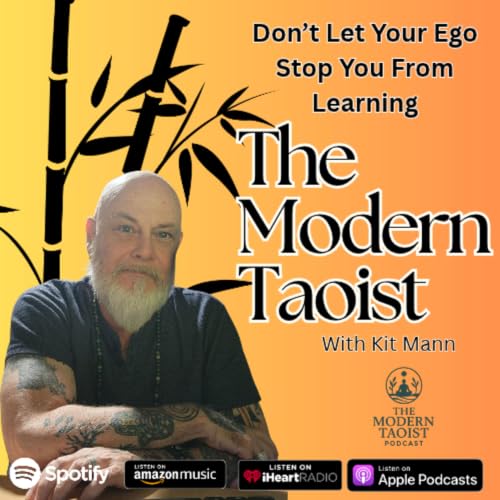
The Modern Taoist cover art

The Modern Taoist

The Modern Taoist

By: Kit Mann
Listen for free

This Season's Biggest Deal | £0.99/mo for 3 months + £10 Audible bonus

£5.99/mo after 3 months - terms apply. Cancel monthly
Summary
The Modern Taoist Podcast is Taoism for people living in the real world. Hosted by Kit Mann of Dao Ananda, each week we explore the situations we all face—relationships, family, work, conflict, stress, ego, expectations, and the past—and look at them through the lens of Taoist wisdom. No sermons. No dogma. No escaping into spirituality. Just practical Taoism for understanding yourself, navigating life, and finding a little less struggle along the way.Kit Mann Spirituality
Episodes
  • Don't Let Your Ego Stop You From Learning
    Nov 24 2026

    Don’t Let Your Ego Stop You From Learning

    “I know that, but...” It sounds polite, and it can keep you stuck for years. In this episode of The Modern Taoist, Kit Mann shares the story of a longtime emailer who calls himself an experienced Taoist and answers every explanation with a “but.” Kit uses that story to look at how ego gets built over a lifetime and how it keeps us pretending we have already arrived.

    Kit explains ego in the everyday Western sense: the self-image we build and then spend our energy defending. Drawing on Chapter 24 of the Tao Te Ching, “He who stands on tiptoe doesn’t stand firm,” he shows what it costs to stay up on your toes. He also answers a question that keeps coming up in listener mail: what do you do when someone tells you, “I understand Taoism, and you’re wrong”? Kit explains the difference between interpreting Taoism and arguing with its foundation. He tells Zhuangzi’s story of Confucius asking to become his own student’s follower, and shares six practical ways to become someone who can learn, starting with listening for your own “but.”

    In the listener question, Desi in South Carolina asks whether Taoism has a view on veganism and how we treat animals. Kit covers the philosophical and religious sides of Taoism, Quanzhen vegetarianism, and Zhuangzi’s story of the seabird.

    Taoist philosophy for humility, ego, personal growth, and staying open to learning at every stage of life.

    Support free Taoist education and scholarships for young people at themoderntaoistfoundation.com.

    Show More Show Less
    50 mins
  • Tao Te Now - Chapter 11
    Nov 22 2026

    What makes a wheel turn, a pot useful, or a house livable? In Chapter 11 of the Tao Te Ching, Lao Tzu says it’s the empty space. In this episode of Tao Te Now, Kit Mann walks through the chapter using the Stephen Mitchell translation, and shows how its three everyday images apply to modern life.

    The open center of a wheel shows how connection happens, backed by research on what happens when teachers wait three seconds after asking a question. The empty inside of a pot shows why so many people struggle to receive help or accept a compliment. The rooms inside a house lead to ma, the Japanese idea of the space between things, and to why the gaps in a day are where life gets lived. Kit closes with the chapter’s final line, “We work with being, but non-being is what we use,” and the link between the Chinese word wu and wu wei.

    Tao Te Now is a series from The Modern Taoist podcast that walks through the complete Tao Te Ching one chapter at a time, in plain, conversational language. Taoist philosophy for mindfulness, listening, letting go, and everyday life.

    Support free Taoist education and scholarships for young people at themoderntaoistfoundation.com.

    Show More Show Less
    19 mins
  • Weekend Check-In - Don't Forget to Have Fun
    Nov 20 2026

    Don’t Forget to Have Fun

    “I get so focused on doing it right that I don’t have any fun.” A listener’s email starts this Weekend Check-In. In it, Kit Mann looks at a trap a lot of people fall into once they start practicing Taoism: turning a philosophy of ease into one more test to pass.

    Kit walks through how meditation turns into grading yourself, and how wu wei turns into a scorecard. Then he goes back to the source. Chapter 38 of the Tao Te Ching says “The Master doesn’t try to be powerful; thus he is truly powerful.” Zhuangzi opened his whole book with “free and easy wandering.” And Zhuangzi and his friend Huizi had a famous argument on a bridge about whether fish are happy. In this tradition, play and practice were never two separate things.

    The weekend practice is simple. Do one thing that will not improve you or count toward anything, and see what happens when you stop grading yourself.

    Taoist philosophy for joy, letting go, self-compassion, and taking your spiritual practice a little less seriously.

    Support free Taoist education and scholarships for young people at themoderntaoistfoundation.com.

    Show More Show Less
    14 mins
adbl_web_anon_alc_button_suppression_t1
No reviews yet