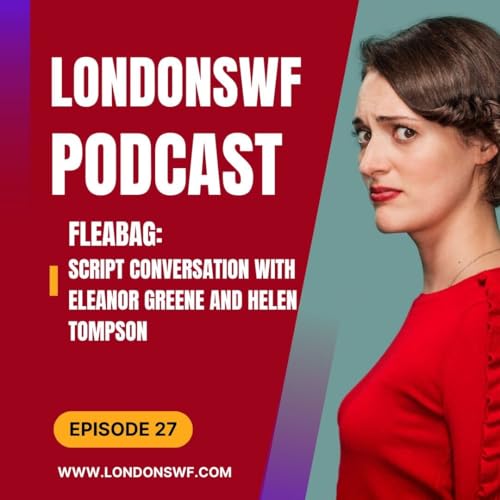
The London Screenwriters' Festival Podcast cover art

The London Screenwriters' Festival Podcast

The London Screenwriters' Festival Podcast

By: Chris Jones
Listen for free

Summary

Podcast from the London Screenwriters Festival

Copyright 2024 Chris Jones
Social Sciences
Episodes
  • Ep 027 Fleabag: With Producer Eleanor Greene and Screenwriter Helen Tompson
    May 13 2026
    Fleabag Script Analysis: What Makes Phoebe Waller-Bridge's Writing So Damn Good

    If you've ever wondered why Fleabag hits differently from everything else on TV, this episode breaks down exactly how Phoebe Waller-Bridge pulled it off — one brilliant script choice at a time. Host Helen Tompson sits down with script editor and development powerhouse Eleanor Greene (25+ years in the industry, starting as a runner on Queer as Folk) to dig into the first episode of Fleabag with the kind of forensic detail that'll change how you watch — and write — forever. They cover the fourth wall and why it works here when it fails everywhere else, how Waller-Bridge's ruthless honesty shapes every character introduction, the feminist subtext hiding in plain sight, the Obama masturbation scene (yes, really), why the show is comedy and drama and why that question even matters, and the specific script cuts that made the final version so much sharper. Whether you're a writer looking for craft lessons or just a massive Fleabag fan who wants to go deeper, this one's got you covered.


    "Really good comedy has tragedy at its heart, 'cause otherwise the comedy's got nothing to feed off." — Eleanor Greene


    00:00 - Welcome & why Fleabag Ep. 1

    01:30 - Meet Eleanor Greene: 25 years in TV drama

    03:30 - From Edinburgh Fringe monologue to the fourth wall

    06:30 - Ruthless honesty & the writer-as-performer

    10:30 - Opening page: stage directions and the rhythm of 5

    14:30 - Character introductions: inverting the convention

    20:30 - Lean writing, white space & the "Handsome man / Asshole guy" gag

    26:00 - The Obama scene & female desire on the page

    30:00 - Comedy or drama? It's really about length

    36:00 - The flip test: turning drama into comedy (and back)

    43:00 - The Save the Cat moment that got cut & the Harry timeline note

    53:00 - The MacGuffin: the statue, stakes and present-day plot

    57:00 - Feminism, the Godmother & disagreeing about who's the bitch

    Show More Show Less
    1 hr and 11 mins
  • Ep 026: Meet Screenwriter Angela Bhardwaj from Talent Campus 9
    May 13 2026

    In this episode, Chris Jones interviews Angela Bhardwaj , a recent graduate of Talent Campus 9.0, about her transformative experience in the screenwriting program. Angela discusses overcoming personal grief, the supportive and emotionally open environment, and highlights inspiring moments with guests like Charlie Brooker and Anthony Horowitz. The conversation explores unique activities such as fire walking, mentorship, and the importance of community. Angela emphasizes how Talent Campus empowered her as a writer, encouraging others to embrace vulnerability and growth. The episode captures the program’s blend of professional development, emotional exploration, and lasting creative connections.


    • Introduction and Angela’s First Impressions (00:00:06) Chris welcomes Angela, who describes Talent Campus as “rocket fuel” and “Disneyland for screenwriters.”
    • Angela’s Writing Background (00:01:34) Angela discusses her experience writing thrillers and her first foray into horror.
    • How Angela Discovered Talent Campus (00:02:46) Angela explains how she found out about Talent Campus through LSF events and an email.
    • Personal Challenges Before Talent Campus (00:04:14) Angela shares the recent loss of her father and her initial doubts about attending.
    • Support and Encouragement to Attend (00:05:45) Chris’s supportive email and a conversation with a previous participant help Angela decide to attend.
    • First Day Nerves and Sharing Her Story (00:07:30) Angela describes her anxiety on the first day and being asked to share her personal story.
    • Emotional Openness and Group Connection (00:10:20) Angela reflects on how sharing her story fostered emotional openness and connection among participants.
    • The Power of Vulnerability in Storytelling (00:11:31) Chris discusses how Angela’s honesty set the tone for a deeper, more authentic experience.
    • Standout Moments: Group Sharing and Writing (00:14:26) Angela notes how participants connected personal experiences to their writing and opened up about their work.
    • Surprise Guest: Charlie Brooker (00:15:55) Angela recounts the shock and excitement of Charlie Brooker’s surprise appearance and his candidness.
    • Guest Speaker: Anthony Horowitz (00:17:58) Angela describes being inspired by Anthony Horowitz’s honesty and unconventional career advice.
    • Fire Walk Experience (00:20:23) Angela and Chris discuss the fire walk on day four as a metaphor for bravery and personal growth.
    • Overcoming Fear and Taking Action (00:25:09) Angela and Chris reflect on how the fire walk and Talent Campus encourage participants to face fears and take bold steps.
    • Screenwriting Masterclasses and Mentorship (00:28:26) Angela highlights the value of John York’s masterclass and working with mentor Emma Millions in small groups.
    • Ongoing Support and Community (00:31:10) Angela describes the lasting support, active WhatsApp groups, and increased self-belief gained from Talent Campus.
    • Transformation and Letting Go of Cynicism (00:33:22) Angela shares how even skeptical participants became fully engaged and transformed by the end.
    • Advice for Prospective Talent Campus Participants (00:35:31) Angela encourages writers on the fence to “jump in” and assures them of the program’s value.
    • The Importance of Process and Holistic Growth (00:38:50) Angela advises writers to trust the process, embrace the holistic approach, and write with heart and truth.
    • Closing Remarks and Aspirations (00:40:28) Chris and Angela wrap up, expressing gratitude and aspirations for future success.
    Show More Show Less
    41 mins
  • Ep 025 Happy Valley: Script Conversation with Lisa Holdsworth and Helen Thompson
    Mar 23 2026

    Helen Tompson is joined by TV writer, Lisa Holdsworth, to explore the pilot script for Happy Valley by Sally Wainwright. Focusing on what’s happening on the page, they look at how the script establishes character, place, and tone with speed and precision. The conversation covers the opening scene, Catherine’s introduction, the handling of exposition, and how story threads are set in motion. They also touch on structure, pacing, and what pulls us into the next episode. A close, practical read for writers looking to deepen their understanding of how strong television scripts work.


    Introduction and Guest Background (00:00:05) Helen introduces the podcast and guest Lisa Holdsworth, who shares her background as a Yorkshire-based TV writer.

    First Impressions of the Script (00:01:41) Lisa discusses the script’s fast pace, immediate immersion into Catherine’s world, and early introduction of Tommy.

    Building Tommy’s Character (00:02:21) They analyze how Tommy is built up through exposition before his full reveal, emphasizing his menace.

    Catherine’s Emotional Monologue (00:02:45) Lisa highlights the emotional impact and economy of Catherine’s monologue about Ryan’s backstory.

    Script Pacing and Scene Length (00:03:39) Discussion on the drawn-out scene on the page versus its brevity on screen, and the writer’s confidence.

    Economy and Confidence in Writing (00:04:25) Lisa praises Sally Wainwright’s efficient use of dialogue and action, and her avoidance of melodrama.

    Advice for Writing Layered Scenes (00:06:06) Lisa gives advice to new writers on handling complex, layered scenes and using dual dialogue.

    Introducing Catherine: Character and Exposition (00:07:41) They discuss how Catherine’s character is established through action and justified exposition.

    Effective Use of Exposition (00:08:28) Lisa explains how exposition is delivered naturally, avoiding info-dumping and making every character purposeful.

    Script’s Circular Structure and Emotional Payoff (00:10:33) They note how plot points come full circle and how emotional moments are earned through setup.

    Audience Alignment and Emotional Stakes (00:11:33) Discussion on how the script aligns the audience emotionally with Catherine’s perspective on Tommy.

    Setting Up Series Arcs and Story Threads (00:13:43) They explore the multiple story arcs, especially Kevin’s, and how structure supports both series and episode arcs.

    Kevin’s Character and Story Structure (00:14:58) Lisa analyzes Kevin’s role as antagonist, his motivations, and the contrast with Catherine’s resilience.

    Twists and Character Choices (00:17:18) They discuss the clever twist where Kevin’s impatience leads to disaster, and the consequences of his actions.

    Act Three and Series Hook (00:18:11) Helen asks about structuring the episode’s end to hook viewers for the next episode.

    Catherine’s Restraint and Character Complexity (00:19:09) Lisa explains Catherine’s adherence to procedure and the complexity of her desires versus her actions.

    Secondary Characters: Claire and Richard (00:22:57) They discuss how Claire and Richard provide different forms of support, enriching Catherine’s character.

    Gendered Support and Character Dynamics (00:25:14) Lisa analyzes the gendered dynamics of support from Claire and Richard, and their impact on Catherine.

    Regional Representation and Sense of Place (00:27:14) Discussion on how Sally Wainwright’s scripts authentically portray Yorkshire without romanticizing it.

    Authenticity vs. Romanticization (00:27:58) Lisa elaborates on the unvarnished depiction of Yorkshire and the importance of honest regional representation.

    Advice for Writers: Voice and Pacing (00:32:45) Lisa advises writers to stay true to their voice, get into the story quickly, and learn from Wainwright’s economy.

    Writing Style and Stage Directions (00:35:11) They discuss Sally’s distinctive stage directions and how they serve both actors and production.

    Closing Thoughts and Takeaways (00:37:39) Helen summarizes the episode’s key lessons and encourages listeners to study the script for its craft.

    Show More Show Less
    39 mins
adbl_web_anon_alc_button_suppression_c
No reviews yet