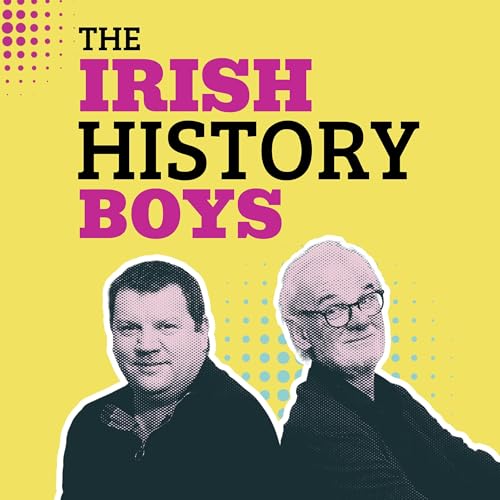
The Irish History Boys cover art

The Irish History Boys

The Irish History Boys

By: The Irish History Boys
Listen for free

Comedian Tim McGarry and Historian Cormac Moore select the stories from the archives of The Irish News that bring Irish history to life in enlightening and amusing ways.

Hosted on Acast. See acast.com/privacy for more information.

The Irish History Boys
Politics & Government World
Episodes
  • Why De Valera’s future looked “Hopeless” in 1926
    Jun 25 2026

    This week’s episode of The Irish History Boys explores pivotal moments from 1926 and 1976, focusing on Ireland’s evolving sovereignty and security.


    We discuss how the Irish Free State and other dominions like Canada began loosening the ties of the British Empire, eventually leading to full independence through agreements like the Statute of Westminster. The episode revisits a biting 1926 critique that deemed Éamon de Valera’s political future "hopeless" just as he was founding Fianna Fáil.


    Shifting to 1976, we examine the Ulsterization of security and the British strategy to criminalise the IRA by treating the conflict as a policing issue rather than a war. Balancing high-stakes politics with local lore, we also share humorous accounts of egg smuggling across the border and highlight Sinn Féin’s 1976 efforts to internationalise their struggle through links with global movements like the PLO and the ANC.

    Hosted on Acast. See acast.com/privacy for more information.

    Show More Show Less
    42 mins
  • Rent-Free in the Irish Free State: Why the British Government funded homes for WWI Veterans in 1926
    Jun 18 2026

    Join Tim McGarry and Dr. Cormac Moore for another episode of The Irish History Boys, where they dig into the archives of the Irish News to explore the stories that shaped Ireland 50 and 100 years ago.

    In this episode, we dive into the year 1926, a time of historical quirks and radical social shifts. They discuss the surprising reality of the British government funding homes for heroes for WWI veterans within the newly independent Irish Free State, a policy move that sparked political tension and eventually led to a landmark court case where veterans won the right to live rent-free.

    We look into the 1926 report from the Association of Head Mistresses regarding barriers women faced in the workforce eight years after the end of the war.

    The dramatic story of a cross-border ambulance dash through a hailstorm after a workhouse master tried to block a life-saving operation based on the new border sparks an interesting discussion followed by a 1920s farmers debate on the Irish Language.

    Lastly, Tim and Cormac jump to the year 1976 and examine the fracturing of unionist unity as the UUUC began to split, and discuss the little-known talks between the Official Unionist Party and the SDLP aimed at ending direct rule.

    Hosted on Acast. See acast.com/privacy for more information.

    Show More Show Less
    46 mins
  • The Man Who Predicted Brexit: Seán Lemass on Britain, Ireland, and Northern Ireland
    Jun 11 2026

    In this episode of the Irish History Boys, we delve into the "lost memoir" of Seán Lemass, drawing on newly discovered tapes that provide a blunt and candid look at the man who transformed a failing state.

    We reflect on Lemass’s rise as the "power behind the throne" during Éamon de Valera’s final years, a period where he transitioned the country away from an "existential threat" and the despair of mass emigration.

    We examine Lemass’s radical shift in economic policy, moving Ireland from the "sterile arguments" of protectionism toward a modern, open economy. This includes a look at the First Programme for Economic Expansion and his partnership with TK Whitaker, which replaced "fantasy land" policies with a pragmatic plan for growth that doubled the size of the Irish economy.

    Additionally, we explore Lemass’s groundbreaking approach to Northern Ireland. We discuss the historic 1965 meeting with Terence O’Neill—the first time the leaders of the North and South had met in 40 years—and his realistic assessment that partition could only end through reconciliation, not military force or British coercion.

    We also highlight his remarkably "prescient" views on Britain's relationship with Europe, including his 1960s warning that the British might only join the EEC to "slow down its development".

    To conclude, we tackle the domestic legacy of the Lemass era, specifically the revolutionary introduction of free secondary education, which sought to remove what was called the "darkest stain" on the country. We also address his complex relationship with his son-in-law, Charles Haughey, and his final, unsentimental reflections on a career that, unlike most in politics, did not end in failure.

    Hosted on Acast. See acast.com/privacy for more information.

    Show More Show Less
    47 mins
adbl_web_anon_alc_button_suppression_t1
No reviews yet