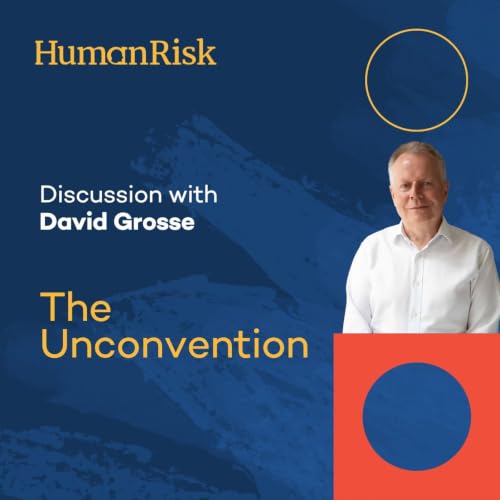
The Human Risk Podcast cover art

The Human Risk Podcast

The Human Risk Podcast

By: Human Risk
Listen for free

People are often described as the largest asset in most organisations. They are also the biggest single cause of risk. This podcast explores the topic of 'human risk', or "the risk of people doing things they shouldn't or not doing things they should", and examines how behavioural science can help us mitigate it. It also looks at 'human reward', or "how to get the most out of people". When we manage human risk, we often stifle human reward. Equally, when we unleash human reward, we often inadvertently increase human risk.

To pitch guests please email guest@humanriskpodcast.comCopyright Human Risk
Science Social Sciences
Episodes
  • David Grosse on The Unconvention
    Jun 25 2026
    What happens when two people who spend their careers thinking about human behaviour meet in a London pub and start complaining about conferences? Apparently, they decide to organise one.

    Episode Summary
    In this episode I'm joined by David Grosse, founder of behavioural risk advisory firm Behavor, to talk about The Unconvention, an event we're creating together that aims to rethink how conversations about risk, culture and human behaviour actually happen. But this isn't just an episode about an event.

    David and I explore why organisations continue to treat behavioural risk as a niche topic, despite human decision-making sitting at the heart of almost every organisational failure. We discuss why so many conferences on culture and conduct feel formulaic, why measuring culture through board packs can miss the point entirely, and why stories often reveal far more than statistics ever can.

    Along the way we touch on Silicon Valley Bank, Plato's Cave, behavioural science, organisational culture, productive discomfort, and why the best events might leave you with fewer certainties than when you arrived.

    If you're curious about The Unconvention, or simply interested in why we think there has to be a better way to have these conversations, I hope you'll enjoy listening.


    Links
    • David on LinkedIn
    • David's company Behavor
    • The Unconvention Website and ticketing site.
    AI-Generated Timestamped summary
    00:00 – Christian introduces the episode and explains how a conversation in a London pub led to the creation of The Unconvention.

    02:20 – David shares his journey from chartered accountant and banker to behavioural risk specialist, and explains why human behaviour became the focus of his work.

    05:30 – Why behavioural risk still isn't taken as seriously as other forms of risk, despite sitting behind so many organisational failures.

    11:30 – Christian and David discuss what's wrong with many industry conferences, from scripted panels to sponsor-led agendas, and why they rarely change anyone's thinking.

    18:00 – The conversation turns to culture, governance and why dashboards and board packs can never fully capture human behaviour.

    24:30 – Stories, rather than statistics alone, often provide the richest insights into how organisations really work.

    29:00 – The origins of The Unconvention and the principles behind creating an event that deliberately breaks with conference convention

    35:30 – Why attendees are being invited to help shape the event, and how behavioural thinking has influenced everything from the format to the ticketing model.

    42:00 – Christian and David discuss what they hope participants will take away: curiosity, productive discomfort and conversations that continue long after the event ends.

    48:45 – Final details on The Unconvention, where to find David, and the unexpectedly simple story behind the name "Behavor".
    Show More Show Less
    49 mins
  • Freewheeling on Human Risk with Thomas Ableman
    Jun 11 2026
    Why is it so hard to stop people playing vides, music or phone calls out loud on public transport — and what does that tell us about changing human behaviour?

    Show Summary
    This episode of The Human Risk Podcast is a little different. It is a cross-cast from The Freewheeling Podcast, hosted by Thomas Ableman, in which I join Thomas to tackle a problem raised by the show's most important listener: his mum.

    The issue? People using phones, videos, music and speaker calls out loud on trains and buses. What begins as a seemingly small transport etiquette problem quickly becomes a much bigger conversation about social norms, antisocial behaviour, customer experience, incentives, enforcement and the limits of signage. In our discussion, we explore why simply telling people to stop may not work, how reactance can make things worse, and why transport operators need to think more creatively about behaviour change.

    Along the way, we consider quiet carriages, “electronic entertainment carriages”, cheap headphones, better-targeted messaging, staff intervention, social media campaigns and the wider question of whether public transport operators are responsible for the behaviour of the humans they carry.

    The Freewheeling Podcast
    The Freewheeling Podcast is a show for transport change-makers. It explores how we can move forwards faster, bringing listeners fresh voices, new ideas and unconventional thinking.
    While it has a strong focus on transport and mobility, the show also ranges into entrepreneurship, politics, public policy, cities and how systems can be designed to work better for the people who use them.

    Links
    The Freewheeling Podcast - https://www.freewheeling.info/the-freewheeling-podcast
    Thomas on LinkedIn - https://www.linkedin.com/in/thomasableman/

    Show More Show Less
    45 mins
  • Jill Wick on The Human Side of Cybersecurity
    May 30 2026
    What if the best way to improve cybersecurity — or any other form of human risk — wasn't another policy, training course, or piece of technology, but a board game? That's the kind of question my guest, Jill Wick, loves asking.Episode Summary Jill is a cybersecurity awareness consultant, business psychologist, podcaster, and author. Her work sits at the intersection of psychology, marketing, behavioural science, and cybersecurity, and she is passionate about helping organisations understand that security is fundamentally a human challenge, not simply a technical one. Drawing on her experience in fraud prevention and her academic background in business psychology, Jill explains why traditional approaches to awareness often fail, why experimentation matters, and how a simple Snakes and Ladders-inspired game can create meaningful conversations about risk and decision-making. The discussion ranges far beyond cybersecurity. We explore creativity, curiosity, communication, organisational culture, social media, learning, and the challenge of measuring success when the outcome you're seeking is something that doesn't happen. Key TopicsIn this episode, we discuss:Why cybersecurity is ultimately a human problem rather than a technology problemThe psychology behind phishing, scams, and social engineeringWhy more policies and more training often fail to change behaviourHow unclear policies can create confusion instead of complianceThe role of curiosity, creativity, and experimentation in risk managementHow games can create psychologically safe environments for learningThe importance of conversation and peer learning in awareness programmesWhat compliance, safety, conduct, and operational risk professionals can learn from cybersecurity awarenessWhy awareness professionals should think more like marketersThe value of experimentation, iteration, and A/B testingHow social media can help build communities around important ideasWhy measuring engagement may be just as important as measuring failuresGuest BiographyJill Wick is a cybersecurity awareness consultant, business psychologist, author, and podcast host who specialises in the human side of cybersecurity. Drawing on a background in fraud prevention and behavioural science, she helps organisations build stronger security cultures through creative, engaging approaches that go beyond traditional training and compliance. Known for her innovative use of games, psychology, and marketing techniques, Jill is a passionate advocate for making cybersecurity awareness more human, effective, and enjoyableLinksJill's LinkedIn profile - https://www.linkedin.com/in/jill-wick/Jill's website - https://www.jillwick.com/Cyber & Psych, Jill's podcast - https://open.spotify.com/show/5uteiqHvCTGCVtCsKCzGJ6?si=322ef51fd6a3423c&nd=1&dlsi=c6d8309550784df9Security-Awareness-Tools, Jill's book - https://www.isbn.de/buch/9783658511111/security-awareness-toolsAI-Generated Timestamped Outline00:00 – Introduction02:15 – Jill's background: From fraud prevention and business psychology to cybersecurity awareness.05:30 – Understanding why people fall for scams, phishing attacks, and social engineering.06:00 – Why cybersecurity is fundamentally a human problem, not just a technical one.08:00 – The limitations of rules, policies, and traditional awareness training.12:00 – The origin of Jill's cybersecurity board game and why simplicity matters.14:00 – How games create psychologically safe conversations and improve learning.19:30 – The game as a conversation tool: building culture, peer learning, and engagement.22:00 – Creativity, curiosity, and the courage to experiment with new approaches.26:00 – What cybersecurity awareness can learn from marketing, advertising, and A/B testing.35:30 – Why awareness and technology must work together rather than compete.41:30 – New projects: workshops, events, games, and Jill's forthcoming book Security Awareness Tools.44:00 – Lessons for compliance and risk professionals: attention is a limited resource.51:00 – Measuring success: engagement, participation, reporting, and positive signals.
    Show More Show Less
    1 hr and 3 mins
adbl_web_anon_alc_button_suppression_t1
No reviews yet