• Teach a man to fish: HR AI adoption strategy that sticks
    Jun 26 2026

    Summary

    On The Human Element, Barb Bidan talks with Jennifer Erfurth, Global Head of HR at the cybersecurity company OPSWAT, about what it actually takes to run an AI-first people function rather than just talk about one. Jennifer canceled a planned Workday rollout, built AI agents on top of BambooHR, rewrote her employer value proposition to lead with AI, and kept her human HR team in place as the safety net. She breaks down the three bets behind the approach: what to build, who to hire, and how to drive adoption without forcing it. She is also candid about the parts that are still messy, including a chatbot that hallucinates an HR contact named "Aaron," and why 25 years of experience is the thing that keeps AI honest. The throughline: going AI-first is not about replacing the human function, it is about deciding what AI handles and what stays human. Built for CHROs, VPs of People, and anyone leading AI adoption in HR.

    Chapters

    00:00 Meet Jennifer Erfurth and OPSWAT
    02:30 Building an AI-first people function from scratch
    04:30 Change management and what's in it for me
    07:30 Running HR like a product, launch at 80% and iterate
    08:00 The AI-first EVP and screening for AI fluency
    12:30 Why they scrapped Workday and built on BambooHR
    15:30 Tier zero AI and tier one human HR
    17:00 The skills-inventory app built in an hour
    21:00 Bringing an existing team along, learn, organize, recognize
    23:30 The future of the CHRO role
    25:00 Lightning round
    27:30 Barb's takeaways and the last word

    Takeaways

    • Build the knowledge base before the agents; OPSWAT spent six months on its before turning on a single agent.
    • Build can beat buy. An engineer built a skills-inventory app in under an hour, replacing tools like Eightfold and Fuel50.
    • An AI-first EVP attracts the talent you want and filters out the talent you don't.
    • Drive adoption by teaching people to self-serve rather than forcing the tool on them.
    • Keep a human in the loop; the AI can be right five times and wrong the sixth, and experience is what keeps it honest.


    Connect with the Guest
    LinkedIn: https://www.linkedin.com/in/globalhrexecutive/
    Website: https://www.opswat.com/


    Sponsor
    Wisq is the AI platform for HR. We built Harper, the world's first AI HR teammate — designed to handle the judgment-heavy work that has historically consumed HR teams: job changes, performance concerns, leaves of absence, onboarding, and employee relations issues. Where HCM bolt-ons and chatbots deflect the easiest questions, Harper resolves full cases, end-to-end. The result is an HR function with the capacity and strategic bandwidth to focus on the work that moves the business.

    Companies get Harper live in weeks, not quarters, with implementation support built on deep HR domain expertise. Wisq serves HR leaders at leading companies across industries, helping them raise the bar on employee experience and expand what their teams are capable of.

    For more information, visit wisq.com.

    Show More Show Less
    30 mins
  • AI Governance is a relationship, not a document
    Jun 23 2026

    Summary
    On The Human Element, Barb Bidan sits down with Joshua Horenstein, who runs both the HR and legal functions at Innophos. Joshua argues that AI governance fails on the org chart, not in the policy document. He walks through his manufacturing-pilot mindset for rolling out AI, names the two reasonable worst cases most HR leaders aren't watching for, and explains why the friction between the CHRO and the GC is the engine of good policy, not a problem to fix. For HR leaders, CHROs, and the chief legal officers who work alongside them.


    Chapters
    00:00 Introduction
    00:45 Joshua's dual hat: CHRO and chief legal officer at Innophos
    03:15 The first governance question, what type of AI are you deploying
    04:45 The pilot-to-policy mindset from manufacturing
    05:45 AI governance as the rules of the road
    07:30 Two reasonable worst cases: productivity backfire and dormant data leak
    10:45 Sandboxing AI in an industrial company
    13:45 The CHRO and CLO tension as the policy engine
    16:45 Curiosity beats the playbook in HR leadership
    23:15 AI as your shadow partner, the two-year forecast
    26:15 The biggest flaw in current AI governance models


    Takeaways

    • AI governance is the rules of the road, not a 50-subpart document. Flexible top-level rules outlast rigid policies that age before they're signed.
    • The internal AI data leak (a dormant folder permission surfaced by an AI tool) is almost as dangerous as the external one, and almost nobody is auditing for it.
    • The friction between CHRO and CLO is the engine of good AI policy. Siloed functions produce one-sided answers.
    • Sandbox the AI like a chemical pilot. Cordon off the data, open the spigots gradually, watch for leaks.
    • Never let AI make a termination, promotion, or compensation decision. Humans own the outcome.

    Connect with the Guest
    LinkedIn: https://www.linkedin.com/in/joshhorenstein/
    Website: https://innophos.com


    Sponsor
    Wisq is the AI platform for HR. We built Harper, the world's first AI HR teammate, designed to handle the judgment-heavy work that has historically consumed HR teams: job changes, performance concerns, leaves of absence, onboarding, and employee relations issues. Where HCM bolt-ons and chatbots deflect the easiest questions, Harper resolves full cases, end-to-end. The result is an HR function with the capacity and strategic bandwidth to focus on the work that moves the business.

    Companies get Harper live in weeks, not quarters, with implementation support built on deep HR domain expertise. Wisq serves HR leaders at leading companies across industries, helping them raise the bar on employee experience and expand what their teams are capable of.

    For more information, visit https://www.wisq.com

    • (00:00) - Introduction
    • (00:45) - Joshua's dual hat: CHRO and chief legal officer at Innophos
    • (03:15) - The first governance question, what type of AI are you deploying
    • (04:45) - The pilot-to-policy mindset from manufacturing
    • (05:45) - AI governance as the rules of the road
    • (07:30) - Two reasonable worst cases: productivity backfire and dormant data leak
    • (10:45) - Sandboxing AI in an industrial company
    • (13:45) - The CHRO and CLO tension as the policy engine
    • (16:45) - Curiosity beats the playbook in HR leadership
    • (23:15) - AI as your shadow partner, the two-year forecast
    • (26:15) - The biggest flaw in current AI governance models
    Show More Show Less
    31 mins
  • AI Can Fake Identity. It Can't Fake Humanity
    Jun 18 2026

    Description

    In December 2024, Christine Aldrich's recruiting team caught their first deepfake candidate. Twelve months later, nearly 1 in 6 applicants at Pindrop shows signs of data manipulation — and every HR leader Christine knows has a story.

    In this episode of The Human Element, host Barb Bidan sits down with Christine Aldrich, Chief People Officer at Pindrop (the company building identity verification and deepfake detection technology), to talk about what hiring really looks like when you can no longer assume the person on the other end of the camera is who they say they are.

    They cover the velocity of the deepfake hiring problem, why the two reflex responses (ban AI / go back in-person) are both wrong, the lightweight tactic any recruiting team can deploy on Monday morning, and why the future of recruiting belongs to the people who let technology verify identity so humans can focus on what only humans can do.


    Takeaways

    • Why December 2024 was the inflection point for deepfake candidates in hiring
    • The Pindrop data behind the "1 in 6" stat — and what it really means for your funnel
    • Why banning AI in your application process filters out your best candidates while letting fraudsters through
    • How recruiter bias training collides with deepfake detection — and how to resolve the conflict
    • The three-minute consistency check any recruiter can start using on Monday
    • How to run identity verification in the background so candidate experience doesn't suffer
    • Why "AI fluency" is now a behavioral attribute at Pindrop
    • The most overrated tool in fighting candidate fraud (hint: you've been on it today)
    • What recruiting looks like when AI takes the bottom of the skill stack

    Christine's closing reframe for every HR leader on the drive home


    Chapters

    (00:00) Cold open and intro

    (01:15) Christine's path: Michigan, Ford, Dunkin' Brands, and four startups

    (04:00) The first fraudulent candidate (December 2024) and the velocity of the problem

    (05:45) The 1-in-6 stat and what data manipulation actually looks like

    (06:30) What a deepfake candidate looks like in a real interview

    (09:00) AI usage vs. AI fabrication — where Pindrop draws the line

    (11:00) Why this isn't just a tech industry problem

    (12:30) The collision between recruiter bias training and fraud detection

    (16:00) The lightweight tactics any team can start using Monday morning

    (18:00) Verification in the background — preserving candidate experience

    (21:30) AI as both threat and defense — and why treating it as only one is the mistake

    (23:30) How Pindrop's own team uses AI in the recruiting process

    (25:30) The candidate side of the verification conversation

    (28:00) Lightning round: first red flag, the recruiter tactic, the most overrated tool

    (29:30) "AI can fake identity. It can't fake humanity."

    (31:00) Barb's takeaways and Christine's final word


    Connect with the Guest

    • LinkedIn: https://www.linkedin.com/in/chriskaszubski/
    • Pindrop: https://www.pindrop.com


      Sponsor
      Wisq is the AI platform for HR. We built Harper, the world's first AI HR teammate — designed to handle the judgment-heavy work that has historically consumed HR teams: job changes, performance concerns, leaves of absence, onboarding, and employee relations issues. Where HCM bolt-ons and chatbots deflect the easiest questions, Harper resolves full cases, end-to-end. The result is an HR function with the capacity and strategic bandwidth to focus on the work that moves the business.

      Companies get Harper live in weeks, not quarters, with implementation support built on deep HR domain expertise. Wisq serves HR leaders at leading companies across industries, helping them raise the bar on employee experience and expand what their teams are capable of.

      For more information, visit https://www.wisq.com

    Show More Show Less
    33 mins
  • How to Onboard Your AI the Right Way
    Jun 9 2026

    Summary

    On The Human Element, Barb Bidan talks with Q Hamirani, Chief People Officer at HighLevel, about treating AI as a teammate you onboard rather than a tool you install. Q draws on building people functions at Airbnb, Paper, and now a 2,000-person fully remote AI company to argue that the real constraint on AI adoption is human cognitive capacity, not technology. He shares how he trained an AI compensation model to stop and validate at three checkpoints so a human always owns the outcome. The throughline: the people leader's job is not to implement AI, it is to decide what stays human. Built for CHROs, VPs of People, and anyone leading AI adoption in HR.

    Chapters

    00:00 Meet Q Hamirani, CPO at HighLevel

    02:20 Backing into HR from an engineering mindset

    06:10 AI as a teammate, not a tool

    11:00 Defining what a digital teammate owns

    13:05 The real bottleneck is human capacity

    16:40 Multi-modality: surveys, songs, and websites

    21:00 Three stops that keep AI out of the black box

    24:40 Accountability as culture, not compliance

    27:30 Bolting AI onto broken work

    30:40 Lightning round and the last word

    Takeaways

    - Onboard AI like a teammate with a loose job description and a clear owner, not a tool you install.

    - The binding constraint on AI adoption is human cognitive capacity, not budget or technology.

    - Break AI processes into blocks with human validation stops so nothing runs as an end-to-end black box.

    - Accountability does not change in an AI world; a human still owns the outcome.

    - The people leader's job is to decide what stays human.

    Connect with the Guest
    LinkedIn: https://www.linkedin.com/in/hamirani/
    Website: https://www.gohighlevel.com/


    Sponsor
    Wisq is the AI platform for HR. We built Harper, the world's first AI HR teammate — designed to handle the judgment-heavy work that has historically consumed HR teams: job changes, performance concerns, leaves of absence, onboarding, and employee relations issues. Where HCM bolt-ons and chatbots deflect the easiest questions, Harper resolves full cases, end-to-end. The result is an HR function with the capacity and strategic bandwidth to focus on the work that moves the business.

    Companies get Harper live in weeks, not quarters, with implementation support built on deep HR domain expertise. Wisq serves HR leaders at leading companies across industries, helping them raise the bar on employee experience and expand what their teams are capable of.

    For more information, visit wisq.com.

    Show More Show Less
    36 mins
  • When Doing Great HR Work Isn't Enough
    Jun 2 2026

    Summary
    In this episode of The Human Element, Chief People Officer John Foster (Tala) makes the case that the biggest risk for HR leaders isn't doing bad work — it's doing great work that the organization isn't ready to receive. John shares the framework he calls scratch OD, his argument for why AI won't fix performance management but will replace it, and the career moment when a boss told him to take his foot off his throat. Essential listening for people leaders who want to use the AI era to redesign, not just optimize.


    Chapters
    00:00 Introduction: John Foster, Tala, and the Gamut framework
    02:30 AI as restructuring work, not optimizing it
    05:30 Organization market fit: the Cambrian explosion analogy
    09:30 Applying AI at Tala: rethinking software development and workflows
    11:30 Performance management's 10-second reinvention
    15:30 Using AI as a thinking partner for organizational rethinking
    19:00 Scratch OD: the chef framework for HR design
    23:00 The change agent's trap: empathy for overwhelmed leaders
    26:30 When HR is correct but not effective
    28:00 The winning organization in 2026: customer-centric and modular
    30:00 Lightning round: Trader Joe's, Ford, and what HR most often skips


    Takeaways

    1. Being entirely right about the work does not make you effective at changing the organization.
    2. Scratch OD starts with the ingredients — what people actually need from work — not with which best practice to borrow.
    3. AI makes individual performance clarity at scale possible for the first time, shifting the model from top-down judgment to individual empowerment.
    4. The organizations that thrive in the AI era will be customer-centric and modular, not defined by their product or technology.
    5. If you can imagine what you want to build and describe it in detail, you already have an entry point into using AI to construct it.

    Connect with the Guest
    LinkedIn: https://www.linkedin.com/in/johnfoster-gamut/
    Website: https://tala.co/careers/


    Sponsor
    Wisq is the AI platform for HR. We built Harper, the world's first AI HR teammate — designed to handle the judgment-heavy work that has historically consumed HR teams: job changes, performance concerns, leaves of absence, onboarding, and employee relations issues. Where HCM bolt-ons and chatbots deflect the easiest questions, Harper resolves full cases, end-to-end. The result is an HR function with the capacity and strategic bandwidth to focus on the work that moves the business.

    Companies get Harper live in weeks, not quarters, with implementation support built on deep HR domain expertise. Wisq serves HR leaders at leading companies across industries, helping them raise the bar on employee experience and expand what their teams are capable of.

    For more information, visit wisq.com.

    • (00:00) - Introduction: John Foster, Tala, and the Gamut framework
    • (02:30) - AI as restructuring work, not optimizing it
    • (05:30) - Organization market fit: the Cambrian explosion analogy
    • (09:30) - Applying AI at Tala: rethinking software development and workflows
    • (11:30) - Performance management's 10-second reinvention
    • (15:30) - Using AI as a thinking partner for organizational rethinking
    • (19:00) - Scratch OD: the chef framework for HR design
    • (23:00) - The change agent's trap: empathy for overwhelmed leaders
    • (26:30) - When HR is correct but not effective
    • (28:00) - The winning organization in 2026: customer-centric and modular
    • (30:00) - Lightning round: Trader Joe's, Ford, and what HR most often skips
    Show More Show Less
    33 mins
  • The Moments That Make or Break Your HR Function
    May 26 2026

    Summary

    In this episode of The Human Element, Barb talks with Heather Oxley, CHRO at Perficient, about what it looks like to run HR for a firm whose entire business is helping other companies transform. Heather walks through three areas where she's deploying AI across the talent life cycle: project staffing, learning and development, and recruiting. Her central argument is that the value of AI in HR isn't primarily about cost reduction — it's about bringing clarity to the decisions that define the function. She also names the one thing AI should never touch.

    Chapters

    00:00 Host Intro: HR at a Firm Built on Transformation
    01:30 Heather's Role at Perficient and the AI-First Mandate
    03:30 AI in Project Staffing: Beyond Skills and Availability
    09:00 The Leapfrog Moment for Smaller Teams
    12:30 Learning as Career Navigation, Not Content Delivery
    17:00 90% Voluntary Adoption in Two Weeks
    19:30 AI in Recruiting: Where the Legal Stakes Are Highest
    22:30 Closing the Candidate Black Hole and Debiasing Panels
    24:30 The Fork in the Road: Cost Reduction vs. Decision Clarity
    26:00 Lightning Round: The Line AI Should Never Cross

    Takeaways

    1. AI in recruiting should augment human judgment, not replace it, especially as legislation in New York, California, and Colorado continues to evolve.
    2. Using agents to close the loop with every candidate who doesn't advance is one of the highest-value, lowest-risk uses of AI in HR.
    3. The fork facing HR leaders today is cost reduction vs. decision clarity, and most organizations are defaulting to cost.
    4. Moments that matter (offers, terminations, promotions, hard conversations) should always involve a person, not an agent.
    5. The HR leaders who matter in this era are the ones who prove the function can be as agentic as any other part of the business.


    Connect with the Guest
    LinkedIn: https://www.linkedin.com/in/heatheroxley/
    Website: https://www.perficient.com/


    Sponsor

    The Human Element is brought to you by Harper, Wisq's always-on AI HR Generalist transforming how work gets done. Powered by deep HR intelligence, Harper delivers instant, accurate, and empathetic support—from policy questions to performance coaching—so your people get answers fast and your teams stay focused.

    Learn more at https://www.wisq.com/

    • (00:00) - Host Intro: HR at a Firm Built on Transformation
    • (01:30) - Heather's Role at Perficient and the AI-First Mandate
    • (03:30) - AI in Project Staffing: Beyond Skills and Availability
    • (09:00) - The Leapfrog Moment for Smaller Teams
    • (12:30) - Learning as Career Navigation, Not Content Delivery
    • (17:00) - 90% Voluntary Adoption in Two Weeks
    • (19:30) - AI in Recruiting: Where the Legal Stakes Are Highest
    • (22:30) - Closing the Candidate Black Hole and Debiasing Panels
    • (24:30) - The Fork in the Road: Cost Reduction vs. Decision Clarity
    • (26:00) - Lightning Round: The Line AI Should Never Cross
    Show More Show Less
    28 mins
  • Why AI Adoption Stalls When Trust Runs Out
    May 21 2026

    Summary

    In this episode of The Human Element, Barb Bidan sits down with Azurée S. Montoute-Lewis, Global Chief People Officer at Burson, to discuss what it actually takes to move AI from pilot programs to organization-wide adoption. Azurée argues that the organizations succeeding at AI adoption aren't moving the fastest. They're the ones who built a foundation of trust before deploying tools, designed metrics around decision quality rather than usage, and drew clear lines between where AI assists human work and where humans must still make the call. With 5,000 employees and 9,000 internal AI agents, Burson is a working example of what that approach produces.

    Chapters

    00:00 Azurée's role at Burson and what makes it unique
    03:10 AI forces an operating model change, not just a technology change
    07:30 Why scaling AI breaks down: ownership, data gaps, change fatigue
    11:45 Bringing along early adopters, skeptics, and global audiences
    14:00 The right way to measure AI impact (not usage)
    17:20 When Burson's data came back inconclusive and what they did next
    20:15 Agentic AI: from AI that assists to AI that acts
    23:50 The feedback coaching agent and where Burson draws the line
    27:00 Trust, fear response, and psychological safety in an AI workplace
    29:30 Lightning round: one metric, one governance mistake, one line AI won't cross

    Takeaways

    1. Measuring AI adoption by usage is the wrong metric — decision quality and output quality are the signals that matter.
    2. Organizations that deploy AI without a transparent trust conversation trigger a predictable fear response; building trust first makes adoption easier and more durable.
    3. The strongest HR AI use cases augment human capability rather than replace human judgment — Burson's feedback coaching agent is a working example.
    4. Calibration, succession, and leadership assessments should stay with humans; AI can aggregate inputs but cannot supply the nuance of real leadership observation.
    5. HR's core job in the AI era is designing the human architecture around the technology: the measurement frame, the trust foundation, and the human/AI boundary.

    Guest links
    Azurée S. Montoute-Lewis on LinkedIn: https://www.linkedin.com/in/azureesmontoutelewis/

    Company Website: https://www.bursonglobal.com/


    Sponsor

    The Human Element is brought to you by Harper, Wisq's always-on AI HR Generalist transforming how work gets done. Powered by deep HR intelligence, Harper delivers instant, accurate, and empathetic support—from policy questions to performance coaching—so your people get answers fast and your teams stay focused.

    Learn more at https://www.wisq.com/

    Show More Show Less
    32 mins
  • How One Survey Fixed Three Issues in a Single Week Using AI
    May 19 2026

    Summary


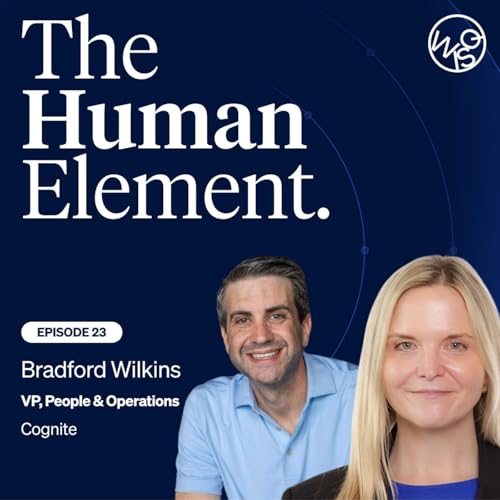
    A new hire fills out their 90-day survey and says they're not getting meaningful time with their manager. Instead of filing it away for a quarterly review, Bradford Wilkins pulls the data—and within ten seconds, AI shows him that the manager is spending nearly 50% of their time on pre-sales activities that aren't even part of their job.


    Within a week, the team is redesigning job responsibilities, reallocating time, and building a fix that will accelerate ramp for every future hire in that department. In this episode of The Human Element, host Barb Bidan sits down with Bradford Wilkins, VP of People and Organization at Cognite, an industrial AI company, for a fast-moving conversation about what happens when you stop looking at people data in silos and start connecting it the same way you'd connect sensors in an oil refinery. Bradford walks through how Cognite is building knowledge graphs that layer engagement data on top of performance data on top of Salesforce data to surface correlations no one was seeing before, why he says 50% of his job is already gone (and why that's exciting, not scary), and his "cheesecloth" framework for AI-first thinking: push everything through AI first, and whatever's left on the other side is the human work. He and Barb also get into why entry-level hires who grew up on AI may be more valuable right now than your mid-career employees, how org charts are starting to include agent boxes alongside human ones, and why the best time to start was twenty years ago—but the second best time is now.


    Timestamps

    • 00:39 How Cognite connects people data the same way it connects industrial sensors
    • 04:30 The 90-day survey that triggered three fixes in a single week
    • 09:54 Where the biggest HR automation opportunities are right now
    • 12:59 "50% of my job is gone"—and why that's the exciting part
    • 14:12 What still requires the human touch: team composition, empathy, judgment
    • 19:42 Building trust by helping employees visualize where their jobs are headed
    • 23:51 Managing agents as direct reports: the new org chart
    • 26:35 Learning labs, AI champions, and building capability through show and tell


    Takeaways

    • Push every process through the "cheesecloth" of AI first—what's left on the other side is the genuinely human work
    • Connect your people data across silos (engagement, performance, time tracking, CRM) instead of analyzing each in isolation
    • Don't add AI on top of a bad process; you're just compounding the problem faster
    • Build trust by helping employees visualize what their jobs will look like after AI, not just telling them not to worry
    • Create learning labs and AI champion roles to drive adoption intentionally instead of hoping it happens organically
    • Recognize that entry-level hires who grew up on AI may be your most valuable asset right now for accelerating adoption


    Guest LinkedIn: https://www.linkedin.com/in/bradfordwilkins/

    Company website: https://www.cognite.com


    Sponsor

    Wisq introduces Harper, your AI-powered HR service bot designed to act like a virtual HR generalist for every employee. No more waiting on emails or digging through policies—Harper gives your team instant answers to HR questions, helps them navigate benefits and policies, and even routes more complex cases to the right person.


    By handling the repetitive requests, Harper frees up your HR team to focus on strategy and people, while ensuring employees always feel supported. It’s a smarter, more consistent way to deliver HR services at scale.


    See Harper in action at https://www.wisq.com/

    • (00:39) - How Cognite connects people data the same way it connects industrial sensors
    • (04:30) - The 90-day survey that triggered three fixes in a single week
    • (09:54) - Where the biggest HR automation opportunities are right now
    • (12:59) - "50% of my job is gone"—and why that's the exciting part
    • (14:12) - What still requires the human touch: team composition, empathy, judgment
    • (19:42) - Building trust by helping employees visualize where their jobs are headed
    • (23:51) - Managing agents as direct reports: the new org chart
    • (26:35) - Learning labs, AI champions, and building capability through show and tell
    Show More Show Less
    33 mins