The Healthy Seas Podcast cover art

The Healthy Seas Podcast

The Healthy Seas Podcast

By: Crystal DiMiceli
Listen for free

Join us as we dive into the depths to explore the challenges and solutions shaping the future of our seas. Hosted by Crystal DiMiceli, each episode features conversations with the people making waves in marine protection: divers, scientists, educators, business partners, and local communities.

Healthy Seas is a unique alliance of NGOs and businesses working together to tackle marine litter, especially ghost fishing gear, and transform waste into opportunity through circular economy solutions. Active across 20+ countries, we operate with a global mission and a local heartbeat.

Through cleanups, education, innovation, and partnerships, we’re restoring the ocean and inspiring action—one net at a time.

Backed by over a decade of impact and part of the UN Ocean Decade movement, this podcast invites listeners and companies alike to dive into a world where environmental restoration meets meaningful collaboration.

© 2026 The Healthy Seas Podcast
Biological Sciences Science
Episodes
  • Circular Economy Starts in the Classroom
    Jun 22 2026

    How Eco-Schools Slovenia, AquafilSLO, and Healthy Seas are helping students turn sustainability into action

    Circular economy can seem like an abstract concept, but in the classroom it becomes tangible through creativity, problem-solving, and hands-on learning.

    In the latest Healthy Seas Podcast episode, Lucija Marovt, Project Director of Eco-Schools Slovenia, discusses how students learn about circular economy by rethinking products, exploring sustainable design, and viewing waste as a valuable resource rather than a problem.

    The episode also highlights the long-standing partnership between Eco-Schools Slovenia, AquafilSLO, and Healthy Seas, which has brought workshops, teacher training, and educational projects on circular economy, marine litter, and sustainable consumption to schools across Slovenia.

    Through practical activities and real-world examples, students develop not only knowledge but also the confidence to take action. By connecting sustainability with design, innovation, and ocean protection, these programmes help young people understand how everyday choices affect the environment and how they can contribute to positive change.

    Listen to the full episode to discover how Eco-Schools Slovenia, AquafilSLO, and Healthy Seas are inspiring the next generation to turn sustainability into action.

    If you enjoyed this episode, please be sure to subscribe, rate and review it! This helps to boost its visibility.

    Healthy Seas is a marine conservation organization whose mission is to tackle the ghost fishing phenomenon and turn this waste into an opportunity for a more circular economy. They do this through clean-ups, prevention, education, and working with partners who recycle and repurpose this material. The podcast is hosted by Crystal DiMiceli.

    Show More Show Less
    28 mins
  • What is plankton, why is it important, and how does it shape our climate and future?
    May 18 2026

    Before forests, before animals, before humans there was plankton.

    In this episode of the Healthy Seas Podcast, we speak with ocean advocate and author Vincent Doumeizel, whose upcoming book The Power of Plankton explores one of the most overlooked yet fundamental components of life on our planet.

    Plankton is often described as the “invisible” part of the ocean. But as Vincent reminds us, it is not just part of the story of life, it is the story.

    A planet shaped by the smallest forms of life

    Plankton is not a single organism, but a vast and diverse community of life forms ranging from microscopic algae and bacteria to larvae and even some animals like jellyfish that drift with ocean currents.

    For over 3.5 billion years, plankton dominated life on Earth. In that time, it fundamentally transformed the planet. It was plankton that first developed photosynthesis, releasing oxygen into the atmosphere. It was plankton that created the carbon cycle, the water cycle, and the conditions that made complex life possible. Quite simply, without plankton, there would be no breathable air, no stable climate, and no ecosystems as we know them.

    The invisible engine of biodiversity

    When we think about ocean conservation, we often focus on what we can see: coral reefs, marine animals, seagrass meadows. But all of these systems depend on plankton.

    As Vincent explains, plankton sits at the base of the entire marine food web. It regulates nutrients, supports fish populations, and drives the biological processes that sustain biodiversity across the ocean and, by extension, across the planet.

    This is where the connection to the Healthy Seas Foundation becomes clear. While our work focuses on removing marine litter, ghost nets, and other debris from the ocean, the ultimate goal is to protect the ecosystems that lie beneath. And those ecosystems depend on something far smaller and less visible: the balance of plankton communities. If we think of ocean conservation as restoring a house, plankton is the foundation. And without a stable foundation, nothing above it can stand.

    A system under pressure

    Plankton is resilient but it is not immune. Rising temperatures, ocean acidification, and pollution are already changing the composition of plankton communities. Species that help regulate climate, such as those that capture and store carbon, are being replaced in some areas by species that thrive in warmer, more polluted conditions.

    This shift may seem invisible, but its consequences are not. Because plankton drives the carbon cycle, changes at this level can accelerate climate change. Because it supports marine food chains, disruptions can cascade through entire ecosystems. In other words, the smallest organisms can have the largest impact.

    From understanding to solutions

    Despite its importance, plankton remains one of the least understood parts of our planet. But this is beginning to change. Advances in DNA sequencing, satellite observation, and artificial intelligence are opening new windows into this microscopic world. In the past decade alone, scientists have discovered millions of new genes and vastly expanded our understanding of ocean life. And with this understanding comes potential.

    Plankton could play a role in future solutions, from carbon capture to bioremediation, from new materials to new sources of food. But as Vincent emphasizes, the first step is not exploitation, it is understanding.

    Starting from the foundation

    At Healthy Seas, we often say that ocean conservation is about more than removing waste, it is about restoring balance. This episode reminds us that balance starts at the smallest scale. Protecting plankton does not mean “saving” it, it will continue to exist in one form or another. The real question is whether we can maintain the conditions that allow plankton to support life as we know it. Because in the end, as Vincent puts it, we may not need to save plankton. Plankton may be what saves us.


    If you enjoyed this episode, please be sure to subscribe, rate and review it! This helps to boost its visibility.

    Healthy Seas is a marine conservation organization whose mission is to tackle the ghost fishing phenomenon and turn this waste into an opportunity for a more circular economy. They do this through clean-ups, prevention, education, and working with partners who recycle and repurpose this material. The podcast is hosted by Crystal DiMiceli.

    Show More Show Less
    31 mins
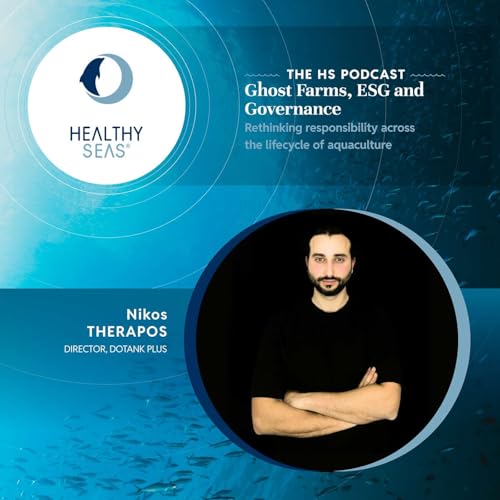
  • Ghost Farms Don’t Appear Overnight
    Apr 29 2026

    🌊 Ghost Farms Don’t Appear Overnight

    They don’t start as pollution—they start as decisions. 🛠️

    In this episode, we explore how abandoned fish farms become marine litter—and why the real issue begins long before cleanup. From governance gaps to ESG, it’s a story about responsibility across the full lifecycle of aquaculture. ♻️

    🎧 Listen to learn:
    • When a “ghost farm” really begins
    • Why planning and decommissioning matter
    • How better decisions today can prevent pollution tomorrow


    #OceanConservation #Aquaculture #ESG #MarinePollution #Podcast

    If you enjoyed this episode, please be sure to subscribe, rate and review it! This helps to boost its visibility.

    Healthy Seas is a marine conservation organization whose mission is to tackle the ghost fishing phenomenon and turn this waste into an opportunity for a more circular economy. They do this through clean-ups, prevention, education, and working with partners who recycle and repurpose this material. The podcast is hosted by Crystal DiMiceli.

    Show More Show Less
    15 mins
adbl_web_anon_alc_button_suppression_t1
No reviews yet