The Health Scientist Podcast cover art

The Health Scientist Podcast

The Health Scientist Podcast

By: The Health Scientist
Listen for free

Unbiased and up-to-date information on evidence-based nutrition, fitness and health.Copyright 2019 All rights reserved. Biological Sciences Exercise & Fitness Fitness, Diet & Nutrition Hygiene & Healthy Living Science
Episodes
  • Ep.52 Kimberley Wilson: The role of nutrition in mental health
    Feb 23 2021

    Kimberley is a chartered psychologist and a governor of the Tavistock & Portman NHS mental health trust as well as the former chair of the British Psychological Society's training committee in counselling psychology. She is also an award-winning food producer with a degree in nutrition, and her work looks at the role food and lifestyle plays in our mental health, including disordered eating, the gut-brain axis and our emotional relationship with food. Kimberley was even a finalist on the Great British Bake Off and on top of all that Kimberley is also author of "How to build a healthy brain", which was published in March, 2020.

    Kimberley's instagram

    Kimberley's website

    Kimberley's book: How to build a healthy brain

    Stronger Minds Podcast

    In this episode we cover:

    • How Kimberley decided to combine her career in psychology with her interest in nutrition
    • A discussion about research into how improved nutrition can reduce violence in prison populations
    • The apparent disconnect between mental health and the physical body and where it comes from
    • The ways stress and other mental health issues can present themselves as physical health issues
    • The taboo around mental health that exists within different factions of society
    • The role that better nutrition can play in keeping children in school and away from crime.
    • Why is hunger a major issue for school aged children, even in the UK?
    • How can dealing with childhood hunger reduce the likelihood of bad behaviour in schools
    • How are charities like "Magic Breakfast" doing to improve the situation?
    • What are some of the key nutrients involved in mental health?
    • The important role of DHA in brain development and function
    • How a mother's diet can influence a child's brain health
    • What role can leafy green vegetables play in brain aging?
    • A discussion about the SMILES trial, a nutrition intervention in depression
    • The importance of understanding that each person's mental health issues is different and what works for one person may not work for others.
    • The importance of an inclusive diet for building brain health
    • The importance of plant foods as sources of fibre and polyphenols for brain health
    • The incredibly important role of sleep in mental health.
    • Kimberley's book "How to build a healthy brain"
    Show More Show Less
    57 mins
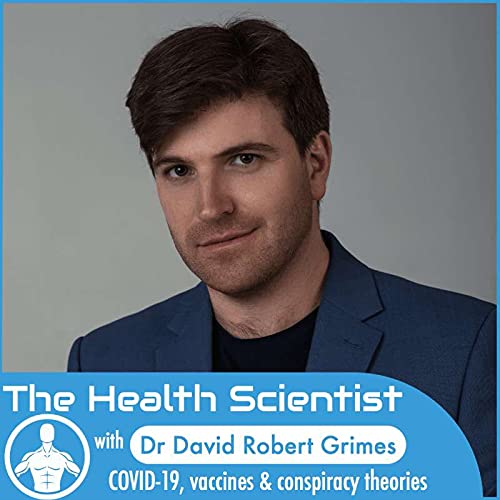
  • Ep.51 David Robert Grimes: COVID-19, vaccines & conspiracy theories
    Jan 28 2021

    David is a physicist, cancer researcher, and science writer. His work encompasses everything from how tumours use oxygen to why conspiracies tend to fail. He has a strong focus on public understanding of science and medicine, contributing to BBC, RTE, The New York Times, The Guardian, The Irish Times, and PBS and he was the recipient of the 2014 Maddox prize.

    David's Instagram

    David's Twitter

    David's book: The Irrational Ape

    In this episode we cover:

    • David's background and achievements
    • How David made the transition from physics to cancer research
    • What spurred David to learn more about science communication and disinformation?
    • What are the different types of false information and what negative effects can they have?
    • Why does disinformation spread so quickly and why do people hold onto such ideas so strongly?
    • How does disinformation or conspiracy theories play on human emotions?
    • The general population's lack of ability to "research" anything online (hint, it doesn't involve a google search)
    • What are the character traits of people who actively spread conspiracy theories online?
    • How many individuals buy into conspiracy theories out of fear
    • The risk of blindly following the ideas of individuals just because of their position or reputation
    • The damage the anti-vax movement has done to public health and the spread of previously declining diseases
    • The inability of the public to determine the risk of catching a disease in relation to the risk of vaccinating against it.
    • The risk of asymptomatically spreading disease to someone who may suffer serious consequences
    • How can we help people to identify disinformation on a society-wide level?
    • What is information hygiene?
    • Some tips form David on how to identify a health-related conspiracy theory
    • The importance of empathy, skepticism and admitting the limits of our own knowledge when speaking to people about their beliefs
    • The limits of what social media companies will do to stem the spread of disinformation.
    • David's book, The Irrational Ape
    Show More Show Less
    57 mins
  • Ep.50 Grant Tinsley: Intermittent fasting, fat loss and performance
    Dec 17 2020

    Dr. Grant Tinsley is an Assistant Professor and the Director of the Energy Balance & Body Composition Laboratory at Texas Tech University. The major research interests of his laboratory are the critical evaluation of body composition assessment techniques, the influence of intermittent fasting on health and physical performance, and sports nutrition strategies to improve performance and body composition.

    Grant's Instagram

    Grant's Research Gate profile

    Grant's website

    In this episode we cover:

    • Grant's background and how he got into researching body composition and intermittent fasting
    • What were the general recommendations on meal frequency for fat loss and performance before IF became popular?
    • How is body composition analysed and what are the limitations with most methods?
    • What are some of the most frequently used techniques for measuring body fat and muscle mass and how do they work?
    • Why might a researcher want to use a combination of techniques for measuring body composition?
    • What is IF, what are the different types and why does that make interpreting research difficult?
    • An explanation of periodic fasting, alternate-day fasting and time-restricted feeding
    • Why focusing on "when" you eat may make a diet more appealing thant "what" you eat.
    • What are some of the possible benefits of IF and are they all weight-loss dependent?
    • Why IF may not be useful for everyone?
    • What are some of the considerations for IF in athletic populations?
    • Why would a higher meal frequency potentially be more beneficial for athletes or people trying to gain muscle?
    • What has Grant's own research shown on the effects of IF while doing resistance exercise?
    • What are the issues with trying to record people's food intake during these free-living trials?
    • Why might protein play such an important role in the effects of IF while resistance training?
    • What has Grant's research shown on the effects of IF in cyclists?
    • How can body composition changes translate to improved performance?
    • Why we need to be much more conservative with changes in meal frequency when working with elite athletes?
    • Could changes in hormones like IGF1or testosterone have important effects in the long term?
    Show More Show Less
    1 hr and 2 mins
adbl_web_anon_alc_button_suppression_c
No reviews yet