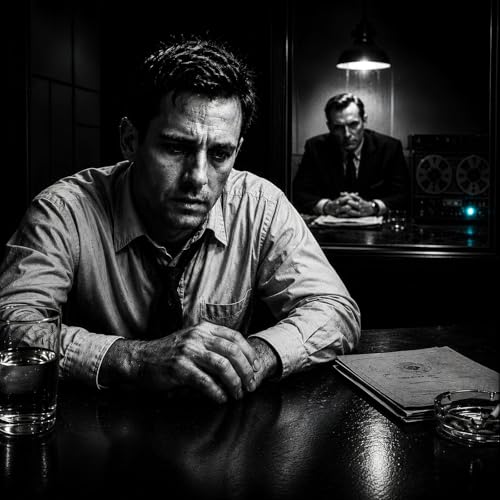
The Fairshake Files cover art

The Fairshake Files

The Fairshake Files

By: The Fairshake Files
Listen for free

The Fairshake Files is a long-form documentary investigation series about the records institutions hoped would stay buried.

Built from declassified files, archival material, court-era reporting, and the documentary record left behind, each episode traces the distance between what was said, what was done, and what the record still reveals.

The focus is not gossip, mythology, or internet folklore. It is the paper trail. The hearing transcript. The memorandum. The testimony. The quiet line in an official document that says far more than it meant to. At its core, The Fairshake Files examines the points where power, secrecy, and public narrative collide. Intelligence operations. institutional abuse. political manipulation. covert programs. historical events that were flattened, softened, denied, or filed away under language designed to make them seem smaller than they were.

This series looks at what happens when those records are read closely, placed in context, and followed where they lead.

Each investigation is built to go beyond the polished version of history. Not to sensationalize it, but to strip away the protective varnish. The aim is to understand how systems behave when they are shielded by prestige, bureaucracy, classification, or time, and how ordinary people are so often left carrying the consequences.

The Fairshake Files is interested in the gap between the official story and the documented one. In some cases, that gap is narrow. In others, it is the whole story.

This is not a channel about conspiracy fantasy. It is a series grounded in records, reporting, and the uncomfortable truth that some of the most disturbing things in history were not hidden because they were unbelievable, but because they were written down in places most people were never expected to look.

Become a supporter of this podcast: https://www.spreaker.com/podcast/the-fairshake-files--6771179/support.The Fairshake Files
Political Science Politics & Government Social Sciences World
Episodes
  • CIA Project MK-Ultra: The Arctic Mind to KUBARK's Interrogation Blueprint (Full Documentary)
    Jun 28 2026
    This feature-length compilation brings together Chapters Four and Five of our MK-ULTRA investigation.

    It begins in the Canadian High Arctic, where military planners and researchers realized that extreme isolation, sensory reduction, and environmental monotony could fracture a human mind without leaving a physical mark.

    It then moves into the sterile, windowless rooms of the CIA, where those environmental observations were codified into the 1963 KUBARK manual: the agency’s foundational blueprint for coercive interrogation.

    This is a documented progression: from the frozen tundra to the isolation chamber. From perceptual deprivation to the systematic application of debility, dependency, and dread.

    Note: This is a bundled release of Chapters Four and Five of our MK-ULTRA series, provided for listeners who prefer to experience the historical arc in one uninterrupted sitting.

    CHAPTER TIMESTAMPS PART FOUR: THE ARCTIC MIND & SENSORY DEPRIVATION

    00:00 - Introduction: Exercise Musk Ox & the Polar Night
    01:51 - The “Meat Locker”: Brutal Conditions of the Arctic Expedition
    03:59 - Captain Kroom: Measuring Psychological Fracture
    05:10 - The Approach Corridor: Strategic Shift in the Cold War
    07:45 - The Defense Research Board (DRB) & Dr. Omond Solandt
    11:31 - Brainwashing Fears: Cardinal Mindszenty & Korea
    13:09 - The Ritz Carlton Meeting: Convergence of Coercion
    14:11 - McGill University: Donald Hebb’s Perceptual Deprivation
    16:04 - Operation Sun Dog: Using the North as a Filter
    19:21 - Dr. Malcolm Brown: Extracting Data from the Inuit
    22:24 - Dr. John Zubek: Miniaturizing the Arctic Laboratory
    26:40 - Fort Churchill: Turning Hardship into Protocol

    PART FIVE: THE KUBARK INTERROGATION MANUAL

    00:00 - The Arranged Room: Psychology of the Interrogator
    03:32 - Introduction to the KUBARK Manual (1963)
    04:28 - Cryptonyms & Administrative Language (KUBARK/ODOK)
    06:27 - The Operator: Patience, Attention, and the “Sadistic Failure”
    08:45 - Building a Baseline: Watching for Bodily Betrayal
    11:33 - The Nine Doors: Categorizing Personalities for Pressure
    12:33 - Orderly Obstinate
    13:33 - Optimistic
    14:28 - Greedy
    15:47 - Anxious & Self-Centered
    16:57 - Guilt-Ridden
    18:16 - Character Wrecked by Success
    19:11 - Schizoid
    20:25 - The Exception
    21:35 - The Average
    23:57 - Architecture as Pressure: Setting the Stage for Regression
    30:50 - “Non-Coercive” Methods: Mutt and Jeff / Good Cop, Bad Cop
    34:52 - DDD: Debility, Dependency, and Dread
    38:55 - Alice in Wonderland Technique
    40:39 - The Yuri Nosenko Case: A 1,277-Day Stress Test
    46:49 - Institutional Memory: The Legacy of Procedure

    SOURCES & MATERIALSPRIMARY / OFFICIAL RECORD
    • CIA Reading Room: KUBARK Counterintelligence Interrogation Manual (1963)
    • CIA Reading Room: Yuri Nosenko declassified files
    • Department of National Defence (Canada): Operation Sun Dog records
    • Defence Research Board (DRB) archivesACADEMIC / ARCHIVAL RECORD
    • McGill University Archives: Dr. Donald Hebb and Contract X-38 perceptual deprivation research
    • Queen’s University Archives: Dr. Malcolm Brown’s vascular characteristics studies
    • University of Manitoba: Dr. John Zubek isolation laboratory grants and reporting
    • Albert Biderman: Chart of Coercion, based on Korean War POW studies
    DISCLAIMER

    This episode explores historical records, documented programs, and competing interpretations connected to MK-ULTRA and coercive interrogation research. The goal of this channel is to examine the evidence presented for all sides, not to endorse any single conclusion.

    Become a supporter of this podcast: https://www.spreaker.com/podcast/the-fairshake-files--6771179/support.

    Thank you for listening to The Fairshake Files.

    If this investigation stayed with you, leave a review, share the episode, or send it to someone interested in history, intelligence, Cold War secrecy, and the machinery behind official stories.

    The full video version, with visuals, is available on YouTube and Spotify:
    @thefairshakefiles

    The Fairshake Files is independently produced.

    Every listen, view, review, and share helps keep the work moving.


    This episode includes AI-generated content.
    Show More Show Less
    1 hr and 18 mins
  • CIA Project MK-ULTRA: The KUBARK Interrogation Manual (Part 5)
    Jun 9 2026
    (00:00:00) CIA Project MK-ULTRA: The KUBARK Interrogation Manual (Part 5) (00:00:01) The Interrogation Room (00:03:13) The Art of Controlled Environment (00:04:03) The Kubark Manual: A Guide to Interrogation (00:06:29) The Interrogator's Role and Personality (00:11:59) Understanding the Subject's Personality Types (00:23:53) The Evolution of Interrogation Techniques (00:25:36) The Controlled Environment: Architecture of Control (00:31:40) Mutt and Jeff: A Two-Act Approach (00:34:54) Debility, Dependency, and Dread (00:40:33) The Nosenko Case: A Failure of Kubark By 1963, the lessons of Cold War mind control had been typed into procedure.No dungeon. No blood on the floor. No theatrical cruelty. Just a manual, a room, an interrogator, and a method for turning fear, isolation, dependency, and dread into instruments of control.Welcome back to The Fairshake Files, where the official record ends… and the real one begins.In Chapter 5 of our MK-ULTRA investigation, we enter the world of KUBARK: the CIA’s 1963 Counterintelligence Interrogation manual.This was not a rumor, a theory, or a whispered claim from the margins. It was a classified guide, written in the language of procedure, designed to teach interrogation as a disciplined system.This chapter examines how KUBARK transformed the lessons of Korea, Montreal, sensory deprivation, isolation research, and Cold War “brainwashing” fears into a portable method for control.We look at the manual’s language, its cryptonyms, its personality categories, its treatment of the interrogation room as an instrument, and its use of techniques such as Mutt and Jeff, Debility, Dependency, Dread, and Alice in Wonderland.We also follow one of the clearest human examples of the danger behind the method: Yuri Nosenko, the Soviet KGB officer who defected to the United States in 1964, only to be held by the CIA for 1,277 days in a custom-built isolation vault at Camp Peary. KUBARK promised control.But control is not the same thing as truth.CHAPTERS 00:00 - Inside the CIA Interrogation Room04:00 - The KUBARK Manual & The Operator11:32 - The 9 Personality Vulnerabilities23:49 - Brainwashing Origins: Korea & Montreal25:57 - Weaponizing the Room & Mutt and Jeff35:50 - DDD: Debility, Dependency, and Dread40:38 - Yuri Nosenko: 1,277 Days in a CIA Vault46:49 - KUBARK’s Legacy: Control Is Not TruthSOURCES & MATERIALSPrimary / Official / Archival RecordCIA: KUBARK Counterintelligence Interrogation, July 1963CIA Reading Room: Counterintelligence Interrogation declassified recordsNational Security Archive: Prisoner Abuse: Patterns from the PastU.S. Senate Select Committee on Intelligence: Project MKULTRA, The CIA’s Program of Research in Behavioral Modification, 1977Joint Hearing House Select Committee on Assassinations: Oswald in the Soviet Union: An Investigation of Yuri NosenkoCIA / Studies in Intelligence: DCI John McCone and the Assassination of President John F. Kennedy: The Nosenko CaseCold War Interrogation / Coercion Research Albert D. Biderman: Communist Attempts to Elicit False Confessions from Air Force Prisoners of War, 1957 Lawrence E. Hinkle Jr. & Harold G. Wolff: Communist Interrogation and Indoctrination of “Enemies of the State”I.E. Farber, Harry F. Harlow & Louis Jolyon West: Brainwashing, Conditioning, and DDD: Debility, Dependency, and Dread, 1957Additional Context National Security Archive: CIA KUBARK release materials and later declassification notesChristian Science Monitor: A Cold War Case of CIA DetentionStill Echoes Declassified JFK/Nosenko records held through the National Archives and related HSCA volumesDisclaimer: The following is an exploration of historical records, declassified materials, and documented claims. The goal of this channel is to examine the evidence presented for all sides, not to endorse any single conclusion. Become a supporter of this podcast: https://www.spreaker.com/podcast/the-fairshake-files--6771179/support.Thank you for listening to The Fairshake Files.If this investigation stayed with you, leave a review, share the episode, or send it to someone interested in history, intelligence, Cold War secrecy, and the machinery behind official stories.The full video version, with visuals, is available on YouTube and Spotify:@thefairshakefilesThe Fairshake Files is independently produced.Every listen, view, review, and share helps keep the work moving.This episode includes AI-generated content.
    Show More Show Less
    49 mins
  • CIA Project MK-Ultra: The Arctic Mind & Sensory Deprivation (Part 4)
    Apr 16 2026
    There are places so empty they begin to act on the mind.

    No dungeon. No confession room. No lamp swinging over a chair.

    Just distance, white-out, isolation, and a state learning that a person can be broken down without ever laying a hand on them.

    Welcome back to The Fairshake Files, where the official record leaves questions behind.

    In Chapter 4 of our MK-Ultra investigation, we explore one of the least discussed origins of Cold War mind-control research: the High Arctic.

    We follow the Canadian military’s 1946 Exercise Musk Ox into the tundra, where distance, cold, monotony, and isolation exposed a different kind of vulnerability in the human machine.

    This file examines how Dr. Omond Solandt and the Defence Research Board came to understand isolation as something that could be studied, measured, and eventually weaponized.

    We trace the 1951 Ritz-Carlton intelligence meeting in Montreal, which helped fund Dr. Donald Hebb’s early sensory deprivation experiments, the grueling Operation Sun Dog tests at Fort Churchill, and Dr. John Zubek’s isolation laboratory at the University of Manitoba.

    The Cold War did not only treat the Arctic as a battlefield.
    It treated the environment as an instrument.

    And once those psychological effects could be studied, they could be recreated inside an interrogation cell.

    Timestamps:

    00:00 The Void: Isolation as an Instrument
    01:19 1946 Exercise Musk Ox: The Flaw in the Machine
    05:14 The High Arctic: A Cold War Approach Corridor
    09:27 Dr. Omond Solandt & The Defence Research Board
    11:04 The Brainwashing Fear: Monotony as a Weapon
    13:10 The 1951 Ritz-Carlton Intelligence Meeting
    14:15 Dr. Donald Hebb & Sensory Deprivation
    16:04 Operation Sun Dog: Hardening the Human Material
    19:21 Cold Tolerance & The Extractive Logic of Science
    22:42 Dr. John Zubek: The Winnipeg Isolation Laboratory
    26:31 Conclusion: Recreating Tundra Damage on Demand
    28:46 Next: Chapter 5, The KUBARK Manual

    The full video version, with visuals, is available on YouTube:
    @thefairshakefiles

    Thank you for listening to The Fairshake Files.

    If this investigation stayed with you, leave a review, share the episode, or send it to someone interested in history, intelligence, Cold War secrecy, sensory deprivation, behavioral research, and the machinery behind official stories.

    The Fairshake Files is independently produced. Every listen, view, review, and share helps keep the work moving.

    Sources & Materials:


    • Canadian War Museum: Operation Musk Ox and Snowmobiles Archive
    • Defence Research and Development Canada: The History of Defence Science in the Canadian Arctic
    • Government of Canada: The Cooper Report
    • Information Canada: The Mirrored Spectrum
    • McGill University: About Dr. D.O. Hebb
    • University of Manitoba Archives: John Zubek fonds
    • Matthew S. Wiseman: Unlocking the “Eskimo Secret”: Defence Science in the Cold War Canadian Arctic
    • Matthew S. Wiseman: Sun Dog One and the Development of Cold War Soldiery in the Canadian Arctic
    Disclaimer: The following is an exploration of historical records, official narratives, and competing interpretations. The goal of this channel is to examine the evidence presented, not to endorse any single conclusion.

    Become a supporter of this podcast: https://www.spreaker.com/podcast/the-fairshake-files--6771179/support.

    Thank you for listening to The Fairshake Files.

    If this investigation stayed with you, leave a review, share the episode, or send it to someone interested in history, intelligence, Cold War secrecy, and the machinery behind official stories.

    The full video version, with visuals, is available on YouTube and Spotify:
    @thefairshakefiles

    The Fairshake Files is independently produced.

    Every listen, view, review, and share helps keep the work moving.


    This episode includes AI-generated content.
    Show More Show Less
    29 mins
adbl_web_anon_alc_button_suppression_t1
No reviews yet