Episodes

  • Ep. 238: The Habsburg Empire at its Zenith - Ferdinand I and the Siege of Vienna - History of the Germans
    May 21 2026
    Today we celebrate the topping out of the Habsburg empire. By the middle of the 16th century it reached its furthest extent as a political entity ruled by one man. Over the last 42 episodes we have seen this family of minor counts playing their game of snakes and ladders until they had amassed lordships over Austria, the Netherlands, Spain and large parts of Italy. Today we look at how they finally got hold of the last bits, Bohemia and Hungary.The story features a dutiful younger brother, the most cruel execution I have ever heard of, a foolish duke and an even more foolish king, the collapse of a kingdom, a love story and the reason for the incessant Habsburg inbreeding. I hope that will be enough to fill the last episode of this season.The music for the show is Flute Sonata in E-flat major, H.545 by Carl Phillip Emmanuel Bach (or some claim it as BWV 1031 Johann Sebastian Bach) performed and arranged by Michel Rondeau under Common Creative Licence 3.0.As always:Homepage with maps, photos, transcripts and blog: www.historyofthegermans.comIf you wish to support the show go to: Support • History of the Germans PodcastFor do it yourself merchandise go to: Merchandise • History of the Germans PodcastFacebook: @HOTGPod Threads: @history_of_the_germans_podcastBluesky: @hotgpod.bsky.socialInstagram: history_of_the_germansTwitter: @germanshistoryTo make it easier for you to share the podcast, I have created separate playlists for some of the seasons that are set up as individual podcasts. they have the exact same episodes as in the History of the Germans, but they may be a helpful device for those who want to concentrate on only one season.So far I have:The OttoniansSalian Emperors and Investiture ControversyFredrick Barbarossa and Early HohenstaufenFrederick II Stupor MundiSaxony and Eastward ExpansionThe Hanseatic LeagueThe Teutonic KnightsThe Holy Roman Empire 1250-1356The Reformation before the ReformationThe Empire in the 15th centuryThe Fall and Rise of the Habsburgs
    Show More Show Less
    53 mins
  • Ep. 237: How Italy Fell to the Habsburgs - From the Peace of Madrid to the Sack of Rome 1527. - History of the Germans
    May 14 2026
    We are coming closer to the end of our series on the Fall and Rise of the House of Habsburg. We have seen the reconsolidation of Austria, the acquisition of Burgundy, the inheritance of Spain and today, we will look at the last stages of the Italian wars. This conflict, kicked off by king Charles VIII in 1494 had given “rise to changes of dominions, subversion of kingdoms, desolation of countries, destruction of cities and the cruellest massacres, but also new fashions, new customs, new and bloody ways of waging warfare, and diseases which had been unknown to that time”. Many players of this game had exited stage left and it was now just France and the Habsburgs in various alliances with the remaining Italian powers, who fought for control. The War of the League of Cognac, 1526 to 1530 was when brutality reached its zenith with the Sacco di Roma, the Sack of Rome that brought back the specter of the Vandals.A lot of drama to get through.The music for the show is Flute Sonata in E-flat major, H.545 by Carl Phillip Emmanuel Bach (or some claim it as BWV 1031 Johann Sebastian Bach) performed and arranged by Michel Rondeau under Common Creative Licence 3.0.As always:Homepage with maps, photos, transcripts and blog: www.historyofthegermans.comIf you wish to support the show go to: Support • History of the Germans PodcastFor do it yourself merchandise go to: Merchandise • History of the Germans PodcastFacebook: @HOTGPod Threads: @history_of_the_germans_podcastBluesky: @hotgpod.bsky.socialInstagram: history_of_the_germansTwitter: @germanshistoryTo make it easier for you to share the podcast, I have created separate playlists for some of the seasons that are set up as individual podcasts. they have the exact same episodes as in the History of the Germans, but they may be a helpful device for those who want to concentrate on only one season.So far I have:The OttoniansSalian Emperors and Investiture ControversyFredrick Barbarossa and Early HohenstaufenFrederick II Stupor MundiSaxony and Eastward ExpansionThe Hanseatic LeagueThe Teutonic KnightsThe Holy Roman Empire 1250-1356The Reformation before the ReformationThe Empire in the 15th centuryThe Fall and Rise of the Habsburgs
    Show More Show Less
    36 mins
  • Ep. 236: Charles V (1520-1555) - The Battle of Pavia - History of the Germans
    May 7 2026
    In 1521 four men dominated Europe. They were all in their twenties: King Henry VIII of England, born 1491, King Francois I of France, born 1494, Suleiman the Magnificent, Ottoman Sultan, born that same year, 1494 and the youngest of them, Charles V, Holy Roman Emperor, King of Spain, Sicily, Naples and Sardinia, lord of the Netherlands, duke of Austria and Count of Tyrol.How the world had changed. In the days of Charles’ predecessor, the emperor Maximilian, European politics was a impenetrable maze of alliances and enmities involving roughly a dozen mid-sized powers trying to get a leg up on each other.Now we are down to four guys, dancing a political Ceilidh, all elegantly dressed, swiftly moving and swapping partners at every turn.In this episode we are going to look at the first rounds of Gay Gordons and Dashing White Sergeants up to the point where Charles V gets a lock on Francois I at the Battle of Pavia in 1525The music for the show is Flute Sonata in E-flat major, H.545 by Carl Phillip Emmanuel Bach (or some claim it as BWV 1031 Johann Sebastian Bach) performed and arranged by Michel Rondeau under Common Creative Licence 3.0.As always:Homepage with maps, photos, transcripts and blog: www.historyofthegermans.comIf you wish to support the show go to: Support • History of the Germans PodcastFor do it yourself merchandise go to: Merchandise • History of the Germans PodcastFacebook: @HOTGPod Threads: @history_of_the_germans_podcastBluesky: @hotgpod.bsky.socialInstagram: history_of_the_germansTwitter: @germanshistoryTo make it easier for you to share the podcast, I have created separate playlists for some of the seasons that are set up as individual podcasts. they have the exact same episodes as in the History of the Germans, but they may be a helpful device for those who want to concentrate on only one season.So far I have:The OttoniansSalian Emperors and Investiture ControversyFredrick Barbarossa and Early HohenstaufenFrederick II Stupor MundiSaxony and Eastward ExpansionThe Hanseatic LeagueThe Teutonic KnightsThe Holy Roman Empire 1250-1356The Reformation before the ReformationThe Empire in the 15th centuryThe Fall and Rise of the Habsburgs
    Show More Show Less
    38 mins
  • Ep. 235: The Youth and Election of the Emperor Charles V (1520-1555) - History of the Germans
    Apr 30 2026

    Born during a ball in Ghent on 24 February 1500, Charles of Habsburg would grow up to rule an empire stretching from the Philippines to Prague and from Lima to Lauwersoog. But who was the man behind one of history's most powerful titles — and how did an unremarkable teenager come to be elected Holy Roman Emperor?

    In this episode, we explore the remarkable — and often dysfunctional — upbringing of Charles V. Raised like an orphan in the Burgundian Netherlands while his mother Joanna of Castile was confined at Tordesillas, Charles was shaped by two very different mentors: the theologian Adrian of Utrecht, who introduced him to Erasmus and laid the groundwork for his complex relationship with the Reformation, and William de Croy, Lord of Chièvres, who drilled into him the discipline of statecraft.

    We examine how Charles' worldview was rooted in Burgundian chivalric tradition, why his advisors kept him politically cautious in his early reign, and how the death of his grandfather Maximilian I in 1519 forced him to step up and fight for the imperial crown against the formidable Francis I of France.

    We also cover the extraordinary financial muscle of banker Jakob Fugger, the crucial diplomatic role of Margaret of Austria, and how a brief stop in Dover to visit Henry VIII helped prevent a Franco-English alliance that could have derailed everything at the Field of Cloth of Gold.

    Topics covered in this episode:

    • Charles V's childhood in Mechelen and his education under Adrian of Utrecht and Lord Chièvres
    • The Burgundian chivalric culture that shaped his worldview
    • The death of Maximilian I and the scramble for the imperial election of 1519
    • The role of the Fugger banking dynasty in funding Charles' election campaign
    • The Field of Cloth of Gold and Habsburg diplomacy with Henry VIII
    • The coronation at Aachen in October 1520 and what it meant for the future of the Holy Roman Empire

    Plus: an update on upcoming episodes and a summer break announcement.

    Show More Show Less
    40 mins
  • Ep. 234: The Charisma of Emperor Maximilian (1493-1519) - History of the Germans
    Apr 23 2026
    Maximilian I died on January 12th, 1519. But his likeness is everywhere. None of his predecessors left behind as many depictions of their life, from being fed by his nurse as a toddler to the Totenbild, the picture of the emperor in death, stripped of all his paraphernalia, even his teeth broken out.If you search in google for the most reproduced image of a Holy Roman Emperor, two come up, the portrait of Maximilian that Albrecht Dürer produced in Augsburg in 1518, as shown on last weeks episode artwork and Titian’s equestrian portrait of Charles V after the battle of Mühlberg, which in turn is a composition that goes back to several equestrian portraits of Maximilian I.Basically, Maximilian I is the most visually present Holy Roman emperor of them all. And that is not by chance. As he said on several occasions, quote:"Whoever does not provide for his commemoration during his lifetime has no commemoration after his death and is forgotten with the sound of the bell that rings at his burial"The music for the show is Flute Sonata in E-flat major, H.545 by Carl Phillip Emmanuel Bach (or some claim it as BWV 1031 Johann Sebastian Bach) performed and arranged by Michel Rondeau under Common Creative Licence 3.0.As always:Homepage with maps, photos, transcripts and blog: www.historyofthegermans.comIf you wish to support the show go to: Support • History of the Germans PodcastFor do it yourself merchandise go to: Merchandise • History of the Germans PodcastFacebook: @HOTGPod Threads: @history_of_the_germans_podcastBluesky: @hotgpod.bsky.socialInstagram: history_of_the_germansTwitter: @germanshistoryTo make it easier for you to share the podcast, I have created separate playlists for some of the seasons that are set up as individual podcasts. they have the exact same episodes as in the History of the Germans, but they may be a helpful device for those who want to concentrate on only one season.So far I have:The OttoniansSalian Emperors and Investiture ControversyFredrick Barbarossa and Early HohenstaufenFrederick II Stupor MundiSaxony and Eastward ExpansionThe Hanseatic LeagueThe Teutonic KnightsThe Holy Roman Empire 1250-1356The Reformation before the ReformationThe Empire in the 15th centuryThe Fall and Rise of the Habsburgs
    Show More Show Less
    37 mins
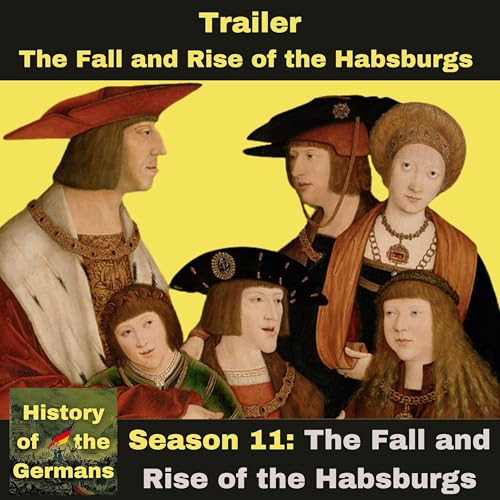
  • Trailer for The Early Habsburgs - Their Fall and Rise
    Apr 19 2026

    The House of Habsburg once ruled Spain, Benelux, Austria, Hungary, Czechia, most of Italy, at times Portugal and all of Latin America, the Philippines and of course, the Holy Roman Empire. Most histories of the Habsburgs start out with Maximilian I, his marriage alliances that brought together this empire. But he was not the first Habsburg emperor, and by no means the first Habsburg ruler of the Holy Roman Empire. Their history goes back to the 13th century when they almost established their dynasty on the throne, had it not been for John Parricida murdering his uncle. In this show we follow the dramatic events that saw this dynasty rising and then falling hard, its struggles to recover, the feats and forgeries, the victories and terrible defeats that shaped this family and its lore. We take the story from Rudolf of Habsburgs’ ascent to the throne in 1273 to the election of Charles V in 1519.

    Show More Show Less
    25 mins
  • Ep. 233: Maximilian I (1493-1519) - Last Days and Legacy - History of the Germans
    Apr 16 2026
    The last decade of emperor Maximilian’s reign was overshadowed by all three challenges to the emerging Habsburg empire gaining strength. The Ottoman empire was piling on resources by taking over Syria, Lebanon and Egypt. A vigorous new king of France, Francois I was turning the tide in the incessant Italian wars into his favor. And finally the greatest of threats to the dynasty emerged as the Prince Electors were contemplating to raise that self-same Francois I to the imperial title.In this episode we will look at how the prematurely aged and exhausted emperor tried to shield his grandsons Charles and Ferdinand from the ton of bricks that was coming down on them. And we will look at his last days and legacy. Clocking in at 18 episodes, Maximilian did achieve one of his objectives in life, outpacing the great emperor Frederick Barbarossa. Let’s find out whether he did this only in terms of number of HotGPod episodes, or in other ways too.The music for the show is Flute Sonata in E-flat major, H.545 by Carl Phillip Emmanuel Bach (or some claim it as BWV 1031 Johann Sebastian Bach) performed and arranged by Michel Rondeau under Common Creative Licence 3.0.As always:Homepage with maps, photos, transcripts and blog: www.historyofthegermans.comIf you wish to support the show go to: Support • History of the Germans PodcastFor do it yourself merchandise go to: Merchandise • History of the Germans PodcastFacebook: @HOTGPod Threads: @history_of_the_germans_podcastBluesky: @hotgpod.bsky.socialInstagram: history_of_the_germansTwitter: @germanshistoryTo make it easier for you to share the podcast, I have created separate playlists for some of the seasons that are set up as individual podcasts. they have the exact same episodes as in the History of the Germans, but they may be a helpful device for those who want to concentrate on only one season.So far I have:The OttoniansSalian Emperors and Investiture ControversyFredrick Barbarossa and Early HohenstaufenFrederick II Stupor MundiSaxony and Eastward ExpansionThe Hanseatic LeagueThe Teutonic KnightsThe Holy Roman Empire 1250-1356The Reformation before the ReformationThe Empire in the 15th centuryThe Fall and Rise of the Habsburgs
    Show More Show Less
    40 mins
  • Ep. 232: The Ottomans – From Mehmet the Conqueror to Selim the Grim (1444-1520) - History of the Germans
    Apr 9 2026
    These last dozen or so episodes we have examined the genesis of two of the three major strategic preoccupations of the Habsburg empire, the rivalry with the French kings and the relationship with the imperial princes. Today we will look at the build-up of the third major strategic challenge to the rulers of the Holy Roman Empire, the Ottomans. One can argue, and many have, that the threat of an Ottoman invasion in the 1520s and 1530s prevented the emperor Charles V from clamping down on the protestants in the empire. By the time the border had been stabilised and the Habsburgs could focus again on the religious and political changes in the German lands, it was too late to reverse events. There is an element of irony here that I will refrain from elaborating on.When Constantinople fell in 1453, the Christian nations of Western Europe assumed that they could regain the ancient capital of Byzantium and even Jerusalem if only they were united under the crusading banner. By the time Suleiman the Magnificent appeared before Belgrade in 1521, that had become inconceivable. The Christian nations, and in particular the Habsburgs were on their back foot.So, what had happened in these 70 years that made the Ottoman armies appear unbeatable?The music for the show is Flute Sonata in E-flat major, H.545 by Carl Phillip Emmanuel Bach (or some claim it as BWV 1031 Johann Sebastian Bach) performed and arranged by Michel Rondeau under Common Creative Licence 3.0.As always:Homepage with maps, photos, transcripts and blog: www.historyofthegermans.comIf you wish to support the show go to: Support • History of the Germans PodcastFor do it yourself merchandise go to: Merchandise • History of the Germans PodcastFacebook: @HOTGPod Threads: @history_of_the_germans_podcastBluesky: @hotgpod.bsky.socialInstagram: history_of_the_germansTwitter: @germanshistoryTo make it easier for you to share the podcast, I have created separate playlists for some of the seasons that are set up as individual podcasts. they have the exact same episodes as in the History of the Germans, but they may be a helpful device for those who want to concentrate on only one season.So far I have:The OttoniansSalian Emperors and Investiture ControversyFredrick Barbarossa and Early HohenstaufenFrederick II Stupor MundiSaxony and Eastward ExpansionThe Hanseatic LeagueThe Teutonic KnightsThe Holy Roman Empire 1250-1356The Reformation before the ReformationThe Empire in the 15th centuryThe Fall and Rise of the Habsburgs
    Show More Show Less
    38 mins