• Can the revised 2024 McDonald Diagnostic criteria solve the misdiagnosis problem in multiple sclerosis?
    Jun 3 2026

    In this episode of the ECTRIMS Podcast, recorded in collaboration with the Multiple Sclerosis Journal "Controversies in MS" series, host Prof. Anneke van der Walt moderates a discussion between Prof. Andy Solomon and Prof. Enrique Gómez on one of the most debated developments in modern multiple sclerosis diagnosis.

    Together, they explore:

    • Why misdiagnosis remains a major challenge in MS care
    • The role of the central vein sign (CVS) and paramagnetic rim lesions (PRLs) in improving specificity
    • Whether expanding diagnostic sensitivity may increase false positives
    • The practical realities of implementing advanced MRI biomarkers globally
    • The importance of radiology training, implementation science, and AI-assisted imaging
    • How clinicians should approach MRI interpretation in real-world practice

    This conversation examines the balance between earlier diagnosis, diagnostic accuracy, and equitable implementation of emerging diagnostic tools across different healthcare settings.

    This episode is part of the MS Journal Controversies in MS series on The revised 2024 McDonald criteria can solve the misdiagnosis problem in MS. The accompanying Yes, No, and Commentary articles are available to read open access for the next month, compliments of MS Journal.

    Show More Show Less
    33 mins
  • EBV and Multiple Sclerosis: Could Infection Hold the Key to MS?
    May 15 2026

    Epstein–Barr virus (EBV) has become one of the most intensely studied topics in multiple sclerosis research. But how strong is the evidence linking EBV to MS, and could targeting the virus change the future of treatment and prevention?

    In this episode of the ECTRIMS Podcast, host Brett Drummond speaks with Prof. Gavin Giovannoni and Prof. Tomas Olsson about the evolving science connecting infections, immunity and multiple sclerosis.

    Together, they explore:

    • Molecular mimicry and how EBV proteins may trigger autoimmune responses
    • Whether EBV contributes to chronic CNS inflammation and disease progression
    • Emerging therapeutic approaches including antivirals, CAR-T cells, and vaccines

    This conversation examines one of the most important scientific questions in MS research and the therapeutic possibilities that may emerge from it.

    Show More Show Less
    29 mins
  • Fenebrutinib in Relapsing MS: FENhance Trial Results Explained
    Apr 22 2026

    New Phase 3 data presented at the AAN conference 2026 provide compelling evidence that fenebrutinib may represent a high-efficacy oral treatment option for people living with relapsing multiple sclerosis.

    In this exclusive episode, leading experts Prof. Ludwig Kappos from University of Basel and Dr. Jiwon Oh from Barlo MS Centre join host Brett Drummond to unpack the full FENhance 1 & 2 trial results.

    Together, they explore:

    • How fenebrutinib performed against teriflunomide in relapsing MS
    • Why BTK inhibition continues to generate strong interest across the MS treatment landscape
    • What the results reveal about relapse reduction, MRI outcomes, and disability progression
    • What the safety profile of fenebrutinib looked like in this cohort of patients

    Listen for a deep dive into the science, clinical context, and future implications for MS care.

    Show More Show Less
    26 mins
  • How MRI and OCT are Changing Multiple Sclerosis Diagnosis, Prognosis, and Treatment
    Apr 8 2026

    Imaging techniques in multiple sclerosis are evolving rapidly, with MRI and emerging biomarkers playing a central role in diagnosis, prognosis and disease monitoring.

    In this episode of the ECTRIMS Podcast, neurologist Gabriel Bsteh and host Brett Drummond explore how MRI, optical coherence tomography (OCT), and imaging biomarkers are reshaping the way clinicians diagnose and manage MS.

    They discuss the 2024 updates to the McDonald diagnostic criteria, including the introduction of the central vein sign (CVS), paramagnetic rim lesions (PRL), and the inclusion of the optic nerve.

    The episode also examines how imaging biomarkers may be used to:

    • Predict disease progression
    • Provide prognostic information at diagnosis
    • Monitor neuro-axonal damage over time
    • Support treatment decisions and personalised medicine

    This episode is essential listening for anyone interested in multiple sclerosis, MRI, OCT, biomarkers, and advances in MS research and care.

    Show More Show Less
    25 mins
  • Does the Label Given to My MS Disease Course Matter?
    Mar 19 2026

    How much do the labels used to describe multiple sclerosis actually reflect the lived experience of people affected by the disease?

    In this first episode of the new ECTRIMS–MS Journal collaboration series, host Dr. Anneke van der Walt, Controversies Editor at the Multiple Sclerosis Journal, speaks with Jon Strum, MS caregiver and host of the RealTalk MS podcast, and Kathryn Smith, patient advocate and volunteer with the National MS Society, and person living with MS.

    Together they explore a deceptively simple question: does the label given to an MS disease course actually matter?

    Jon argues that disease labels shape perception, communication and expectations for people living with MS and their families. Kathryn explains why those same labels increasingly fail to capture the day-to-day reality of living with the disease.

    They discuss:

    • Why traditional MS disease course labels can feel disconnected from lived experience
    • The emotional and practical impact of terms such as relapsing-remitting and secondary progressive
    • The concept of PIRA (progression independent of relapse activity) and what it reveals about MS progression
    • Why functional outcomes and patient experience should play a greater role in how MS is described
    • The importance of patient voice in research, clinical conversations and scientific publishing

    Although they begin from opposing viewpoints, Jon and Kathryn ultimately arrive at a shared conclusion: the MS community may need a new language — one that better reflects biology, individual experience and the realities of living with the disease.

    Note: This episode is part of the MS Journal Controversies in MS series, specifically its new Controversies: Patient Voice section – a dedicated space highlighting the lived experiences of people affected by MS. Please see the following articles for more information:

    • "Yes" – The label does matter
    • "No" – The label does not matter
    • Commentary
    Show More Show Less
    24 mins
  • Rehabilitation in MS and the Case for Early Intervention
    Feb 25 2026

    Rehabilitation is more than exercise – it is a personalised process of learning and adaptation that empowers people living with MS to maximise independence, participation and quality of life.

    In this episode – recorded at ECTRIMS 2025 in Barcelona during the joint ECTRIMS–RIMS meeting – host Brett Drummond speaks with Prof. Roshan das Nair from SINTEF and Dr. Blanca de Dios Pérez from University of Nottingham about the evolving role of rehabilitation in MS care.

    They explore:

    · Why rehabilitation should be integrated from diagnosis

    · The rise of vocational rehabilitation and supporting people to remain in work

    · Mental health as a core component of MS care

    · Digital technologies for cognitive screening and personalised triage

    · The importance of implementation — turning research into real-world care

    · Moving toward a "community of care" model beyond the clinic

    As MS care advances, rehabilitation remains essential for translating medical progress into meaningful everyday outcomes.

    Show More Show Less
    22 mins
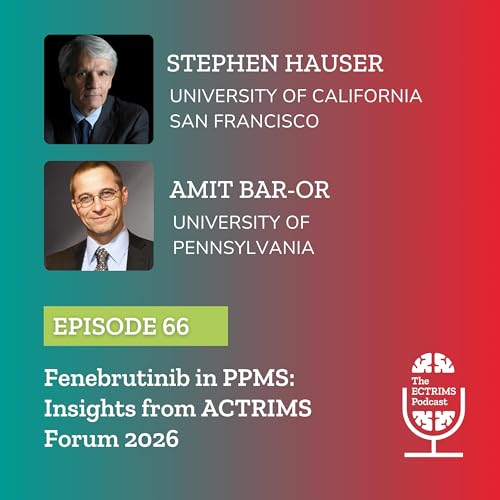
  • Fenebrutinib in PPMS: Insights from ACTRIMS Forum 2026
    Feb 7 2026

    Clinical trial results unveiled today at ACTRIMS Forum 2026 suggest that fenebrutinib may be a novel and effective treatment option for people living with primary progressive multiple sclerosis. In this exclusive episode providing the first expert discussion of the complete dataset, FENtrepid trial leads Prof. Amit Bar-Or (University of Pennsylvania) and Dr. Stephen Hauser (University of California San Francisco) break down what the fenebrutinib results really show. Together, they explore:

    • Why BTK inhibition is uniquely positioned to address progressive MS biology
    • How fenebrutinib compared to ocrelizumab in the Phase 3 FENtrepid PPMS trial
    • What the data suggest for patients with non-relapsing, chronic disease

    Listen for a deep dive into the science and the clinical implications.

    Editorial Note:
    At 21:49, the discussion refers to Müller cells. The correct term is Kupffer cells.

    Download the transcript

    Show More Show Less
    34 mins
  • Harnessing the Gut Microbiome in MS: From Insight to Intervention
    Jan 13 2026

    What role does the gut microbiome play in multiple sclerosis — and how close are we to translating microbiome research into meaningful clinical interventions?

    In this episode of the ECTRIMS Podcast, host Brett Drummond is joined by Mahesh Desai (Luxembourg Institute of Health) and Ashutosh Mangalam (University of Iowa), two internationally recognised leaders in microbiome and MS research, to explore how gut microbes influence disease susceptibility, progression, and immune regulation in MS.

    The discussion moves beyond simple "good vs bad bacteria" narratives, highlighting why microbial function, community structure, and host–microbiome dialogue are far more informative than individual taxa alone. The speakers examine evidence from animal models and human studies, including twin studies, microbial networks, and immune markers such as IgA coating, to understand whether microbiome changes are drivers or consequences of disease.

    They also explore the potential of the gut microbiome as a predictive biomarker, the challenges of causality, and why diet and personalised approaches may be key to restoring immune balance in MS.

    Show More Show Less
    33 mins