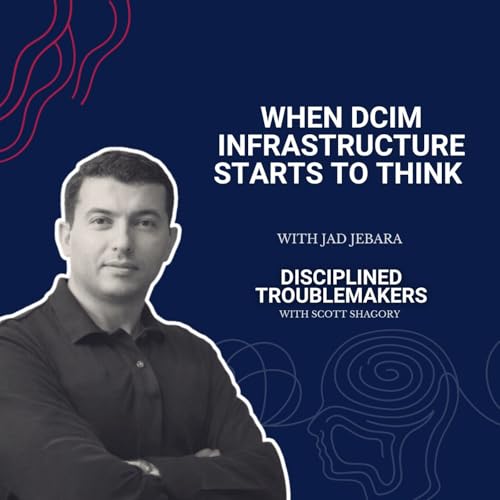
The Disciplined Troublemakers cover art

The Disciplined Troublemakers

The Disciplined Troublemakers

By: Scott Shagory
Listen for free

LIMITED TIME OFFER

£0.99/mo for 3 months - terms apply. Offer ends 24 August 2026.
The Disciplined Troublemakers Podcast is a weekly show exploring how technology CEOs and their teams are scaling, expand profitability, and exiting their companies – on their terms. Hosted by Scott Shagory, Disciplined Troublemakers is designed to provide technology CEOs and leaders with insights they can use immediately in their companies and organizations.Copyright Heartcast Media Economics Leadership Management & Leadership Marketing Marketing & Sales
Episodes
  • Scaling SaaS Security: Cybersecurity for Tech CEOs with Roselle Safran
    Jul 21 2026
    What happens when security finally speaks the language of the business?

    Most cybersecurity teams are working harder than anyone in the building knows. They are triaging threats, patching vulnerabilities, and running on fumes, and almost none of it lands with the board, the CFO, or the CEO in a way that actually registers. That gap is not a communication problem. It is a structural one.

    For technology CEOs and founders scaling SaaS companies, the question of how to connect security operations to business outcomes is one of the most underrated scaling decisions you will make. Get it wrong and you are protecting everything equally, which means you are protecting nothing strategically. Get it right and your security posture becomes a genuine competitive asset.

    Roselle Safran knows this terrain from every angle. She led cybersecurity operations at the Executive Office of the President during the Obama administration, built and sold an incident response platform to McAfee, and is now the CEO and founder of KeyCaliber, a cybersecurity company helping MSSPs and enterprise customers understand what they have, what matters most, and where their real exposures are. She is a Princeton engineering graduate, a frequent speaker on cybersecurity and entrepreneurship, and one of the clearest thinkers in the field on the gap between security jargon and business reality.

    Key Takeaways

    Security teams that skip the identification layer and jump straight to detection and response are building on an unstable foundation, because you cannot protect what you do not know you have.

    Pricing by number of assets creates friction because organizations almost always undercount, and discovering 3,000 assets they did not know existed is a hard conversation when the invoice is tied to that number.

    Shadow AI is the new shadow IT, and employees dumping sensitive data into unapproved tools are not being reckless, they are just trying to meet a deadline, which is why awareness training matters more than policy alone.

    Rebuilding a product to be AI native is not just a technology decision, it is a way to erase years of accumulated tech debt that was quietly becoming a ceiling on what the team could ship.

    Doubling down on existing customer segments, MSSPs, managed service providers transitioning to MSSPs, and enterprise, is a more disciplined growth path than chasing new markets when the product is still maturing.

    Roselle Safran said, "If you can say we had some major risks related to our critical business applications and we have addressed that, so now we have less risk of our revenue not flowing, that makes sense to someone who does not understand security."

    Host Scott Shagory said, "Real maturity is when it's considered to be a strategic asset, that is cybersecurity."

    Timestamps

    00:00 Welcome and guest introduction
    01:06 The founding frustration behind KeyCaliber
    03:15 Why security teams struggle to connect to business outcomes
    07:31 Where cybersecurity sits in the org and why it matters
    09:21 How the threat landscape has shifted since Roselle's first startup
    12:48 Who KeyCaliber's ideal customer is and what they misunderstand
    15:39 The NIST CSF pyramid and why identify is the unglamorous foundation
    18:18 Shadow AI, unapproved tools, and the awareness training response
    21:53 When prospects think they can build asset inventory themselves
    26:13 How KeyCaliber prices to avoid asset count disputes
    29:58 How Roselle protects time for the work she actually enjoys
    34:44 The decision to go AI native and erase years of tech debt
    37:03 Best practices for companies navigating a legacy architecture refactor
    40:19 What the next 12 to 18 months look like for KeyCaliber
    45:32 Making cybersecurity language accessible to non security audiences
    48:23 How to reach Roselle and wrap

    Connect with Roselle Safran

    LinkedIn: https://www.linkedin.com/in/rosellesafran
    Email: roselle@keycaliber.com
    Website: https://www.keycaliber.com

    Show More Show Less
    53 mins
  • Embedding Security as a Growth Engine with Jon McLachlan
    Jul 7 2026
    What if your security program was your best sales tool?

    Most B2B SaaS founders treat security as a cost center, something to minimize, budget around, and deal with only when it bites them. Jon McLachlan has spent years making the case that this framing is exactly backwards, and the founders who get that earliest tend to scale the fastest.

    This episode gets into the real mechanics of scaling SaaS companies with security embedded from the start, not bolted on. For technology CEOs and operators weighing build versus buy decisions, the conversation around fractional security teams versus in-house hiring is one of the most honest you will hear on the topic of B2B software scaling.

    Jon McLachlan is the CEO and co-founder of Ysecurity.io, where he helps SaaS companies build practical embedded security and compliance programs without slowing down product development. He also leads Cyberbase AI, focused on the intersection of AI and cybersecurity, and co-hosts the Security Podcast of Silicon Valley, now over 90 episodes deep. Jon started Ysecurity almost by accident, helping founder friends who needed security guidance, and grew the team to more than 45 people through referrals alone.

    Key Takeaways

    Bootstrapping a security firm through referrals is possible when trust is the product: every client at Ysecurity has come through word of mouth, a signal that founders are handing over the keys to people they already believe in.

    The fractional security team model solves a real gap in B2B software scaling: founders can rent an entire embedded security function, from vCISO to red teaming to GRC, without the complexity of building an in-house team from zero.

    Checkbox security is a floor, not a ceiling: SOC 2 Type 2 and ISO certifications matter for sales cycles, but the real return on investment comes from integrating security into marketing, sales training, and product positioning so it opens new business.

    Chasing enterprise clients when your DNA is startup-focused is a costly detour: Ysecurity tried repositioning for large publicly traded organizations, landed a few deals, and found the red tape incompatible with their speed and culture, a pivot that clarified everything.

    Founder mental health deserves more airtime than it gets: with depression rates among tech founders estimated around 43 percent compared to roughly 9 percent in the general population, protecting personal recovery time, whether running, cycling, or scheduling unstructured space, is an operational decision, not a luxury.

    Jon McLachlan said, "Security is not just this little box on the side that we should think of as a cost center. The right way to do this stuff is really to integrate it into the entire organization. It is an investment in every sense of the word, and you should expect it to pay off."

    Host Scott Shagory said, "Sell security without selling security, to overgeneralize. If you can do that, it is just such a potent message, and to be able to really enable gains that are more challenging and yet at the same time provide genuine security, it is not just a checkoff list."

    Timestamps
    00:00 Welcome and guest introduction
    01:05 Why Jon and his co-founder Sasha started Ysecurity
    02:50 ICP focus: organic growth toward B2B SaaS and AI-enabled companies
    03:33 Why ideal customers sometimes still say no, build versus buy
    08:47 Scaling from 2 to 45 people: culture, remote work, and staying connected
    12:38 Decisions that created disproportionate leverage, and the enterprise pivot mistake
    15:17 Selling security as a growth engine, not a cost center
    18:19 Where the market undervalues or oversimplifies embedded security
    23:43 What work founders must protect: running, biking, and personal recovery
    27:22 Silicon Valley pressure, 996 culture, and how Jon navigated a difficult personal period
    34:49 What the next 12 to 18 months look like for Ysecurity and Cyberbase AI
    37:42 Networking effects, trust, and why referrals are the whole game
    42:11 Conviction, authenticity, and what the best founder relationships actually feel like
    44:25 Where to connect with Jon and closing thoughts

    Connect with Jon McLachlan

    LinkedIn: https://www.linkedin.com/in/jonmclachlan

    Ysecurity: https://www.ysecurity.io

    Cyberbase AI: https://www.cyberbase.aiS

    ecurity Podcast of Silicon Valley: available on major podcast platforms
    Show More Show Less
    48 mins
  • When DCIM Infrastructure Starts to Think with Jad Jebara
    Jan 6 2026
    Scott Shagory opens Disciplined Troublemakers with a scene many leaders know well: complex infrastructure, rising costs, and the pressure to scale without surprises. Across the table sits Jad Jebara, the co-founder, President, and CEO of Hyperview, who has turned hard-earned lessons into a cloud-native DCIM platform built for clarity and speed.

    Jad’s path runs through two corporate turnarounds—at Peer 1 Hosting, where disciplined execution helped drive a $650MM acquisition by Cogeco, and at IDS Software, which was acquired by PDF Solutions. He’s led finance, supply chain, and IT; run a consulting firm on ERP and process design; and built a career at the intersection of finance and technology. That background now fuels Hyperview’s product-led approach: self-serve deployment, transparent pricing, and global scale without the bloat.

    In this conversation, Scott follows the thread from problem to practice: how operators move from scattered systems to a single source of truth; how data center teams balance utilization, ESG, and AI-era demand; and how a CEO’s four Rs—responsibility, realism, reflection, and resilience—shape decisions when the stakes are high.

    If you work in or around critical infrastructure, this story offers a practical map: what to measure, how to act, and how to lead when growth arrives all at once. Press play.

    Chapters:

    00:00 - Intro
    00:09 - Entrepreneurship, Scaling, and Insights
    03:50 - "Reinventing DCIM for Sustainable Infrastructure"
    07:41 - Data Centers and Rising Costs
    10:43 - Scaling for Global Data Solutions
    16:51 - "Optimizing Industry Sustainability Metrics"
    20:54 - Comprehensive Infrastructure Monitoring Solution
    23:33 - "Clear AI Roadmap and Vision"
    25:40 - "Product-Led Growth and Strategy"
    30:44 - Complexity in Tech and Strategy
    34:56 - Founder Challenges and Growth Insights
    37:19 - Driving Network, AI, and Growth
    42:19 - AI's Impact and Leadership Evolution
    45:34 - Reflection, Responsibility, Resilience
    48:43 - "Empathy and a Learner Mindset"
    51:15 - "Discipline Troublemakers Podcast Outro"
    51:26 - Outro

    Quotes:

    "Make critical infrastructure think. Build the tools we needed. With vision and a learner’s mindset, curiosity becomes an impact."- Jad Jebara

    "Make the complex simple so others can win. Trust, clarity, and connection matter as much as the tech."- Scott Shagory

    Key Takeaways:

    From Frustration to Innovation
    Making Critical Infrastructure Think
    Redefining Data Center Management
    Scaling Globally, Collaborating Locally
    Sustainability With Real Impact
    Leading With Joy and Resilience
    Product Led, Customer Driven

    Connect with the Guest: Jad Jebara
    LinkedIn: https://www.linkedin.com/in/jadjebara/
    Website:https://hyperviewhq.com/

    Connect with the Host: Scott Shagory
    Website: http://purplefinchgroup.com
    LinkedIn: http://linkedin.com/in/scottshagory
    Email: scott@purplefinchgroup.com

    Sponsor: Purple Flinch Group
    https://www.purplefinchgroup.com/

    Powered by:http://heartcastmedia.com/
    Show More Show Less
    52 mins
adbl_web_anon_alc_button_suppression_t1
No reviews yet