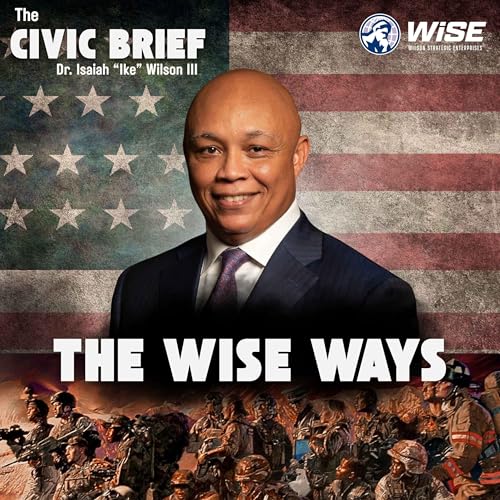
The Civic Brief cover art

The Civic Brief

The Civic Brief

By: Dr. Isaiah (Ike) Wilson III
Listen for free

Explore civic engagement, global affairs, and national security through real stories that connect public policy, systems thinking, and everyday life. The Civic Brief unpacks how domestic and international issues are colliding at the local level, reshaping how we live, lead, and make sense of a rapidly evolving world. Hosted by Dr. Isaiah “Ike” Wilson III, this podcast bridges the gap between abstract policy and real human impact. From political polarization to economic instability, climate disruption to global conflict, this podcast helps listeners navigate complexity with clarity. It explores the intersections of foreign policy, civic breakdown, and leadership under pressure. These aren't distant headlines. They are systems-level challenges that affect communities, households, and individuals in real time. Dr. Wilson brings over 40 years of leadership across military, academic, and public service domains. His experience spans national security, civic strategy, education reform, and diplomacy. With each episode, he brings that perspective to bear through compelling solo insights and thought-provoking interviews with experts who have lived and led through complexity. These guests include policy makers, military leaders, educators, and civic and commercial innovators who understand how change really happens. The podcast explores a wide range of core themes including civic engagement, global affairs, public trust, political polarization, compound security, and long-term strategic foresight. It brings together systems thinking, leadership, and cross-sector innovation to offer listeners the tools to think critically and act ethically. A standout feature of The Civic Brief is the “Walk With Me” audio series. These immersive narrative experiences imagine near future scenarios guided by the lessons of historic visionaries such as Nelson Mandela, Dwight Eisenhower, and Dr. Martin Luther King Jr. These speculative futures are not just stories. They are creative civic tools designed to stretch our imagination, expand our understanding of possibility, and invite strategic reflection on what comes next. The show is part of the Professors Without Portfolio initiative, a strategic audio-visual extension of Wilson W.i.S.E. Consulting LLC. This platform reclaims public knowledge as a shared civic resource and connects diverse voices across disciplines, generations, and sectors. The goal is to democratize expertise, break institutional silos, and create a new kind of civic-intellectual commons. Whether you are a policymaker, educator, strategist, student, or concerned citizen, The Civic Brief gives you the insights and foresight to better understand today’s biggest challenges and contribute meaningfully to tomorrow’s solutions. This podcast is for those ready to engage deeply, think broadly, and help shape a more resilient and just society. About the host: Dr. Ike Wilson III is a scholar-practitioner, retired U.S. Army colonel, and founder of Wilson W.i.S.E. Consulting LLC. He is widely respected for his work in national security strategy, civic education, and interdisciplinary leadership. Through his platforms, he is building civic capacity and ethical leadership to meet the demands of our most complex challenges. You can find The Civic Brief on Spotify, Apple Podcasts, YouTube, and all major podcast platforms. Subscribe now to access the latest episodes, exclusive narratives, and expert perspectives. Resource Links: Website Ike Wilson: https://wilsonwise.com/ Think Beyond War: https://thinkbeyondwar.com/ Substack Ike Wilson: https://compoundsecurityunlocked.substack.com/ Consulting and Projects: Wilson W.i.S.E. Consulting LLCCopyright 2026 Dr. Isaiah (Ike) Wilson III Political Science Politics & Government Social Sciences World
Episodes
  • Walk With Me: Hope and Realism in a Hardening World
    Apr 15 2026
    In this episode of The Civic Brief, Dr. Isaiah “Ike” Wilson III explores the critical balance between hope and realism in today’s hardening global landscape. Drawing on the moral leadership of Reverend Jesse Jackson and the strategic insights of E. H. Carr, he argues that hope is not naïve—it is disciplined and essential to sustaining legitimacy. Revisiting the lessons of Munich 1938, Wilson highlights how humanitarian failure and institutional erosion often precede larger crises. As nationalism rises and global systems strain, he warns that power without restraint corrodes, while idealism without enforcement collapses. The path forward requires both: hope anchored in realism, and realism grounded in restraint—before history’s warnings become consequences.What You’ll Learn in This Episode:✅ Why hope is a strategic asset, not a naïve ideal, in global leadership✅ How humanitarian policy functions as preventative security, not charity✅ The dangers of separating moral aspiration from power realities✅ Why rising nationalism must remain embedded within institutions✅ How lessons from the 1930s apply directly to today’s geopolitical environmentJoin the Travelers Community and explore resources at Wilson WiSE Consulting, as well as at Dr. Wilson’s companion Substack Newsletter, “Compound Security, Unlocked,” where you can share insights, ask questions, and help shape the future—one brief at a time.Wilson WiSE Consulting Website: https://wilsonwise.com/Substack: https://compoundsecurityunlocked.substack.com/Key Timestamps:00:00 Welcome to The Civic Brief: Opening reflection: history whispers before it warns00:55 Walking with Jesse Jackson: hope as strategy01:34 Lessons from the Munich Agreement02:45 Post-1945 humanitarian architecture and “never again”03:22 The modern “hardening world” and shrinking humanitarianism04:04 Why humanitarianism is upstream security05:21 Walking with E. H. Carr05:58 The Twenty Years' Crisis explained06:35 Nationalism and institutional breakdown07:39 Present-day parallels: fragmentation and polarization08:44 The balance between hope and realism09:49 Critical questions for the modern West10:25 Closing reflection: history’s warnings and choicesKey Takeaways:💎Hope is a strategic discipline, not an emotional luxury. Hope, as framed through Jesse Jackson’s legacy, is not passive optimism. It is an active commitment to dignity, restraint, and institutional responsibility—especially in times of uncertainty.💎Humanitarianism is foundational to security, not separate from it. The lesson of the 1930s is clear: when compassion erodes, instability grows. Refugee crises, famine, and inequality are not side issues—they are catalysts for conflict and extremism.💎Realism without restraint leads to systemic corrosion. E. H. Carr’s warning remains urgent. Power must be exercised within rules and institutions. Without restraint, strength becomes destabilizing rather than stabilizing.💎Nationalism must remain embedded within institutions. Unchecked nationalism fractures cooperation and accelerates conflict. The post-1945 order succeeded because it balanced sovereignty with multilateral frameworks.💎The greatest risk is not ignorance—but dismissal. History offers warnings before consequences. The danger lies in recognizing patterns but choosing to ignore them until it is too late.Resources & Mentions:Apple Podcast- The Civic BriefSpotify - The Civic BriefYouTube- The Civic BriefWilson WiSE Consulting Website: https://wilsonwise.com/Connect with Dr. Wilson on LinkedIn: https://www.linkedin.com/in/dr-ike-wilson/Think Beyond War: https://thinkbeyondwar.com/Subscribe to the Substack Community to join the discussion, share your insights, and help defend the guardrails of democracy: https://compoundsecurityunlocked.substack.com/Tags:Civic Engagement Podcast, National Security and Public Policy, Leadership and Strategy Podcast, Dr. Ike Wilson Podcast, The Civic Brief, hope and realism in international relations, Jesse Jackson keep hope alive meaning, EH Carr realism theory, Munich 1938 lessons today, humanitarianism as security strategy, rise of nationalism global politics, transatlantic relations 2020s, global institutional decline, geopolitical realism vs idealism, democratic legitimacy and security, compound insecurity global system, modern international relations strategy, lessons from 1930s Europe, balancing power and principle, global order under strain
    Show More Show Less
    11 mins
  • The W.i.S.E. Way Applied: EU Collective Defense Industrial Sovereignty
    Apr 8 2026
    What happens when Europe can no longer rely on old security assumptions? In this episode of The Civic Brief, Dr. Isaiah "Ike" Wilson III applies his W.i.S.E. Way framework to one of the defining geopolitical questions of our time: how Europe can build collective defense industrial sovereignty while preserving the transatlantic alliance.Drawing on the principles of defense, diplomacy, development, and commercial integration, Dr. Wilson explains why Europe must move beyond fragmented military procurement and toward a more resilient, NATO-compatible security architecture. He explores the need for shared munitions production, coordinated logistics, STEM workforce development, and stronger connections between defense systems and commercial technologies like artificial intelligence, cyber infrastructure, and quantum computing.The episode also moves beyond strategy and into the foundations of democratic legitimacy. Dr. Wilson argues that durable security abroad depends on institutional trust and civic stability at home. Through a discussion of majority rule, minority rights, and the lessons of post-World War II Europe, he explains why democratic resilience is inseparable from national and collective defense.If you are interested in NATO, European defense, transatlantic relations, democracy, or the future of global security, this episode offers a practical and thought-provoking roadmap.What You’ll Learn in This Episode:✅ Why Europe’s fragmented defense system leaves the continent vulnerable in a new era of geopolitical competition✅ How Dr. Wilson’s W.i.S.E. Way framework combines defense, diplomacy, development, and commercial power✅ Why NATO compatibility matters even as Europe pursues greater defense sovereignty and strategic autonomy✅ How technologies like AI, cyber infrastructure, and quantum computing are transforming modern defense industries✅ Why democratic legitimacy, institutional trust, and minority rights are critical to long-term national and collective securityJoin the Travelers Community and explore resources at Wilson WiSE Consulting, as well as at Dr. Wilson’s companion Substack Newsletter, “Compound Security, Unlocked,” where you can share insights, ask questions, and help shape the future—one brief at a time.Wilson WiSE Consulting Website: https://wilsonwise.com/Substack: https://compoundsecurityunlocked.substack.com/Key Timestamps:00:00 Welcome to The Civic Brief: Today’s W.i.S.E. Way Framework01:32 Why anticipating compound risks is essential03:28 Applying the W.i.S.E. Way to Europe’s defense future04:17 The “3D times C” framework explained05:13 Europe’s defense fragmentation problem05:56 The need for joint military production and shared logistics06:20 Why European defense sovereignty must remain NATO-compatible07:00 Strategic autonomy versus strategic isolation07:14 The role of education, skilled labor, and development07:51 How AI, cyber, and commercial technology shape defense08:17 What a polycentric defense architecture looks like09:26 Why resilience matters more than centralized control10:19 The connection between security and civic legitimacy11:37 Majority rule and minority rights in democratic systems14:10 Final reflections on protecting democracy and the transatlantic allianceKey Takeaways:💎 Europe’s defense challenge is structural, not simply political. Fragmented procurement systems and duplicated military efforts make Europe less resilient in a rapidly changing security environment.💎 The W.i.S.E. Way framework shows that modern security requires integration across defense, diplomacy, development, and commercial innovation. No single pillar can succeed alone.💎 Europe can strengthen its own defense sovereignty without weakening NATO. Strategic autonomy should reinforce the alliance, not replace it.💎 Distributed “polycentric” defense systems are more resilient than centralized ones. Shared capability across multiple nations reduces vulnerability and increases flexibility.💎 Strong democratic institutions remain the foundation of long-term security. Respect for minority rights, institutional trust, and civic legitimacy are essential to preventing instability.Resources & Mentions:Apple Podcast- The Civic BriefSpotify - The Civic BriefYouTube- The Civic BriefWilson WiSE Consulting Website: https://wilsonwise.com/Connect with Dr. Wilson on LinkedIn: https://www.linkedin.com/in/dr-ike-wilson/Think Beyond War: https://thinkbeyondwar.com/Subscribe to the Substack Community to join the discussion, share your insights, and help defend the guardrails of democracy: https://compoundsecurityunlocked.substack.com/Related Readings:“The Compound Security Dilemma of the Western Defense-Industrial Base “A 'General Theory of Compound Security' (GToCS) Narrative Analysis of Fragility, Transition, and the Future Arsenal(s) of Democracy(ies),” Isaiah Wilson III (Dec 06, 2025)“How Europe Must De-Risk the Transatlantic Relationship,” Isaiah ...
    Show More Show Less
    15 mins
  • How Europe Must De-Risk the Transatlantic Relationship
    Apr 1 2026
    For 75 years, the transatlantic alliance has depended on both American power and American predictability. In this solo episode of The Civic Brief, Dr. Isaiah “Ike” Wilson III argues that while the United States remains powerful, its reliability across political cycles can no longer be assumed. As a result, Europe is beginning to “de-risk” its relationship with Washington—not by abandoning the alliance, but by reducing its dependence on it.Drawing on the 2026 World Economic Forum in Davos, the Munich Security Conference, and the EU Security and Defense Forum in Brussels, Dr. Wilson identifies a deeper shift underway. Davos revealed the rise of geoeconomics and resilient supply chains. Munich exposed growing European concern about American political volatility. Brussels signaled Europe’s institutional response: building greater sovereignty in defense, energy, technology, and political resilience.Dr. Wilson emphasizes that de-risking is not the same as decoupling. Europe is not turning away from the United States; it is preparing for the possibility of a less predictable America. That means investing in indigenous defense capacity, diversified energy systems, semiconductors, artificial intelligence, cyber defense, and more resilient democratic institutions.The discussion also highlights the growing importance of middle powers like France, Japan, Canada, India, and Australia. In a world shaped by “compound insecurity,” where economic, technological, and geopolitical threats overlap, these countries may play a decisive role in maintaining global stability.Ultimately, Dr. Wilson argues that the transatlantic alliance must evolve from dependency to reciprocity. In an era of uncertainty, resilient partnerships will depend less on unquestioned reliance and more on shared capability and mutual responsibility.What You’ll Learn in This Episode:✅Why Europe is beginning to “de-risk” its relationship with the United States✅How the World Economic Forum, Munich Security Conference, and EU Defense Forum revealed a changing global order✅Why Europe is investing in greater defense, energy, and technology sovereignty✅How middle powers like France, Japan, India, and Canada are becoming more influential in global strategy✅Why the future of the transatlantic alliance depends on reciprocity rather than dependencyJoin the Travelers Community and explore resources at Wilson WiSE Consulting, as well as at Dr. Wilson’s companion Substack Newsletter, “Compound Security, Unlocked,” where you can share insights, ask questions, and help shape the future—one brief at a time.Wilson WiSE Consulting Website: https://wilsonwise.com/Substack: https://compoundsecurityunlocked.substack.com/Key Timestamps:00:00 Welcome to The Civic Brief: Compound insecurity and the transatlantic alliance02:37 Why Davos, Munich, and Brussels matter together03:37 Europe begins to de-risk the transatlantic relationship04:26 The rise of geoeconomics and resilient supply chains05:39 Munich reveals concern about American reliability07:09 Brussels and Europe’s strategy of “strategic de-risking”07:57 Defense sovereignty: ammunition, air defense, and indigenous capability08:18 Energy security after the Ukraine war08:39 Technology sovereignty and industrial power09:24 Why Europe must de-risk without decoupling10:09 The growing importance of middle powers11:50 Why control of global “nodes” shapes future power12:14 The historical lesson of Munich 193813:21 Compound insecurity and cascading global shocks14:09 The future of the alliance: from dependency to reciprocityKey Takeaways:💎Europe is not abandoning the United States—it is preparing for uncertainty. Europe’s emerging strategy is not anti-American. Rather, it reflects growing concern that U.S. domestic politics may produce greater inconsistency in foreign policy. De-risking means reducing vulnerability to those swings while preserving the alliance.💎The future of security is no longer just military—it is economic, technological, and political. Supply chains, semiconductors, energy systems, cyber defense, and political legitimacy have become essential components of national security. The countries that can secure these domains will shape the next global order.💎Alliances work best when they are reciprocal, not dependent. The transatlantic alliance must evolve from one built on European reliance toward one grounded in shared capability and mutual contribution. Reciprocity creates more durable partnerships than dependency.💎Middle powers are becoming decisive actors in world politics. Countries like France, Canada, Japan, South Korea, Australia, and India may not dominate the global system individually, but collectively they control many of its most important strategic nodes. Their choices will increasingly shape the future balance of power.💎Compound insecurity requires a new kind of strategic thinking. Today’s threats do not remain isolated. Economic ...
    Show More Show Less
    16 mins
adbl_web_anon_alc_button_suppression_t1
No reviews yet