• Profitability Is an Operations Problem, with Sarah Still
    Jul 1 2026
    Points of Interest
    • 00:00 – 01:43 – Introduction: Marcel introduces Sarah Still, Partner and COO at RAYNE IX, and frames the conversation around agency operations, profitability, scaling, and building valuable businesses.
    • 01:44 – 02:28 – Helping Women Build Valuable Agencies: Sarah explains how RAYNE IX works with women agency owners to improve performance, build enterprise value, and prepare for future exit opportunities.
    • 02:29 – 04:33 – From Finance to Agency Operations: Sarah shares how her accounting background led her into agency operations after helping clean up the books of a startup marketing agency.
    • 04:34 – 06:10 – Building RAYNE IX After Agency Leadership: Sarah describes leaving her COO role after 11 years and eventually partnering with Kylie Peters to support women building healthier agencies.
    • 06:11 – 08:39 – Why Focus on Women Agency Owners: Sarah explains the personal and professional motivation behind helping women founders capture the value they are creating in their businesses.
    • 08:40 – 11:32 – Operationalized Leadership: Sarah argues that agencies often miss the importance of defining values, behaviors, standards, and leadership cadences that protect the business as it scales.
    • 11:33 – 13:58 – Clarifying Founder Values: Marcel reflects on how unclear values at Parakeeto led to frustration, poor leadership moments, and delayed decisions around hiring and accountability.
    • 13:59 – 15:43 – Culture as the Result of Enforced Values: Sarah explains that culture is not created through intention alone, but through the behaviors, standards, and values that leaders consistently enforce.
    • 15:44 – 19:18 – The Power of Clear Expectations: Marcel and Sarah discuss how expectations shape leadership, performance, accountability, pricing, forecasting, and enterprise value.
    • 19:19 – 24:52 – Assumptions Before Certainty: Sarah and Marcel explore why agencies should not wait for perfect clarity before taking action, but should make assumptions explicit so results can be compared against expectations.
    • 24:53 – 28:59 – Time Tracking and Precision Traps: Sarah and Marcel discuss why unreliable time-tracking data can be worse than no data, and how agencies often overcomplicate measurement without knowing what question they are trying to answer.
    • 29:00 – 43:38 – Finance, Operations, and Profitability: Sarah and Marcel unpack why profitability is an operational problem made visible through finance, and why agency leaders must understand the tradeoffs between margin, hiring, utilization, pricing, team health, and growth.
    Show Notes
    • RAYNE IX
    • Connect on LinkedIn
      • Sarah Still


    Hosted by Simplecast, an AdsWizz company. See pcm.adswizz.com for information about our collection and use of personal data for advertising.

    Show More Show Less
    43 mins
  • We Take Care of the Money: Parakeeto's New Positioning, Explained, With Kristen Kelly & Carson Pierce
    Jun 17 2026
    Points of Interest
    • 00:01 – 00:53 – Why Revisit Positioning: Carson and Kristen introduce Parakeeto's repositioning effort and explain why they wanted to publicly discuss the evolution of the company's messaging.
    • 00:53 – 02:18 – The Profitability Problem: The discussion explores how Parakeeto's heavy emphasis on profitability created confusion about what the company actually does for clients.
    • 02:18 – 04:21 – The Challenge of Category Creation: Carson and Kristen reflect on attempts to create or fit into categories like FinOps and why unfamiliar categories often create more confusion than clarity.
    • 04:21 – 06:18 – From Profitability to Stewardship: The conversation introduces the new positioning centered around helping agency owners focus on building their businesses while Parakeeto takes care of the money.
    • 06:18 – 09:11 – The Emotional Side of Finance: Carson shares how financial discomfort and avoidance can affect decision-making and explains why confidence is a critical outcome of financial stewardship.
    • 09:11 – 11:31 – What Taking Care of the Money Means: Kristen outlines the practical components of Parakeeto's approach, including accounting, forecasting, reporting, and operational guidance.
    • 11:31 – 13:19 – Agency-Specific Financial Expertise: Carson explains how deep agency experience allows Parakeeto to interpret financial data within the operational realities of agency businesses.
    • 13:19 – 15:06 – Turning Financial Insights into Action: The discussion highlights the importance of translating financial reporting into operational recommendations that improve agency performance
    • 15:06 – 17:37 – Expanding into Accounting and Bookkeeping: Kristen explains how bringing bookkeeping and accounting services in-house creates continuity between financial data and strategic decision-making.
    • 17:37 – 19:54 – The Agency CFO Perspective: The conversation explores why the title "Agency CFO" better communicates Parakeeto's blend of financial expertise and operational advisory support.
    • 19:54 – 24:13 – Who Benefits Most from This Approach: Carson and Kristen discuss ideal client profiles, including agencies crossing the $1M mark and larger firms seeking greater visibility and clarity.
    • 24:13 – 28:19 – Building Confidence Through Partnership: The episode concludes with a discussion about education, long-term partnerships, and helping agency owners feel more confident managing the financial side of their businesses.
    Show Notes
    • Free Agency Toolkit
    • Parakeeto Foundations Course
    • Free access to our Model Platform
    • Connect on LinkedIn
      • Carson Pierce
      • Kristen Kelly

    Hosted by Simplecast, an AdsWizz company. See pcm.adswizz.com for information about our collection and use of personal data for advertising.

    Show More Show Less
    28 mins
  • Shifting From Operator to Owner, With Jason Swenk
    Jun 4 2026
    Points of Interest
    • 00:00 – 02:12 – Jason Swenk's Agency Journey: Jason shares how he accidentally started an agency in 1999, grew it to more than 100 employees, sold it after 11 years, and eventually transitioned into coaching agency owners worldwide.
    • 02:12 – 06:22 – Designing a Lifestyle Business: Jason explains how agency owners often aspire to more freedom and flexibility, sharing how he structures his own workweek and prioritizes experiences outside of work.
    • 06:23 – 10:14 – Escaping the Operator Trap: Jason introduces an exercise that helps founders identify the tasks they dislike and begin designing their business around their strengths instead of remaining stuck in daily operations.
    • 10:15 – 13:19 – The Manager Stage and Delegation Challenges: The conversation explores why many founders struggle after hiring employees and how poor delegation often creates more work rather than less.
    • 13:20 – 16:50 – Building Trust and Better Decision-Making: Jason explains the 1-3-1 framework for problem solving and discusses how leaders can develop trust while allowing team members to learn through small mistakes.
    • 16:51 – 19:41 – The CEO Identity Shift: The discussion focuses on how founders must evolve their role as the business grows, moving from execution toward vision, coaching, and strategic leadership.
    • 19:42 – 22:17 – Becoming an Architect: Jason outlines the Architect stage, where leaders create systems, processes, and frameworks that allow teams to operate independently without constant oversight.
    • 22:18 – 24:09 – AI as a Founder Knowledge System: The conversation explores how agency owners can use AI to capture expertise, document decision-making processes, and reduce dependency on the founder.
    • 24:10 – 27:31 – Avoiding the Rubber Band Effect: Jason explains how founders often sabotage growth by reverting to old habits and stepping back into roles their team is capable of handling.
    • 27:32 – 30:31 – The Difference Between CEO and Owner: The discussion examines the Owner stage, where the business no longer relies on the founder for day-to-day decisions and leadership functions.
    • 30:32 – 34:30 – Growing Leaders Within the Organization: Jason shares insights on helping employees develop their own careers while recognizing that not everyone wants to move into leadership positions.
    • 34:31 – 41:02 – Building a Business Around Your Goals: The episode concludes with Jason discussing his book, Operator to Owner, and emphasizing that agency owners should intentionally design businesses that align with their desired lifestyle and ambitions.
    Show Notes
    • Agency Mastery Website
    • Operator to Owner book details
    • Smart Agency Masterclass Podcast
      • The Seth Godin Episode
    • Upcoming Events
    • Epic Friday
    • Jason Swenk on LinkedIn

    Hosted by Simplecast, an AdsWizz company. See pcm.adswizz.com for information about our collection and use of personal data for advertising.

    Show More Show Less
    41 mins
  • Cash Flow & The Future of AI, With Colin Hewitt
    May 20 2026
    Points of Interest
    • 00:00 – 01:00 – Introduction: Marcel welcomes Colin Hewitt, CEO and founder of Float, and frames cash flow as the lifeblood every agency depends on.
    • 01:01 – 02:09 – The Origin of Float: Colin shares how running his own agency exposed the limits of spreadsheet-based forecasting and led him to build a cash flow product for service businesses.
    • 02:10 – 05:24 – Direct vs Indirect Cash Flow Methods: A look at why traditional P&L-derived forecasts age the moment they are finished, and how a hybrid direct method delivers a forecast owners can trust day-to-day.
    • 05:24 – 07:31 – Why Agency Cash Flow Is Uniquely Complex: Retainers, milestone billing, and time-and-materials projects each behave differently — modeling them well requires more nuance than most generic tools provide.
    • 07:32 – 09:09 – The Trade-Offs of Outsourcing the Forecast: When forecasting is handed off entirely, owners often lose the context behind the numbers and end the month more confused than clear.
    • 09:09 – 12:48 – Precision vs Accuracy in a Forecast: Colin and Marcel discuss the tension between infinitely precise forecasts and forecasts that owners will actually maintain — and how to find the right level for the business.
    • 12:48 – 14:07 – Mapping Budgets to the Accounting System: A deliberate separation between transactional accounting detail and forward-looking budget categories keeps the forecast usable without doubling the work.
    • 14:07 – 16:54 – Cash Flow Strategy When Things Get Tight: Visibility into the next 30, 60, and 90 days lets owners distinguish a temporary blip from a structural issue — and decide what to push, chase, or restructure.
    • 16:54 – 18:47 – Pulling Cash Forward and Deferring Expenses: A short walk-through of practical levers — invoice financing, payment timing, expense sequencing — and a pointer to a deeper episode on the topic.
    • 18:47 – 21:10 – AI's Impact on Software and Agencies: Colin reflects on what is changing for SaaS founders and what is opening up for agencies as the cost of building software falls.
    • 21:10 – 23:43 – Where Software Moats Hold Up in an AI World: A candid view on which products remain defensible — auditability, trust, collaboration — and which become commoditized prompts.
    • 23:43 – 27:23 – When Conversational Interfaces Replace UIs: A near-future where owners interact with agents instead of dashboards, and the underlying systems quietly stay in sync.
    • 27:23 – 30:43 – Sustainability and Boundaries Around AI Work: A frank conversation about the pull of constant tinkering, the risk of AI-driven bloat, and the case for considered, well-crafted decisions.
    • 30:43 – 35:20 – Speed vs Velocity, and Closing Thoughts: When everything can be built, the discipline shifts to choosing what to build — and Colin shares where listeners can follow along with Float.
    Show Notes
    • Float Website
    • Colin Hewitt on LinkedIn
    • The Definitive Guide to Improving Your Agency's Cash Flow with Carson Pierce – Ep.210


    Hosted by Simplecast, an AdsWizz company. See pcm.adswizz.com for information about our collection and use of personal data for advertising.

    Show More Show Less
    35 mins
  • Inside a Boutique Agency Holdco, With Sei-Wook Kim
    May 6 2026
    Points of Interest
    • 00:01 – 00:38 – Introduction: Marcel introduces Sei-Wook Kim, co-founder of Barrel and Barrel Holdings, highlighting his experience building and scaling multiple agencies.
    • 00:38 – 01:31 – What Barrel Holdings Does: Sei-Wook explains their holdco structure, managing a portfolio of independent, specialized marketing agencies with a long-term acquisition strategy.
    • 01:31 – 03:31 – Origin of the Holdco Model: The conversation explores how Barrel evolved from a single agency into multiple businesses through spin-offs and organic opportunities.
    • 03:31 – 04:56 – Shift from Incubation to Acquisition: Sei-Wook shares why they moved from building agencies from scratch to acquiring established firms to accelerate growth.
    • 04:56 – 06:07 – Independent Portfolio vs Roll-Up Strategy: They discuss why Barrel Holdings avoids the traditional roll-up model in favor of independently operated agencies with separate P&Ls.
    • 06:07 – 07:31 – Long-Term Investment Philosophy: Sei-Wook explains their long-term hold strategy, focusing on durability, adaptability, and avoiding short-term exit pressure.
    • 07:31 – 09:09 – Capital Strategy and Self-Funding: The discussion covers their decision to fund acquisitions through internal capital and debt rather than external investors.
    • 09:09 – 12:52 – What Makes an Agency Attractive: Sei-Wook outlines key acquisition criteria, including specialization, recurring revenue, and strong leadership teams.
    • 12:52 – 15:06 – Challenges in Financial Diligence: They break down common issues in agency financials, including inconsistent revenue tracking and unclear cost structures.
    • 15:06 – 17:29 – Understanding True Profitability: The conversation highlights how to normalize owner compensation and adjust financials to reflect true EBITDA.
    • 17:29 – 21:01 – Operating Model and Performance Metrics: Sei-Wook explains their weekly and quarterly cadence, including key metrics like revenue, expenses, and pipeline forecasting.
    • 21:01 – 35:43 – Forecasting, Scaling, and the Impact of AI: The episode closes with insights on forecasting discipline, scaling leadership across multiple agencies, and how AI may reshape agency value and delivery.
    Show Notes
    • Sei-Wook Kim on LinkedIn
    • Peter Kang on LinkedIn
    • Agency Habits Website
    • Barrel Holdings Website

    Hosted by Simplecast, an AdsWizz company. See pcm.adswizz.com for information about our collection and use of personal data for advertising.

    Show More Show Less
    37 mins
  • Profitability Sequencing: How Agencies Maximize Margins, With Kristen Kelly
    Apr 22 2026
    Points of Interest
    • 00:01 – 02:30 – The Cost of Poor Sequencing: Marcel and Kristen introduce the core issue—agencies often apply the right tactics in the wrong order, leading to wasted effort and stalled profitability.
    • 02:30 – 05:00 – The Insight Formula: They explain that data alone is meaningless without context, introducing the key concept that insight comes from comparing expectations to reality.
    • 05:00 – 06:30 – Start with a Business Model: Agencies should begin by building a model of their business to define what success should look like before measuring performance.
    • 06:30 – 08:30 – The Danger of Starting with Data: Many firms overinvest in tracking actuals first, only to realize they lack the benchmarks needed to interpret the data effectively.
    • 08:30 – 10:30 – Why Expectations Come First: Establishing expectations is faster, requires no new data, and is essential for designing meaningful feedback loops.
    • 10:30 – 12:30 – Misguided Pricing and Benchmarking: Agencies often rely on market benchmarks instead of internal cost structures, leading to misaligned pricing and profitability issues.
    • 12:30 – 14:30 – Framework vs. Frankenstein Metrics: Combining disconnected industry formulas creates inconsistent and unreliable financial insights, highlighting the need for a unified framework.
    • 14:30 – 17:00 – Forecasting as the Next Step: Once a model is established, agencies must forecast workload and capacity, starting with clear scope and effort assumptions.
    • 17:00 – 20:00 – The Precision Trap in Forecasting: Overly detailed planning creates friction and reduces adaptability; executive-level forecasting should prioritize accuracy over precision.
    • 20:00 – 22:30 – The Power of Forecasting Without Time Tracking: A strong forecast can provide meaningful insight even without detailed time-tracking data.
    • 22:30 – 25:30 – Installing Feedback Loops: Feedback loops help refine assumptions and uncover operational issues by comparing planned vs. actual performance.
    • 25:30 – 30:00 – Prioritizing Profitability Levers: Marcel outlines the correct order for improving profitability—starting with overhead (if needed), then utilization, followed by pricing (effective rate), and finally cost structure.
    Show Notes
    • Connect with Kristen via LinkedIn
    • Free Agency Toolkit
    • Parakeeto Foundations Course
    • Free access to our Model Platform

    Hosted by Simplecast, an AdsWizz company. See pcm.adswizz.com for information about our collection and use of personal data for advertising.

    Show More Show Less
    38 mins
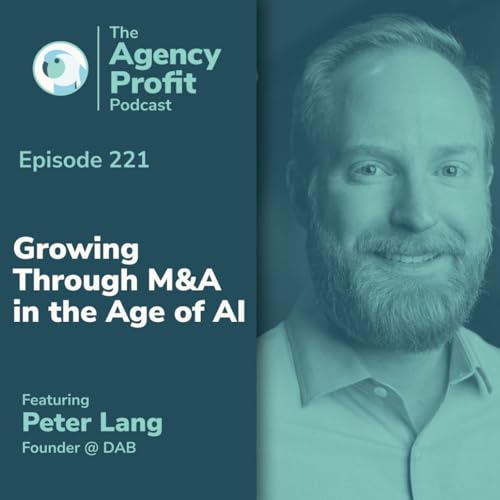
  • Growing Through M&A in the Age of AI, With Peter Lang
    Apr 8 2026
    Points of Interest
    • 00:0100:38Introduction: Marcel opens the episode by introducing Peter Lang as an entrepreneur, investor, and operator deeply focused on mergers and acquisitions.
    • 01:0002:13From Holding Company to Teaching M&A: Peter explains that he now runs a holding company, invests in assets including agencies, and is focused on teaching other founders how to acquire and grow businesses.
    • 02:4106:09How an Agency Owner Became Obsessed with Acquisitions: Peter shares how an early interest in corporate finance, investing, and business ownership evolved alongside accidentally building a digital agency.
    • 06:3409:23The First Deal and the Power of a Motivated Seller: Peter recounts the unusual acquisition that pulled him into M&A, showing how urgency, creative deal structure, and downside protection shaped his first major transaction.
    • 09:4412:25Why Buying Can Be Faster Than Building: Peter reflects on completing 21 transactions and argues that acquiring existing cash flow is often easier than spending years building the same result organically.
    • 12:3415:13Why More Founders Still Do Not Pursue Acquisitions: Marcel and Peter discuss the real barriers to M&A, including fear, lack of information, false beliefs, and the failure to consistently make time for acquisition work.
    • 15:2018:28Risk Versus Risky Behavior in M&A: Peter explains the difference between unavoidable business risk and reckless decision-making, emphasizing that preparation, education, and structure are what reduce exposure.
    • 19:0723:19Diligence, Integration, and What Buyers Are Really Acquiring: The conversation shifts to best practices in deals, with Peter stressing that due diligence and post-close integration matter more than the excitement of signing the deal itself.
    • 23:1928:12How to Evaluate Culture Before an Acquisition: Peter outlines why cultural fit must be measured, not guessed, using tools like NPS, eNPS, personality frameworks, and manager-role alignment to avoid poor integrations.
    • 28:1232:00The Great Wealth Transfer Creates a Major Opportunity: Marcel and Peter discuss how retiring owners and succession gaps are creating a historic supply of businesses that need buyers over the next two decades.
    • 32:0036:21How AI Is Changing Seller Behavior and Buyer Strategy: Peter explains that AI is accelerating uncertainty for agency owners, which may push more founders to sell while also reshaping what makes a business attractive to buyers.
    • 36:3845:45Why AI-Forward Agencies and Programmatic Buyers Will Win: Marcel and Peter close by exploring why service businesses remain resilient, why agencies still have a future, and why buyers who combine acquisitions with AI adaptation will likely outperform.
    Show Notes
    • Connect with Peter via LinkedIn
    • Website: Scale your agency with Mergers & Acquisitions
    Love the Podcast

    Leave us a review here


    Hosted by Simplecast, an AdsWizz company. See pcm.adswizz.com for information about our collection and use of personal data for advertising.

    Show More Show Less
    47 mins
  • Implications of Agency Founder Bottlenecks and How to Fix Them, With Kristen Kelly
    Mar 25 2026
    Points of Interest
    • 00:0100:37Introduction: Marcel and Kristen open the episode by introducing a more philosophical discussion about why Parakeeto’s work matters beyond the surface-level goal of improving profitability.
    • 00:3702:01The provocative reframe: Kristen references Marcel’s recent message, “you don’t actually care about profitability,” and frames the conversation around why that idea sits at the center of a broader positioning shift.
    • 02:0103:59Profit is not the full story: Marcel explains that Parakeeto has become very good at talking about profitability tactically, but has not spent enough time explaining why profitability matters in the first place.
    • 04:1707:05The ‘Dig’ process and brand clarity: Marcel shares how a day spent with his friend Rich, using a branding exercise called the Dig, helped reveal that Parakeeto’s messaging had been missing the emotional and philosophical “why.”
    • 07:1710:13Business as a vehicle for social change: Marcel outlines his belief that well-run, for-profit businesses are one of the most powerful tools for creating positive change because they solve problems, create jobs, and enable founders to do more good.
    • 10:1311:31Profitability as the ‘so that’: The conversation reframes profitability as an enabling condition rather than the end goal, since most agency owners ultimately want freedom, creative fulfillment, stability, and a healthy team.
    • 11:3114:43Escaping agency trauma: Marcel explains that many agency founders are not chasing profit obsessively, but are trying to avoid repeating the burnout-driven, exploitative culture they experienced in traditional agency environments.
    • 15:1919:08Why profitability is hard to own: Marcel breaks down the structural challenge that profitability touches finance, operations, sales, and leadership, yet rarely belongs clearly to any one role inside the agency.
    • 19:1121:38Empowered, fearless, and abundant: Marcel shares that the word he landed on for how he wants clients to feel is “empowered,” along with “fearless” and “abundant,” reflecting the confidence that comes from financial clarity.
    • 22:4426:13A more complete solution for the money side: Marcel describes how this reframe is pushing Parakeeto toward a more holistic offering, including the possibility of integrating accounting and bookkeeping more directly.
    • 26:3128:09Removing title confusion for clients: The discussion highlights how confusing the financial services landscape can be for founders, who are often left trying to decode titles like CFO, accountant, consultant, and ops lead just to solve one problem.
    • 28:4130:11The closing takeaway: Marcel closes by reinforcing that the goal is not money for money’s sake, but getting money out of the way so agency owners can build the business, team, and impact they originally set out to create.
    Show Notes
    Love the Podcast

    Leave us a review here


    Hosted by Simplecast, an AdsWizz company. See pcm.adswizz.com for information about our collection and use of personal data for advertising.

    Show More Show Less
    30 mins