Sounds Like Change cover art

Sounds Like Change

Sounds Like Change

By: Drowned in Sound
Listen for free

What if music isn’t just entertainment but a tool for healing and social change?

Sounds Like Change, hosted by music and social change expert and organiser Ariana Alexander-Sefre, brings together artists, thinkers, and changemakers to explore the profound role music plays in shaping our mental health, identities, and collective futures.

The podcast offers an uplifting lens that sees music as a cultural force with the power to shift how we feel, relate, and act in a society that has left so many of us feeling hopeless.

Each episode starts with a song of hope chosen by the guest, then moves from personal stories to wider societal questions, and ultimately toward imagining better futures. Conversations are interwoven with moments of sound and reflection, creating space to feel and process.

“Music has always been one of the most powerful tools we have for unity, hope and progress, but we’ve barely scratched the surface of its potential,” says host Ariana Alexander-Sefre. “This podcast is about exploring how music can help us heal, connect more deeply, and imagine new ways forward, both individually and collectively.”

The series will feature a diverse range of voices, from well-known musicians and producers to psychologists, activists, and cultural leaders. Together, they explore themes including mental health, creativity, identity, social justice, and the role of artists in shaping culture.

This podcast launch comes amid increasing scientific and cultural interest in the relationship between music and wellbeing, as well as a growing movement positioning artists not just as entertainers, but as leaders in social and emotional change.

Sounds Like Change is a Drowned in Sound production.

Copyright 2026 All rights reserved.
Music
Episodes
  • Turning Being Sectioned Into a Lifeline for Others | Shocka
    Jul 7 2026

    Every episode of Sounds Like Change opens with a song chosen in answer to one question: what song most faithfully captures the future you'd love to build, and why? This week's guest picked 'Love Yourz' by J. Cole.

    He first felt its healing power while he was sectioned for the third time, on a ward where one of the younger nurses used to take him to the local park for an hour a day and let him choose what to listen to. Years later, it's still tied to the memory of being handed a small, ordinary kindness at the lowest point of his life.

    Our guest is Shocka, one of the UK's leading voices on mental health in music.

    He first rose to fame as part of the grime collective Marvell, and after being dropped by his label he went through multiple mental health episodes that led to him being sectioned, eventually diagnosed with paranoid schizophrenia and manic depression. He talks us through what that actually looked like: the private ward he ended up on because every other hospital was full, the strange, unexpected solidarity he felt with strangers going through the same thing regardless of background, and the moment he realised his music had to speak to something universal rather than the version of himself he used to rap about.

    He's just as candid about what came after. He's an ambassador for Rethink Mental Illness, and his work has included a TEDx talk and an ITV documentary, for which he asked his auntie to take part, well aware that meant her story would reach millions too.

    He tells us about writing his book, 'A Section of My Life', which he started while in a suicidal phase and finished because he refused to let other people tell his story for him. He talks about losing his mum to cancer in 2022, and how something as small as a letter telling her she no longer had a job compounded her fear while she was ill. And partway through the conversation comes our minute breather, a spoken word moment that says more about what he's trying to do than any interview answer could.

    Zooming out, we talk about why sectioning still carries so much shame, particularly within his own community, and why he thinks cultural beliefs need to be revisited every so often rather than treated as fixed. He's frank about the gap between how comfortable his generation was talking about feelings and how open the next one seems to be, and about why he thinks vulnerability, not toughness, is what actually protects people. His album 'Vulnerability Is the New Cool' is medicine track by track, he says, written to heal himself first and everyone else after.

    We end, as we always do, by asking what message our guest hopes reaches our collective descendants in a hundred years. His answer is simple: nothing new, just the old one, properly done. Self-love, he says, unlocks almost everything else. It's a fitting note to close out our first season on, and this episode marks the Season 1 finale of Sounds Like Change. Thank you for building this with us from episode one. We'll be back with more soon.

    Recorded at Shure.

    Links: Shocka is an ambassador for Rethink Mental Illness. His TEDx talk, 'Self love is the glue that puts us back together', is on TED.com. His book, 'A Section of My Life', is available via Waterstones. His album 'Vulnerability Is the New Cool' is on all streaming platforms. He also featured in ITV's documentary Black Boys Can Cry with Alex Beresford, watch it on ITVX.

    Shocka on Instagram Shocka's Linktree

    Find out more and follow the show: https://linktr.ee/soundslikechange

    Sounds Like Change is part of the Drowned in Sound Podcast Network, an independent media production company built for social impact.

    Edited by: tell.studio (Phil, Louisa, Owen, Matt)

    Show More Show Less
    1 hr and 7 mins
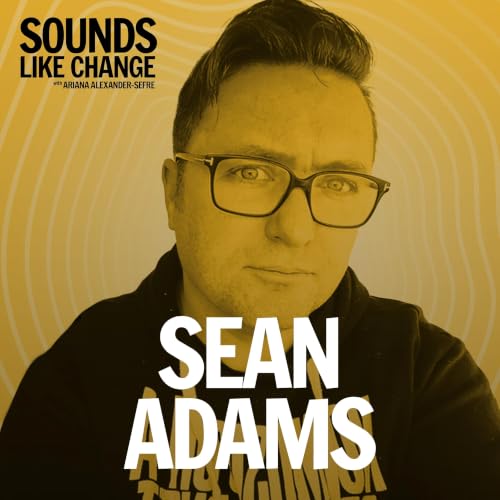
  • "What's broken collectively can be fixed collectively" | Drowned in Sound founder Sean Adams
    Jun 25 2026

    Sean Adams chose Jóhann Jóhannsson's 'Fordlandia' as his song of hope, and the reason he gives tells you a lot about where this conversation goes.

    He'd considered Solange, Feist, even Elliott Smith, then realised most of the songs that felt hopeful to him were actually about breakups or had difficult histories behind them. 'Fordlandia' stopped him in his tracks years ago, when he was mostly into noisy punk and emotional singer-songwriters, and he still can't fully explain it. He describes it as warm plumes of air, hot pockets of pressure, something like riding geysers of smoke, which he thinks about partly because Jóhannsson was living in Iceland at the time.

    His hope for the future is that everyone gets the time and the mental space to luxuriate in a thirteen-minute piece of music without worrying whether it's going to hold anyone's attention in the first three seconds.

    Sean founded Drowned in Sound in October 2000, but this episode traces the thread back further, to a kid growing up in a seaside town in Dorset, listening to Bob Marley and Motown in the car, not quite understanding what people were talking about when they mentioned civil rights, but feeling it.

    He talks about the record that unlocked something bigger: the opening of Dead Prez's 'Let's Get Free', a visceral wolf metaphor about addiction and the prison industrial complex, delivered over a swaying sample. He was sixteen, and he still gets goosebumps thinking about it.

    From there, the conversation moves into what music actually does to us, physically and neurologically. Ariana shares research on how music experienced in childhood continues to regulate us in adulthood.

    Sean reflects on only being diagnosed with ADHD a couple of years ago, and how understanding his brain has reframed his whole relationship with sound: why he's lived in headphones since he was twelve, why small talk is genuinely painful in a way that performing on stage isn't, why "how are you?" feels like an existential question he can't answer honestly when there's a genocide happening and politicians are dismantling net zero targets.

    The episode spends real time on the hyper-individualised wellness industry, and why Sean finds it inadequate. He uses the example of Universal Music giving staff mental health days while freelancers absorb the extra work, and argues that what we actually need are systemic fixes, not individual coping mechanisms. He talks about chill-out rooms in clubs, sleep pods in cities, therapy funded as part of salary, not as a bonus for burning out. The personal is always political here, but it doesn't feel like a lecture. It feels like someone thinking out loud.

    There's a genuinely funny section about meditation apps, transcendental meditation courses, and how Sean eventually found something that worked: a VR app called TRIPP, following a butterfly down a tunnel, which gave him ten minutes of not thinking about anything else. "I know I'm taking a screen break to another screen," he says, "but if I didn't, I'm not going to carve out twenty minutes to go to the forest."

    The second half widens out. Sean talks about the StopTheTories tactical voting campaign, the power of collective action, what it meant to work with Max Richter and Yulia Mahr on the "Voices" project, setting the Universal Declaration of Human Rights to music. He reads a passage from Charles Mackay's 1841 "Extraordinary Popular Delusions and the Madness of Crowds" as his moment of calm, which feels entirely right for this episode. And when Ariana asks what he'd say to listeners a hundred years from now, he comes back to human rights as an anchor and a compass, more reliable than any religious text or platform terms and conditions.

    Please note: This was recorded as a pilot episode. Sean produces Sounds Like Change, and Ariana decided it was too good not to publish.

    Find out more and follow the show: https://linktr.ee/soundslikechange

    Sounds Like Change is part of the Drowned in Sound Podcast Network, an independent media production company built for social impact.

    Edited by: tell.studio (Phil, Louisa, Owen, Matt)

    Show More Show Less
    1 hr and 16 mins
  • Complicity Is the Opposite of Community & How Media Storm Fights Back | Helena Wadia
    Jun 9 2026

    Helena Wadia chose "People's Faces" by Kae Tempest as her song of hope. It's a song about what actually saves us - not stuff, not safety nets of money, but the faces of the people in our lives. It's also a song that keeps evolving: every time Kae performs it, new lines appear, new distinctions are drawn. When Helena first heard it in 2017, the lyric was "oppressor and oppressed." Now it's "oppressor, complicit, and oppressed." That shift, she says, is everything.

    This episode moves from the personal to the political and back again. Who decides which stories matter and what happens when we change the lens?

    Helena has spent her career trying to answer that question, first in legacy newsrooms where her pitches about women, trans people, and communities of colour were repeatedly told they weren't "relevant," and now through Media Storm, the podcast she co-created with Mathilda Mallinson to do journalism the way it should be done: from lived experience, with the people at the centre rather than as an afterthought.

    Helena Wadia is a multimedia journalist and award-winning presenter working across print, video and audio. She co-hosts and co-created Media Storm with Mathilda Mallinson, a podcast that puts people with lived experience at the centre of news stories, teaches media literacy through "news watches," and has built a devoted audience of listeners who wanted the news to feel like it was actually for them.

    Helena spent years as a news anchor on London Live's News at Six and presented NME's In Conversation series. Her work has appeared across the Evening Standard, Channel 5 News, BBC Asian Network, The Independent, The Line of Best Fit and more. She specialises in feminism, race issues, and social justice and as of this year, she is also the new co-host of the Drowned in Sound podcast.

    Helena talks about what it took to leave a stable journalism career behind: the moment she and Matilda looked at forty articles about refugees, not one of which quoted an actual refugee, and decided to do something different. She talks about how the left/right divide is less a political reality than a system designed to keep people from realising they share most of the same values. She reflects on her own route into music - Top 40 until 17, when an ex-boyfriend played her the Pixies and sent her on "a huge journey," eventually to Bristol, to the student music press, and to journalism. She speaks honestly about the difficulty of resting while reporting on Gaza, and why she's come to understand that community - a gig, a choir, a friend you call - is the only kind of rest that actually works. And she ends with a message for the future, tattooed on her body: "it takes an ocean not to break."

    This podcast is part of the Drowned in Sound network, and was produced by Sean Adams and edited by: tell.studio (Phil, Louisa, Owen, Matt)

    Helena Wadia https://www.linkedin.com/in/helena-wadia-4a653889

    Media Storm podcast https://mediastormpodcast.com/about-us/

    Recorded remotely.

    Find out more and follow the show: https://linktr.ee/soundslikechange

    Show More Show Less
    1 hr and 5 mins
adbl_web_anon_alc_button_suppression_t1
No reviews yet